Artwork
The queen of Rum watches the peahen prefer to burn rather than abandon her eggs while the peacock flees the nest, from a Tuti-nama (Tales of a Parrot): Thirty-ninth Night
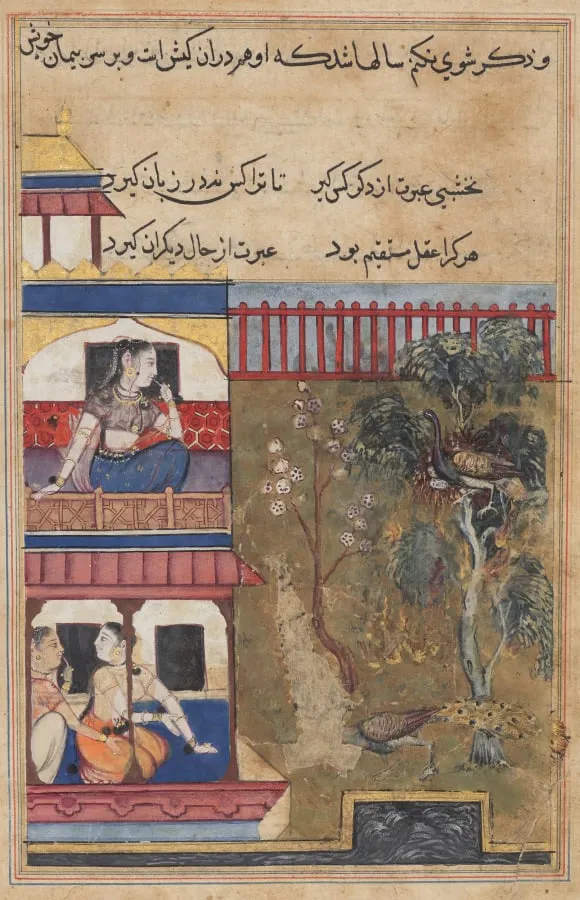
The queen of Rum watches the peahen prefer to burn rather than abandon her eggs while the peacock flees the nest, from a Tuti-nama (Tales of a Parrot): Thirty-ninth Night is an unspecified painting by the Mughal Painting artist Unknown. It dates from 1560 and is held in the collection of the Cleveland Museum of Art. The work depicts a regal figure perched on an upper balcony, observing a fire that consumes a peahen refusing to abandon its clutch.
About this work
You see a queen on a palace balcony watching a peahen burn rather than leave her eggs, while the peacock flees.
You see a queen on a palace balcony watching a peahen burn rather than leave her eggs, while the peacock flees.
The story comes from a book of parrot tales told to Emperor Akbar’s court. The queen decides men are cowards and swears off marriage. Bright colors and tiny details show how much care went into each figure.
To see more paintings like this, look up Mughal India, court of Akbar (reigned 1556–1605).
Overview
The work depicts a regal figure perched on an upper balcony, observing a fire that consumes a peahen refusing to abandon its clutch. Below, two female attendants watch the scene, while a peacock retreats from the blaze. The composition captures a moment of dramatic tension, rendered in vivid hues and intricate detailing characteristic of Mughal miniature painting.
Subject & Meaning
Derived from a tale in the Tuti‑nama, a collection of parrot stories presented to Emperor Akbar’s court, the narrative uses the peacock’s flight and the peahen’s sacrifice to symbolize male cowardice. The queen interprets the bird’s behavior as a sign of disloyalty among men, prompting her to renounce marriage and assert her independence.
Technique & Style
Executed in the Mughal miniature tradition, the painting employs bright, saturated pigments and fine brushwork to delineate elaborate costumes, architectural elements, and foliage. Minute ornamental motifs populate the scene, reflecting the high level of craftsmanship and the court’s patronage of detailed, narrative-driven visual art.
History & Provenance
The piece originates from the Mughal period (mid‑16th to early‑17th century) and is associated with the artistic productions of Emperor Akbar’s reign (1556–1605). It forms part of a manuscript illustrating the Tuti‑nama, a text that circulated among the imperial atelier and was copied for elite patrons.
Context
Mughal court painters often visualized literary and moral stories, integrating Persian artistic conventions with Indian motifs. This painting exemplifies that synthesis, situating a Persian‑inspired moral tale within a distinctly Indian royal setting, thereby reflecting the cultural hybridity of Akbar’s empire.
Artist & collection

 Domestic Scene
 Giacomo and Cardinal Marco, investing Andrea, Abbot of San Zeno, with his Benefice
 The Nymph of Fontainebleau
 Portrait of a Woman
 Madonna and Child with Saints in the Enclosed Garden
 Venus and Minerva
 Family Group of Four on Sofa
 Wall painting from Room H of the Villa of P. Fannius Synistor at Boscoreale
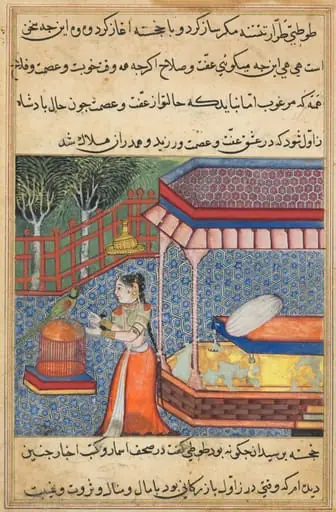 The parrot addresses Khujasta at the beginning of the thirty-sixth night, from a Tuti-nama (Tales of a Parrot)
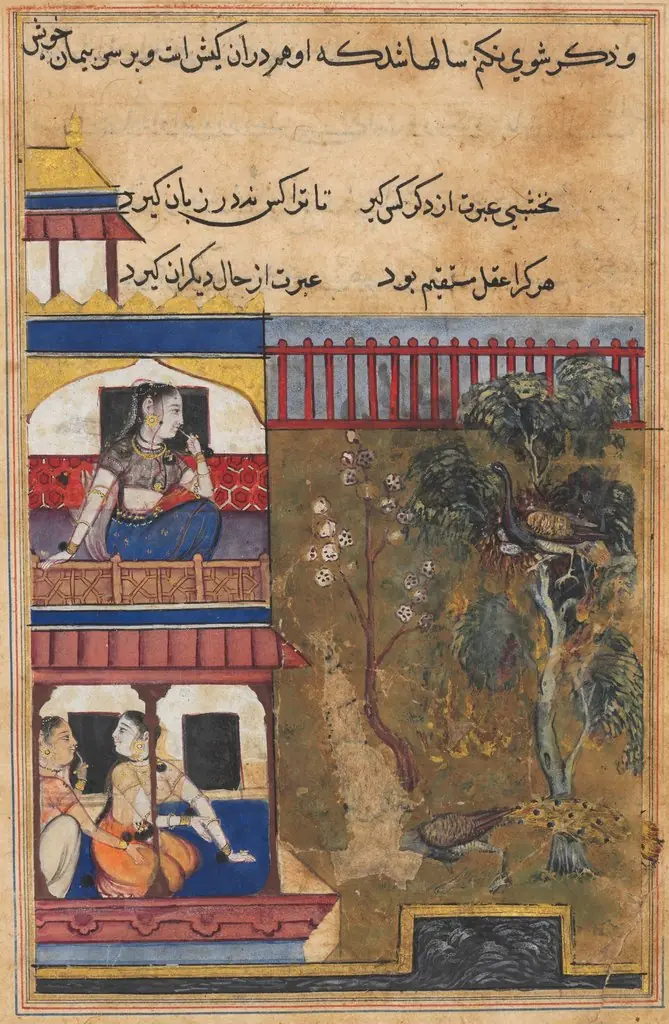 The queen of Rum watches the peahen prefer to burn rather than abandon her eggs while the peacock flees the nest, from a Tuti-nama (Tales of a Parrot): Thirty-ninth Night
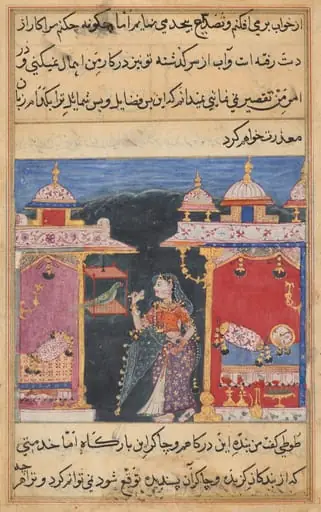 The Parrot Addresses Khujasta at the Beginning of the Seventh Night, from a Tuti-nama (Tales of a Parrot)
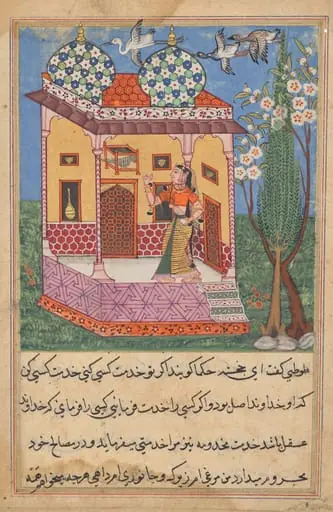 The Parrot Addresses Khujasta at the Beginning of the Twenty-sixth Night, from a Tuti-nama (Tales of a Parrot)
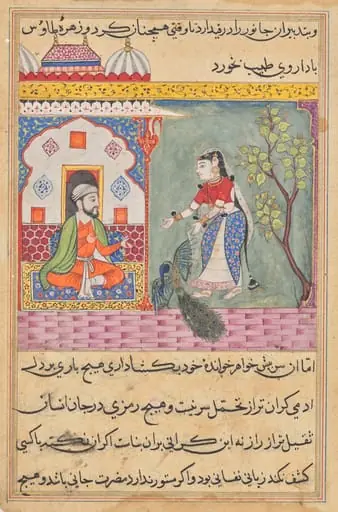 The Brahman’s wife who killed a peacock and ate its gallbladder on the physician’s advice, from a Tuti-nama (Tales of a Parrot): Nineteenth Night
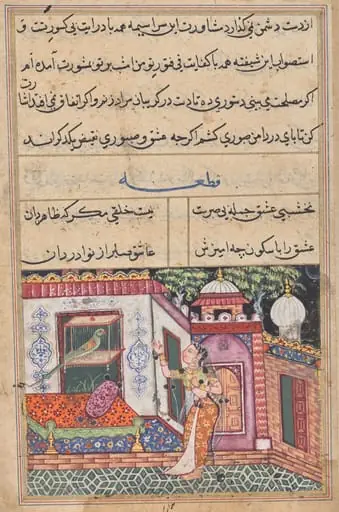 The Parrot Addresses Khujasta at the Beginning of the Eleventh Night, from a Tuti-nama (Tales of a Parrot)
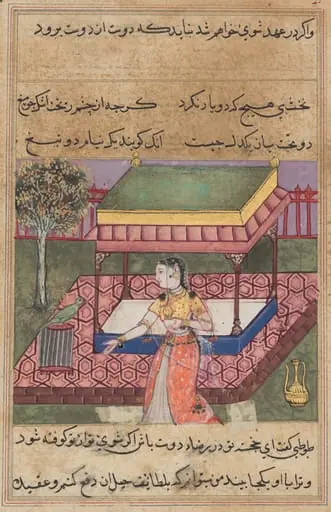 The parrot addresses Khujasta at the beginning of the fortieth night, from a Tuti-nama (Tales of a Parrot)
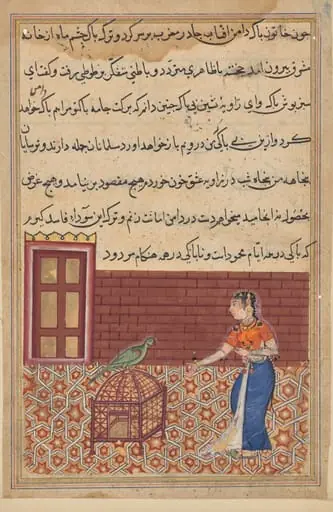 The parrot addresses Khujasta at the beginning of the fifty-first night, from a Tuti-nama (Tales of a Parrot): Fifty-first Night
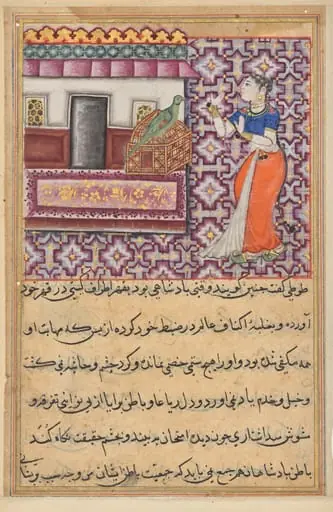 The parrot addresses Khujasta at the beginning of the fiftieth night, from a Tuti-nama (Tales of a Parrot): Fiftieth Night
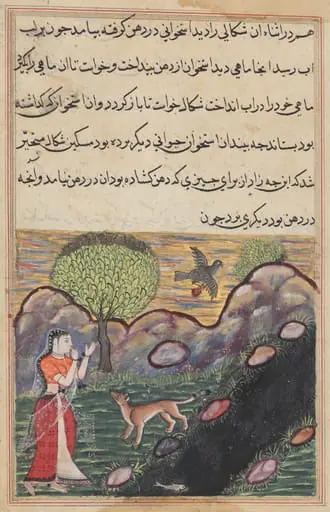 The daughter-in-law of the king of Banaras sees the jackal deprived of its food by a bird, as it unsuccessfully attempts to catch a fish, from a Tuti-nama (Tales of a Parrot): Sixteenth Night