Artwork
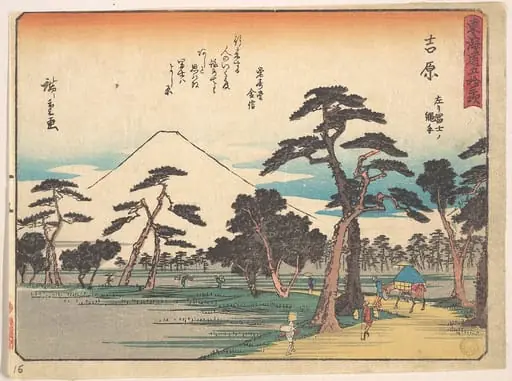
東海道五十三次之内 吉原|Yoshiwara
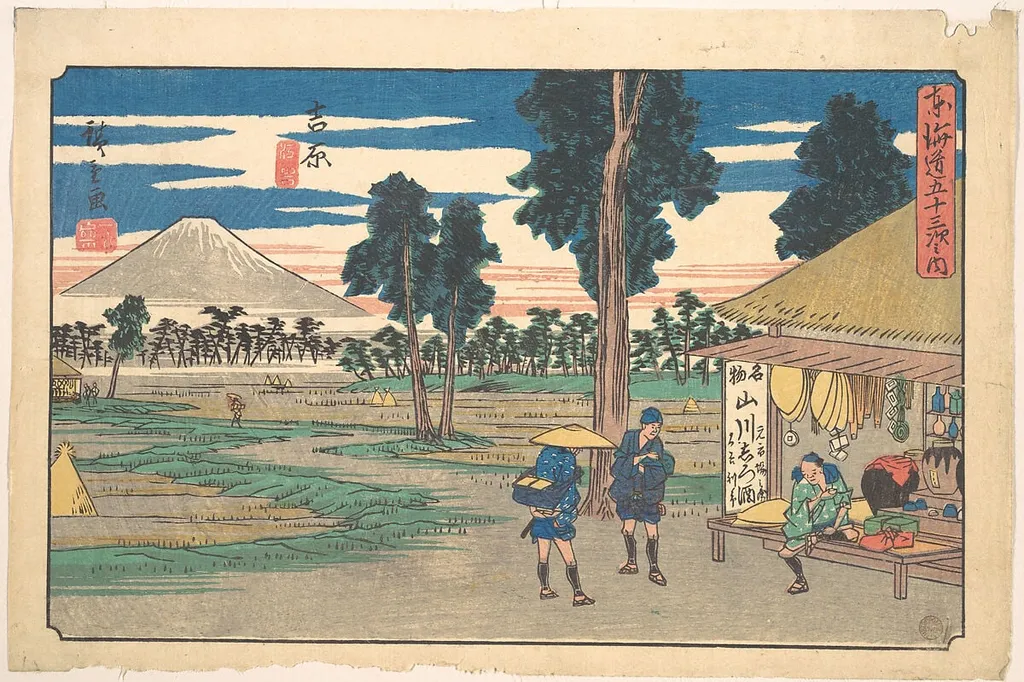
東海道五十三次之内 吉原|Yoshiwara is an ink print by the Romanticist artist Utagawa Hiroshige. It dates from 1842 and is held in the collection of the Metropolitan Museum of Art.
About this work
Overview
Created around 1842 by Utagawa Hiroshige, this woodblock print is one of fifty-three scenes in the series *The Fifty-three Stations of the Tōkaidō*.
Created around 1842 by Utagawa Hiroshige, this woodblock print is one of fifty-three scenes in the series *The Fifty-three Stations of the Tōkaidō*. Though the series documents the road connecting Edo and Kyoto, this particular image captures a tranquil moment in Yoshiwara, a district often associated with pleasure, here rendered as an ordinary roadside village. The work is executed in ink and color on paper, typical of ukiyo-e printing methods of the Edo period.
Subject & Meaning
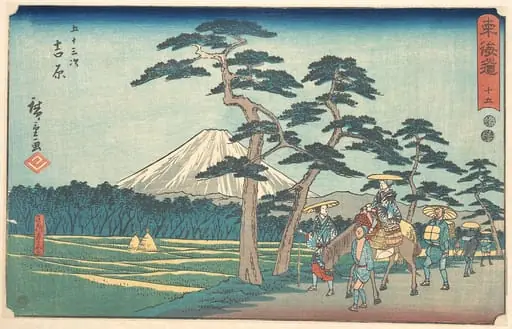
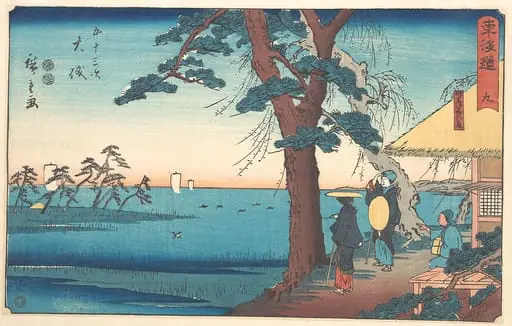
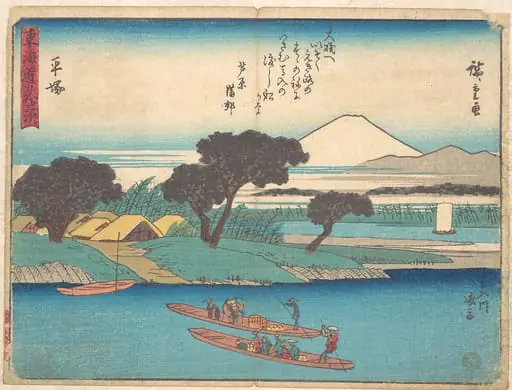
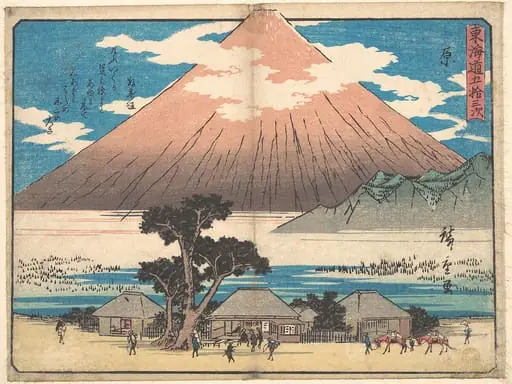
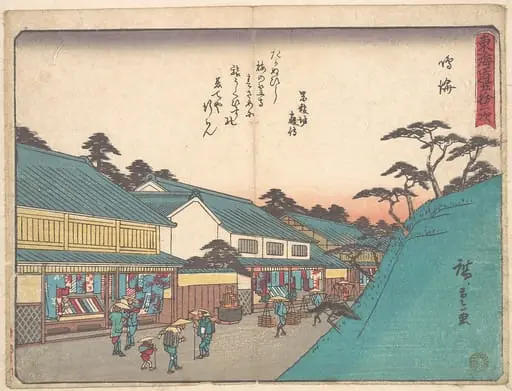
The scene depicts two travelers passing through a quiet rural stretch, one carrying a bundle, the other leaning on a staff. A modest shop with tools displayed on its wall suggests local life, while cultivated fields and a distant mountain frame the journey. Rather than emphasizing Yoshiwara’s reputation for entertainment, Hiroshige presents it as a humble waypoint, reflecting the quiet rhythm of travel and the dignity of everyday movement along the highway.
Technique & Style
Hiroshige employs flat planes of color and simplified forms to evoke depth without perspective distortion. The sky is rendered in pale blue with delicate cloud strokes, contrasting with the rich greens of the fields and the dark silhouette of the tree. Bold outlines define structures and figures, while the mountain’s presence is suggested through layered tones rather than detailed rendering—hallmarks of his atmospheric approach to landscape.
History & Provenance
The print was produced during Hiroshige’s most active period, when demand for travel-themed ukiyo-e was high. It entered the collection of The Metropolitan Museum of Art through established channels of early 20th-century Japanese art acquisition. As part of a widely distributed series, multiple impressions exist, but this version retains the original coloration and paper quality characteristic of early printings.
Context
During the Edo period, the Tōkaidō was a vital route for merchants, pilgrims, and officials. While many artists focused on bustling post towns, Hiroshige turned attention to the spaces between—fields, trees, and distant peaks. His choice to depict Yoshiwara not as a red-light district but as a quiet hamlet reflects a broader shift in ukiyo-e toward contemplative, nature-infused scenes over urban spectacle.
Legacy
Hiroshige’s *Tōkaidō* series influenced later Western artists, including Impressionists drawn to its compositional clarity and seasonal mood. This print exemplifies how Japanese printmakers redefined landscape as a vehicle for quiet observation. Today, it remains a key example of how everyday moments, rendered with restraint, can convey the emotional texture of travel in pre-modern Japan.
Artist & collection
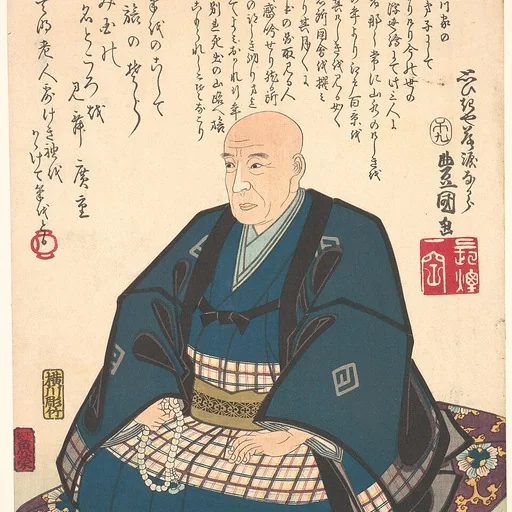
Artist
Utagawa Hiroshige (歌川 広重) or Andō Hiroshige (安藤 広重), born Andō Tokutarō (安藤 徳太郎; 1797 – 12 October 1858), was a Japanese ukiyo-e artist, considered the last great master of that tradition.