Artwork
Tablou, ulei pe pânză, „Epoca Ceaușescu – Omagiu” semnat A. Cordea și datat 1986 în partea dreaptă jos. Tabloul îl prezintă pe Nicolae Ceaușescu în medalion dreapta sus privind zâmbitor la orașul Satu Mare scăldat de lumina soarelui, soarele reprezentat de tricolor și steagul PCR. Deasupra medalionului este notat cu majuscule ”EPOCA NICOLAE CEAUȘESCU”. În partea stângă stema județului Satu Mare. În partea de jos o ghirlandă, printre ramurile ei mesajul ”MĂREAȚĂ CTITORIE”. Comandat de Comitetul Județean de Partid Satu Mare (1986)
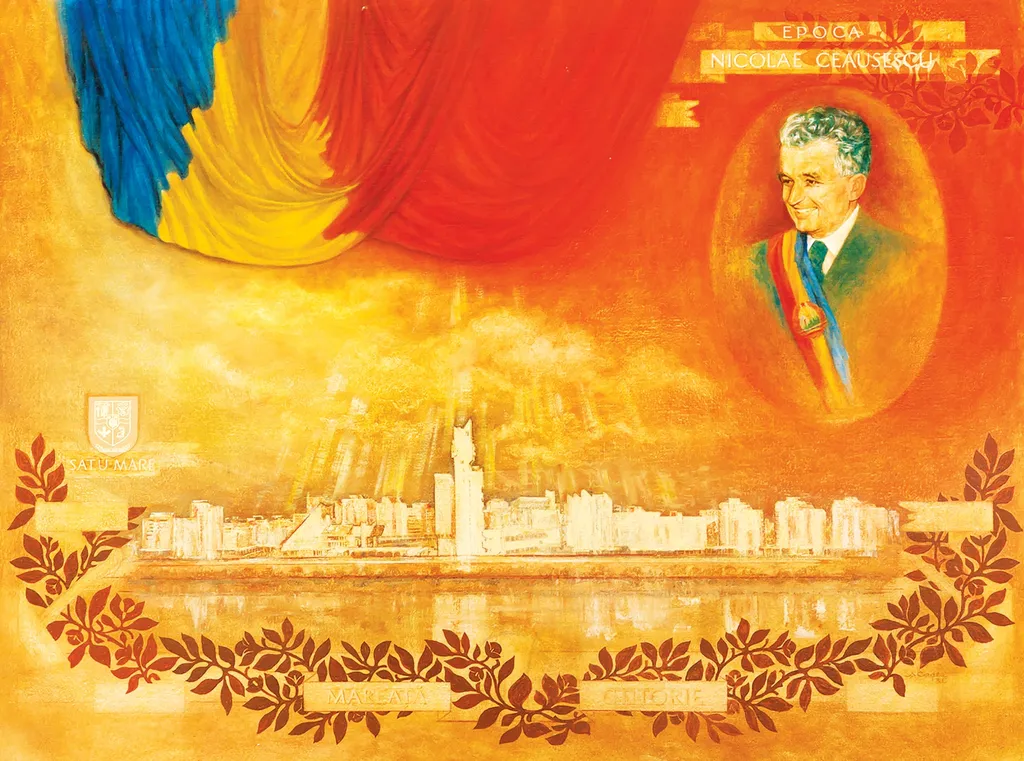
Tablou, ulei pe pânză, „Epoca Ceaușescu – Omagiu” semnat A. Cordea și datat 1986 în partea dreaptă jos. Tabloul îl prezintă pe Nicolae Ceaușescu în medalion dreapta sus privind zâmbitor la orașul Satu Mare scăldat de lumina soarelui, soarele reprezentat de tricolor și steagul PCR. Deasupra medalionului este notat cu majuscule ”EPOCA NICOLAE CEAUȘESCU”. În partea stângă stema județului Satu Mare. În partea de jos o ghirlandă, printre ramurile ei mesajul ”MĂREAȚĂ CTITORIE”. Comandat de Comitetul Județean de Partid Satu Mare (1986) is a print by A. Cordea. It is held in the collection of the National Museum of Romanian History. This 1986 oil on canvas painting was commissioned by the Satu Mare County Party Committee to honor Nicolae Ceaușescu.
About this work
Overview
It depicts him in a radiant medallion above the city of Satu Mare, surrounded by symbolic elements of state propaganda.
This 1986 oil on canvas painting was commissioned by the Satu Mare County Party Committee to honor Nicolae Ceaușescu. It depicts him in a radiant medallion above the city of Satu Mare, surrounded by symbolic elements of state propaganda. The work combines portraiture, civic emblematics, and ideological messaging in a highly stylized composition, typical of official art from the late communist period in Romania.
Subject & Meaning
Nicolae Ceaușescu is portrayed in a glowing, halo-like medallion, smiling benevolently over Satu Mare, which is bathed in golden light. The Romanian tricolor functions as the sun, merging national identity with party symbolism. The inscription 'EPOCA NICOLAE CEAUȘESCU' frames him as the defining force of the era. Below, the county coat of arms and the phrase 'MĂREAȚĂ CTITORIE' (Glory to the Founder) reinforce his cult of personality and role as nation-builder.
Technique & Style
The painting employs a luminous, idealized realism with flat, saturated colors and sharp contours. Ceaușescu’s portrait is rendered with soft lighting to suggest divine favor, while the cityscape and flag are simplified into symbolic forms. The decorative garland at the base echoes ecclesiastical or royal iconography, elevating the subject beyond mere political representation into a quasi-sacred tableau.
History & Provenance
Commissioned in 1986 by the local Communist Party committee, the work was likely displayed in public buildings or party offices in Satu Mare. After 1989, such imagery fell out of favor, and the painting was archived. It is now held by the Museum of Ethnography in Romania, where it serves as a historical artifact of state-sponsored visual propaganda during the final years of the regime.
Context
Created during Ceaușescu’s final years of rule, the painting reflects the intensifying personality cult surrounding him. Official art of the period routinely merged civic pride with adulation of the leader, using religious and imperial visual codes to legitimize authority. Satu Mare, like other cities, was expected to produce such tributes as demonstrations of loyalty and ideological conformity.
Legacy
The painting stands as a documented example of how communist regimes used visual culture to manufacture consent and reverence. Its preservation in a museum setting allows critical examination of state propaganda mechanisms. It no longer functions as tribute but as a historical record of how power was visually constructed and later dismantled.
Artist & collection
Artist
A. Cordea painted official portraits in the 1980s Romanian Socialist Realist style. One of their works, *Epoca Ceaușescu – Omagiu* (1986), shows Nicolae Ceaușescu in a medallion above a sunburst of red, yellow, and…

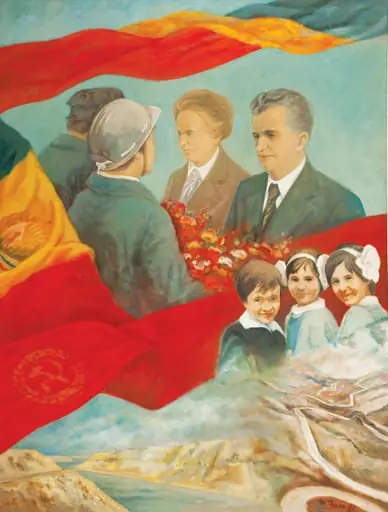 Tablou „Omagiul Președintelui Țării”, ulei pe pânză; semnat Gheorghe Pogan și datat în partea dreaptă jos. Tabloul îi prezintă pe soții Ceaușescu întâmpinați cu flori de două personaje masculine (un miner și un petrolist), învăluiți de tricolor și steagul PCR. În dreapta lui Nicolae Ceaușescu (dreapta tabloului) trei elevi. Partea de jos a tabloului este completată cu reprezentarea Transfăgărășanului și a Canalului Dunăre - Marea Neagră. Comandat și oferit de Comitetul Județean de Partid Hunedoara (1988).
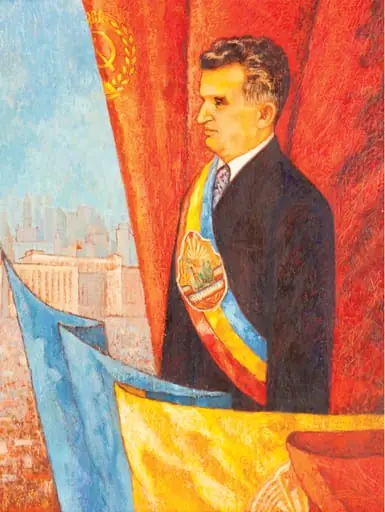 Tablou, ulei pe pânză, „Nicolae Ceaușescu, întâiul președinte al României”, semnat C.Aurel și datat 1974 în partea dreaptă jos. Nicolae Ceaușescu purtând banderolă tricoloră cu stema R.S.R., stând la balcon primind ovații din partea oamenilor muncii adunați într-o piață. În spatele său, steagul cu sigla PCR. Tablou oferit de către autor originar din Câmpina (Prahova), 19 august 1974.
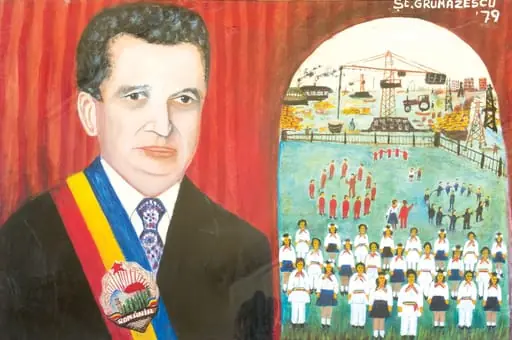 Tablou, ulei pe pânză, Nicolae Ceaușescu și copii, semnat și datat în partea dreaptă sus Șt. Grumăzescu, 1979. Nicolae Ceaușescu este prezentat în partea stângă urmărind o festivitate - pionieri, copii dansând în horă. Maniera de realizare a tabloului este una naivă. Oferit de Ștefan Grumăzescu din București.
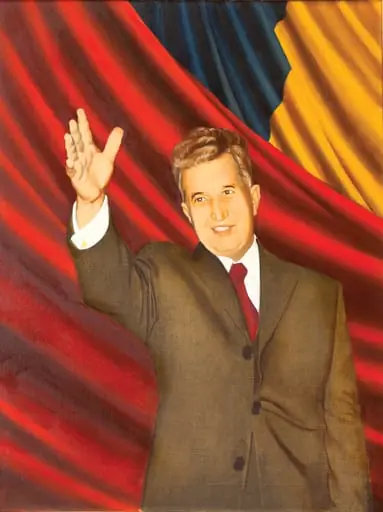 Tablou, ulei pe pânză, „Salutul președintelui”, atribuit lui Viorel Toma, nedatat. Nicolae Ceaușescu este reprezentat în centrul tabloului salutând, pe fundal steagul PCR și cel al RSR. Comandat și oferit de Comitetul Județean de Partid Timiș (1985).
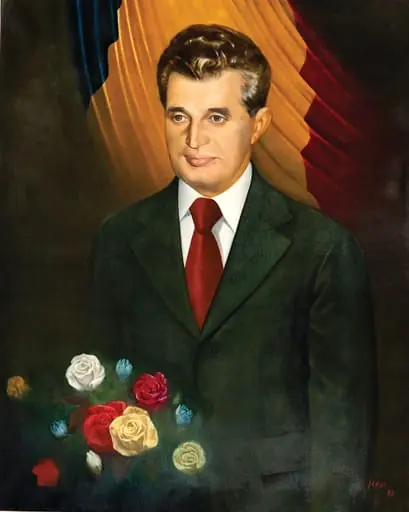 Tablou ulei pe pânză, portret Nicolae Ceaușescu semnat Ispas și datat în partea dreaptă jos. Este prezentat într-o postură solemnă cu un buchet de trandafiri, în spatele său tricolorul. Culorile drapelului se regăsesc și în coloritul trandafirilor. Comandat de Comitetul Județean de Partid Alba (1983).
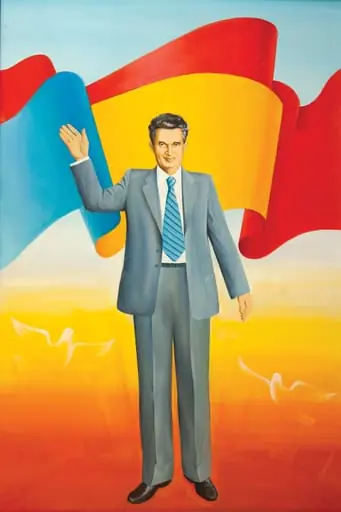 Tablou „ Ceaușescu Pace”, semnat M. Ceacîru și datat dreapta jos. Tabloul îl prezintă pe Nicolae Ceaușescu salutând, în spatele său flutură tricolorul și stegul PCR, în stânga și în dreapta sa doi porumbei albi în zbor.Comandat de Comitetul Județean de Partid Neamț (1989)
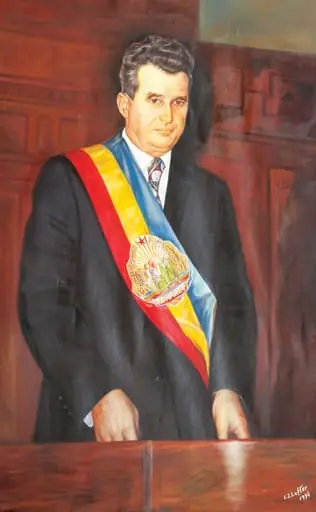 Tablou, ulei pe pânză, ”Portret Nicolae Ceaușescu”, semnat C.I. Lefter și datat 1974 în partea dreaptă jos. Reprezentat într-un cadru oficial în spatele unui pupitru, Nicolae Ceaușescu purtând eșarfa cu stema RSR. Oferit lu Nicolae Ceaușescu de Comitetul de Partid Sănătatea, cu ocazia zilei de naștere, ianuarie 1978.
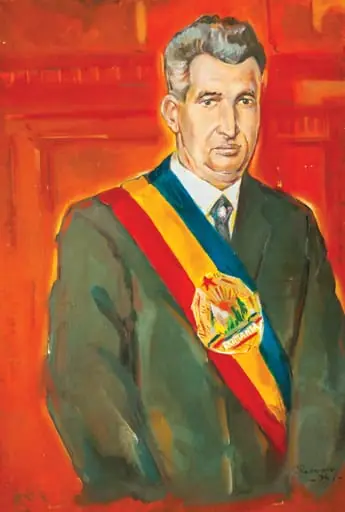 Tablou, ulei pe pânză, Nicolae Ceaușescu, semnat C.Radovan și datat 1974 în partea dreaptă jos. Nicolae Ceaușescu este prezentat într-o atitudine mirat deranjată. Tablou oferit cadou lui Nicolae Ceaușescu de către autor, Ciprian Radovan, București.
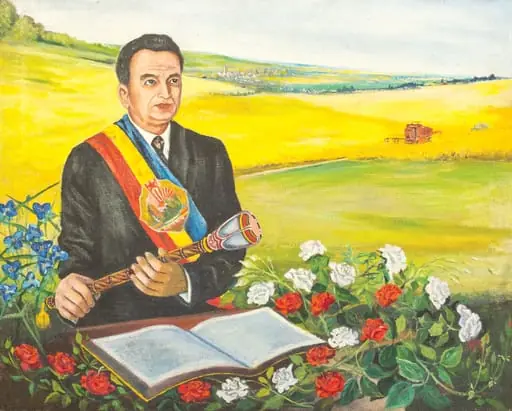 Tablou, ulei pe pânză, ”Nicolae Ceaușescu, președinte”, nesemnat, atribuit I.C. Popescu - Stolojan. Nicolae Ceaușescu este prezentat în momentul învestirii în funcția de președinte al Republicii Socialiste România. Poartă însemnele funcției eșarfa tricoloră, sceptrul prezidențial. Sala Marii Adunări Naționale a fost înlocută cu un fundal agricol - un lan de grâu treierat de o combină. Pupitrul este decorat cu trandafiri și iriși. Oferit de autor, 1976.
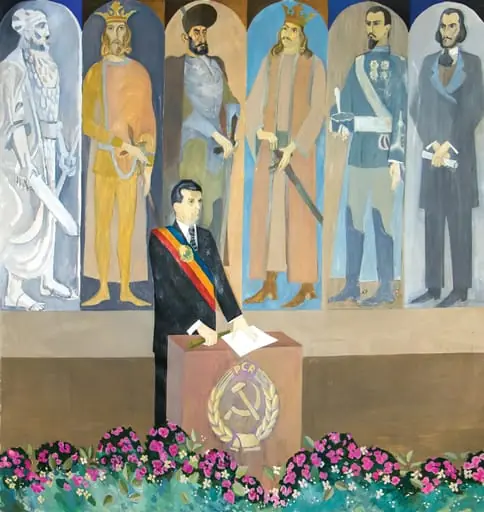 Tablou, ulei pe pânză, ”Omagiu”, semnat Constantin Piliuță. Nicolae Ceaușescu la un pupitru cu însemnele PCR depunând jurământul de învestire; poarte însemnele prezidențiale eșarfa tricoloră cu stema RSR, sceptrul, însemnul de ”Erou al Republicii Socialiste România”. Pe fundal sunt reprezentați Burebista, Mircea cel Bătrân, Mihai Viteazul, Ștefan cel Mare, Alexandru Ioan Cuza, Nicolae Bălcescu, personajele au o mimică solemnă, dau impresia că sunt garanții jurământului pe care-l face Nicolae Ceaușescu. Comandat și oferit lui Nicolae Ceaușescu de Consiliul Culturii și Educației Socialiste, ianuarie 1978.
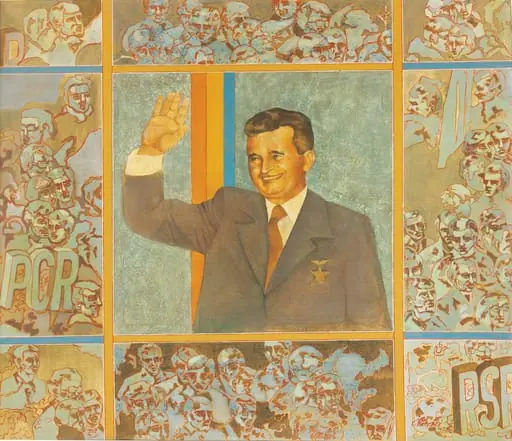 Tablou, ulei pe pânză, „Portret Nicolae Ceaușescu”, semnat în partea dreaptă jos C.Macavei și datat 1978. Tablou împărțit în mai multe registre, în plan central Nicolae Ceaușescu salutând oamenii muncii din celelalte registre. Comandat și oferit de Comitetul Județean de Partid Ilfov, 23 ianuarie 1978.
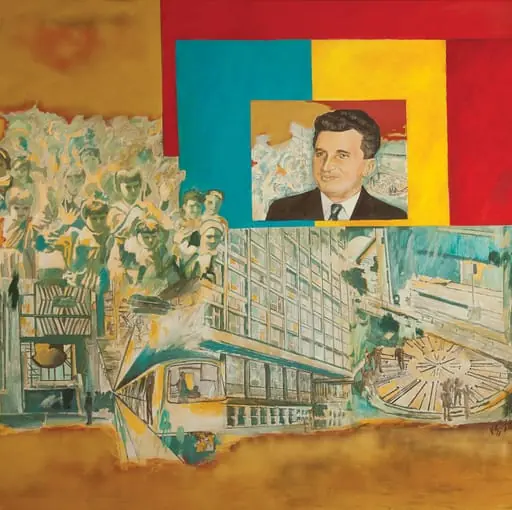 Tablou „Omagiu”, semnat Ion Bitzan și Vladimir Setran.Tabloul prezintă portretul lui Nicolae Ceaușescu încadrat de tricolor în partea dreaptă sus. Restul tabloului este completat de realizările epocii socialiste. Comandat de Comitetul Municipal de Partid 1981.
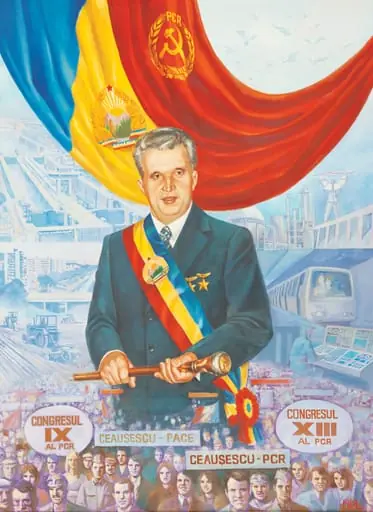 Tablou, ulei pe pânză, ”Ctitorul României Socialiste”, nesemnat, atribuit lui V.Tănase. Tabloul îl prezintă pe Nicolae Ceaușescu în prim plan purtând toate însemnele funcției: eșarfa tricoloră, sceptrul prezidențial, două însemne de ”Erou al Republicii Socialiste România”. În partea de sus a tabloului este redat steagul RSR unit cu steagul PCR. În partea de jos, poporul, oamenii muncii purtând pancarte cu ”Ceaușescu Pace”, ”Ceaușescu PCR”, ”Congresul IX al PCR” (alegerea lui Nicolae Ceaușescu în fruntea partidului), ”Congresul XII al PCR” (realegerea în fruntea partidului). Pe fundal sunt redate realizările socialismului: Canalul Dunăre Marea Neagră, Barajul Vidraru, metroul etc. Tablou comandat de Ministerul Apărării Nașionale (1985).
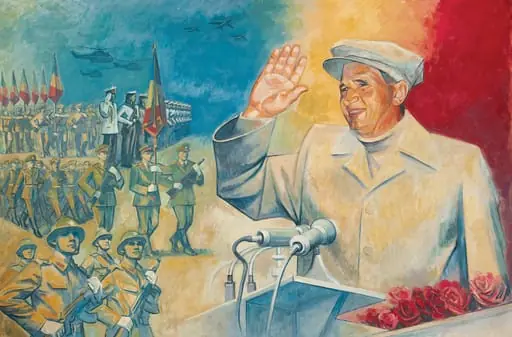 Tablou ulei pe pânză „Onor comandantului suprem”, semnat stânga jos în monogramă C.M., atribuit lui Maricel Chițac, nedatat. Tabloul îl prezintă pe ”comandantul suprem”, Nicolae Ceaușescu, la tribună primind onorul din partea aviației, trupelor de uscat și a marinei. Pe fundal tricolorul. Tablou comandat și oferit de Ministerul Apărării Naționale lui Nicolae Ceaușescu cu ocazia aniversării zilei de naștere (ianuarie 1989).
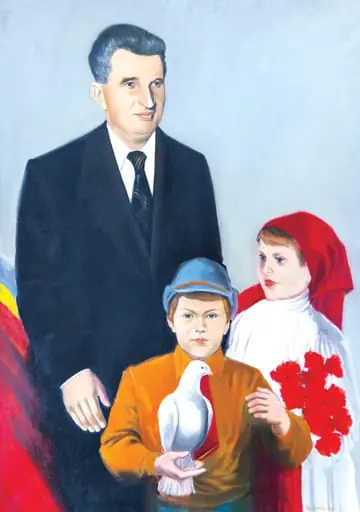 Tablou, ulei pe pânză, „Mesajul României”, semnat Nicolae Costachi în partea dreaptă jos și datat 1984. Nicolae Ceaușescu alături de doi copii, o fată îmbrăcată în costum popular ținând în mâini un buchet de garoafe roșii și un băiat în uniformă de șoim al patriei cu un porumbel alb în palma dreaptă. Comandat și oferit de Comitetul Județean de Partid Bistrița Năsăud (1985).
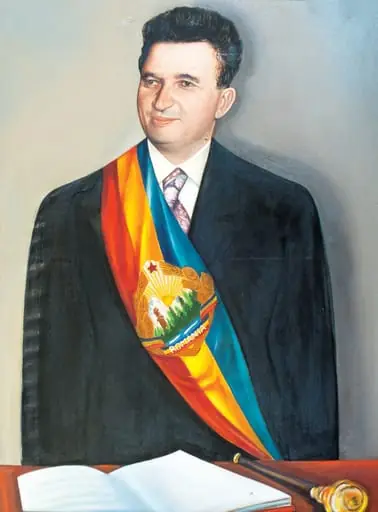 Tablou, ulei pe pânză, ”Portret Nicolae Ceaușescu”, nesemnat, atribui lui Nicolae Toma. Oferit de autor, cu ocazia zilei de naștere a lui Nicolae Ceaușescu, Ploiești, ianuarie 1978.