Artwork
Patience
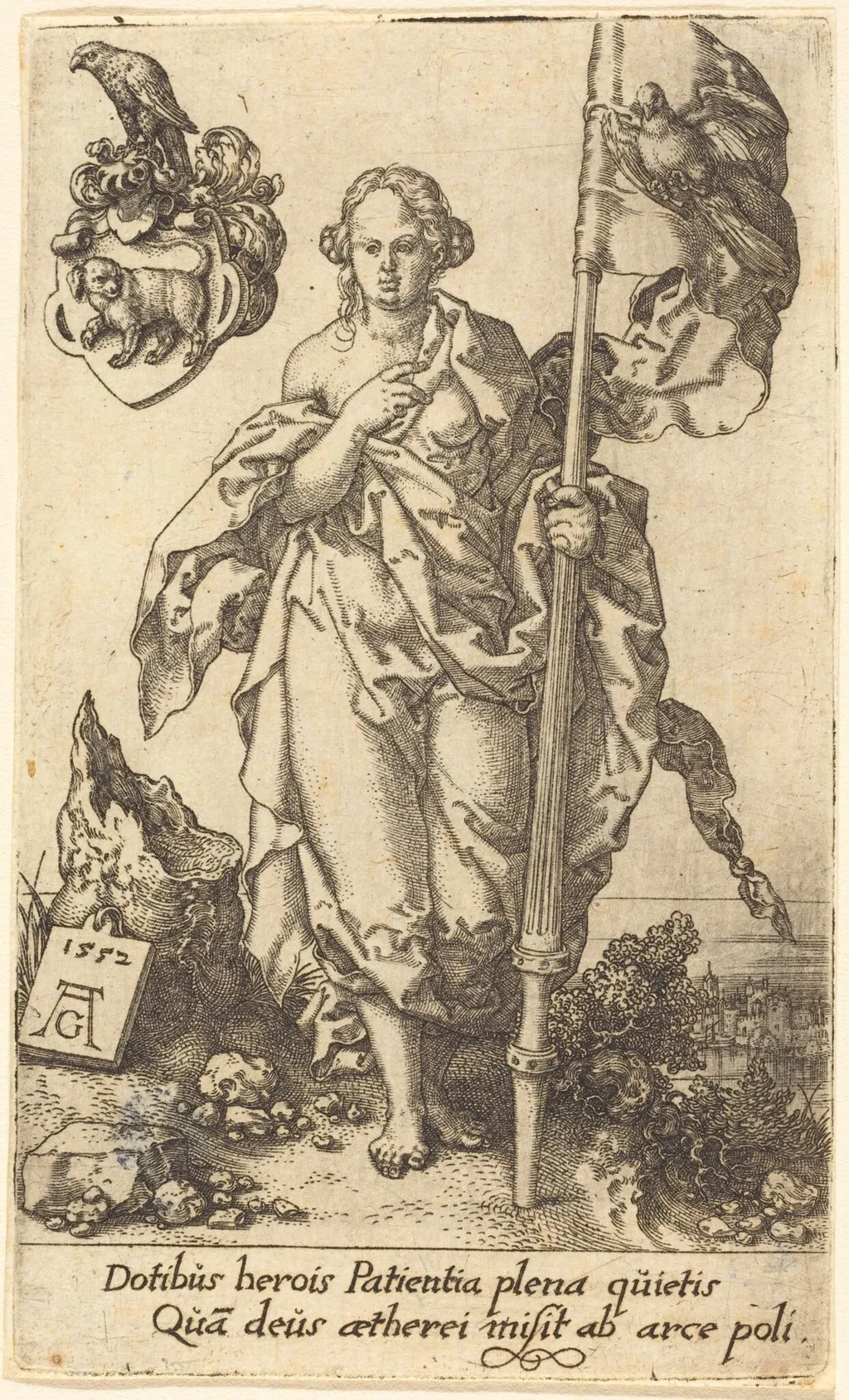
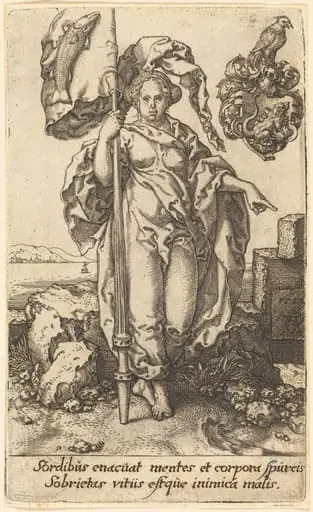
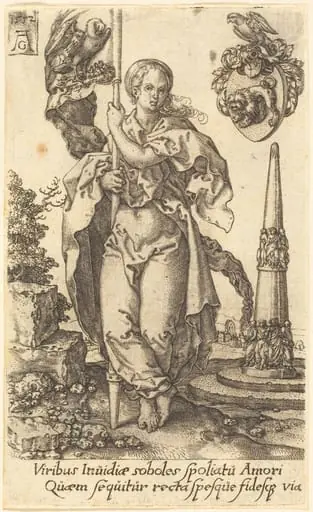
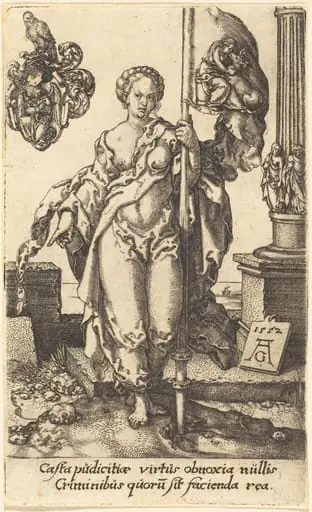
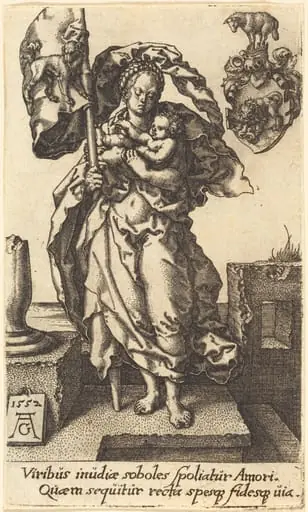
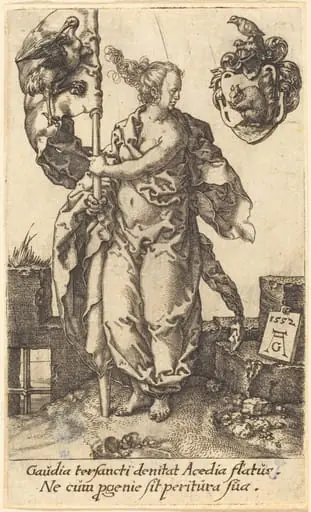
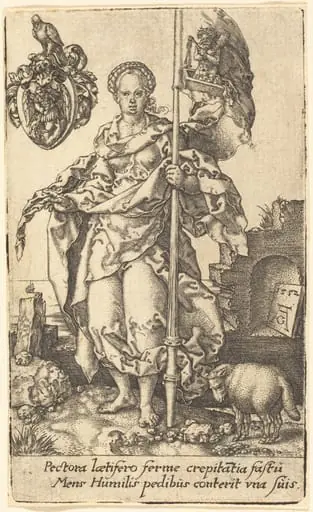
Patience is a print by the Northern Renaissance artist Heinrich Aldegrever. It dates from 1552 and is held in the collection of the National Gallery of Art.
About this work
The Latin words below mean "Patience full of quietness, which the gods sent from heaven to the city.
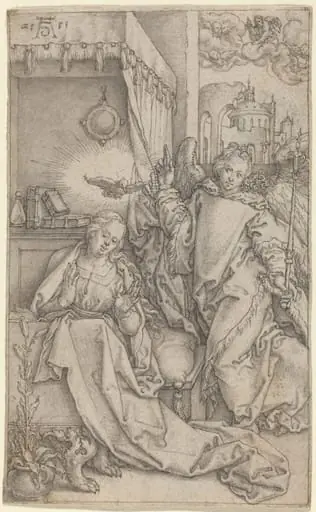
This print shows a woman holding a staff with a flag. She stands on a rocky ground with clouds and strange, swirling shapes around her. Her dress is draped loosely, and her hair is pulled back. The background has a city and what looks like a rocky cliff.
The Latin words below mean "Patience full of quietness, which the gods sent from heaven to the city." The year 1552 is marked on a small plaque in the scene.
Next, check out the Renaissance movement to see how artists used symbols like this.
Overview
Heinrich Aldegrever, a German printmaker linked to the so‑called Little Masters, executed the engraving titled Patience in 1552. The work is a modestly sized copper plate print that exemplifies the meticulous detail characteristic of the generation that followed Albrecht Dürer. Its composition centers on a solitary female figure, rendered with fine line work and a restrained palette.
Subject & Meaning
The central figure is a woman holding an open book, a conventional emblem of the virtue of patience. A staff topped with a flag rests in her hand, and a Latin inscription beneath reads, “Patience full of quietness, which the gods sent from heaven to the city.” The text reinforces the moralizing intent of the image.
Technique & Style
Aldegrever employed the intaglio engraving method, incising intricate lines into a copper plate to achieve delicate shading and texture. The rendering of drapery, hair, and the surrounding clouds displays the precise, miniature craftsmanship associated with the Little Masters, while the swirling background forms a subtle, almost allegorical landscape.
History & Provenance
Patience bears the date 1552 on a small plaque incorporated into the scene, confirming its production in the mid‑sixteenth century. The print circulated among collectors of emblematic works and is documented in several early modern inventories, though its precise ownership trail before entering museum collections remains fragmentary.
Context
The engraving belongs to a broader Renaissance tradition of personifying virtues through allegorical figures. Symbolic objects such as books, staffs, and flags were commonly used to convey moral lessons, and Aldegrever’s work reflects the period’s interest in didactic imagery that could be reproduced and disseminated through prints.
Artist & collection

Artist
Heinrich Aldegrever or Aldegraf was a German painter and engraver. He was one of the "Little Masters", the group of German artists making small old master prints in the generation after Albrecht Dürer.