Artwork
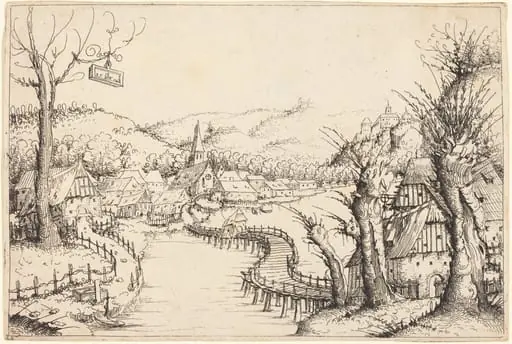
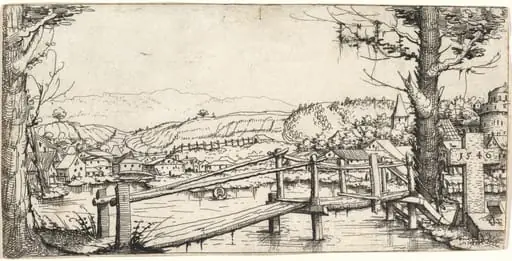
River Landscape with Three Bare Willow Trees at Right and a Long Winding Wooden Bridge at Center Leading to a Village
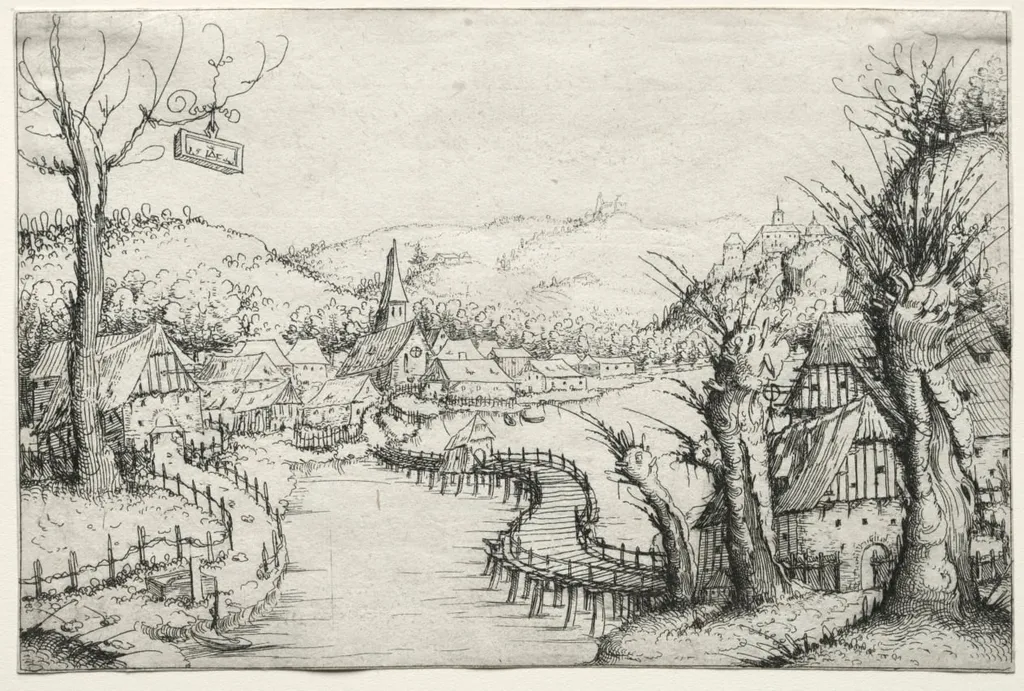
River Landscape with Three Bare Willow Trees at Right and a Long Winding Wooden Bridge at Center Leading to a Village is a print by the Renaissance artist Augustin Hirschvogel. It dates from 1546 and is held in the collection of the Cleveland Museum of Art.
About this work
Overview
This etching by Augustin Hirschvogel depicts a stretch of the Danube River framed by three slender willow trees and a long wooden bridge arching toward a distant village. Created in the mid-16th century, it belongs to a small group of topographically grounded landscapes that mark a shift in German printmaking, moving away from symbolic or religious backdrops toward observed natural environments.
Subject & Meaning
Human presence is subtle but integral—figures and animals are scaled appropriately, suggesting lived experience rather than decorative addition.
The scene presents a quiet, inhabited countryside: cultivated fields, winding paths, and modest buildings are rendered with careful attention to spatial relationships. Human presence is subtle but integral—figures and animals are scaled appropriately, suggesting lived experience rather than decorative addition. The composition conveys a sense of place as something known and recorded, not imagined.
Technique & Style
Hirschvogel employed fine, controlled lines in etching to model terrain, vegetation, and architecture with precision. Subtle variations in line density suggest light and shadow, enhancing the illusion of depth without overt chiaroscuro. The delicate rendering of the willows and the bridge’s wooden slats reflects a close observation of natural forms, grounded in direct experience rather than convention.
History & Provenance
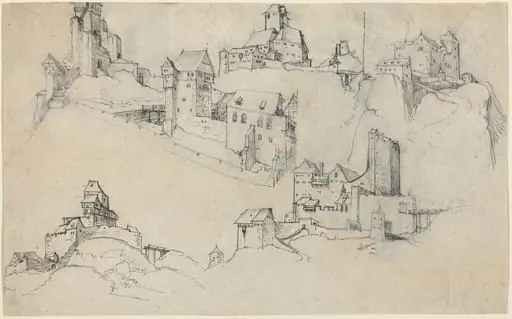
The print was likely made after Hirschvogel’s journey along the Danube from Nuremberg to Vienna around 1545. His route took him through Regensburg and Passau, areas whose topography is reflected in the etching’s hills, river bends, and settlement patterns. The work circulated widely in Europe, influencing landscape artists in Italy and the Netherlands through its factual depiction of terrain.
Context
In mid-16th-century Germany, landscape as an independent subject was emerging from religious and allegorical frameworks. Hirschvogel’s work responded to earlier innovations by Altdorfer and Huber but distinguished itself through its topographical accuracy. Unlike idealized views, this etching records specific geographic features, aligning with growing Renaissance interest in empirical observation.
Legacy
Hirschvogel’s etchings helped establish landscape as a legitimate subject for printmaking in Northern Europe. Their clarity and attention to real terrain influenced later generations of draftsmen and printmakers who sought to depict nature not as backdrop but as subject. The work remains a key example of how travel and direct observation reshaped artistic representation in the early modern period.
Artist & collection
Artist
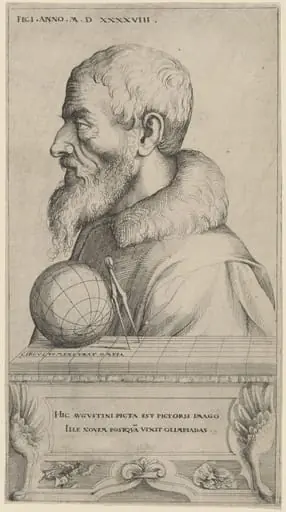
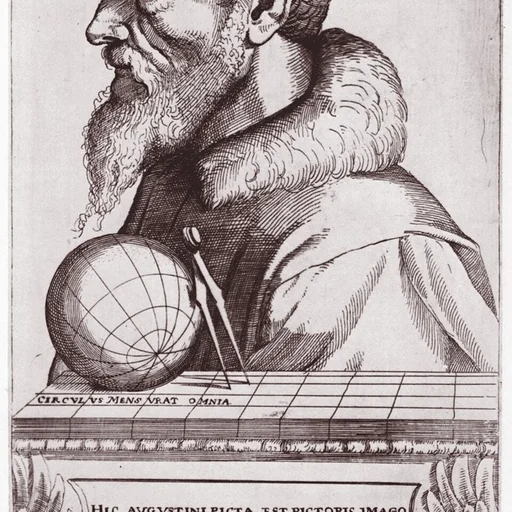
Augustin Hirschvogel (1503 – February 1553) was a German artist, mathematician, and cartographer known primarily for his etchings.