Artwork
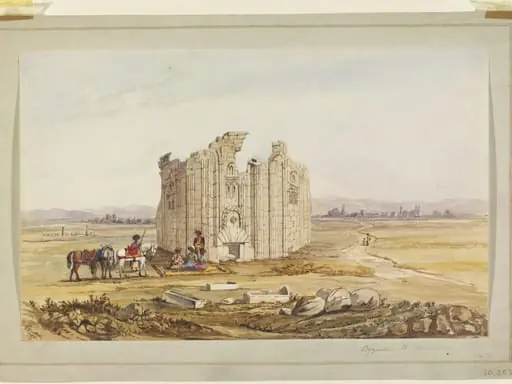
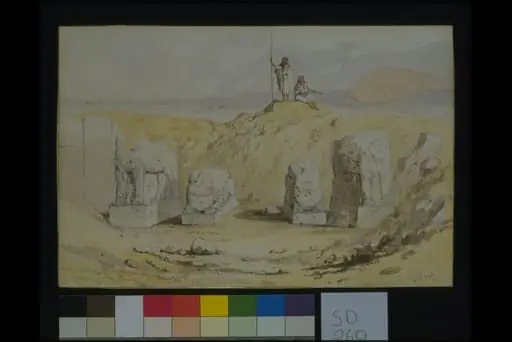
Tomb of Caliph, Erzerum
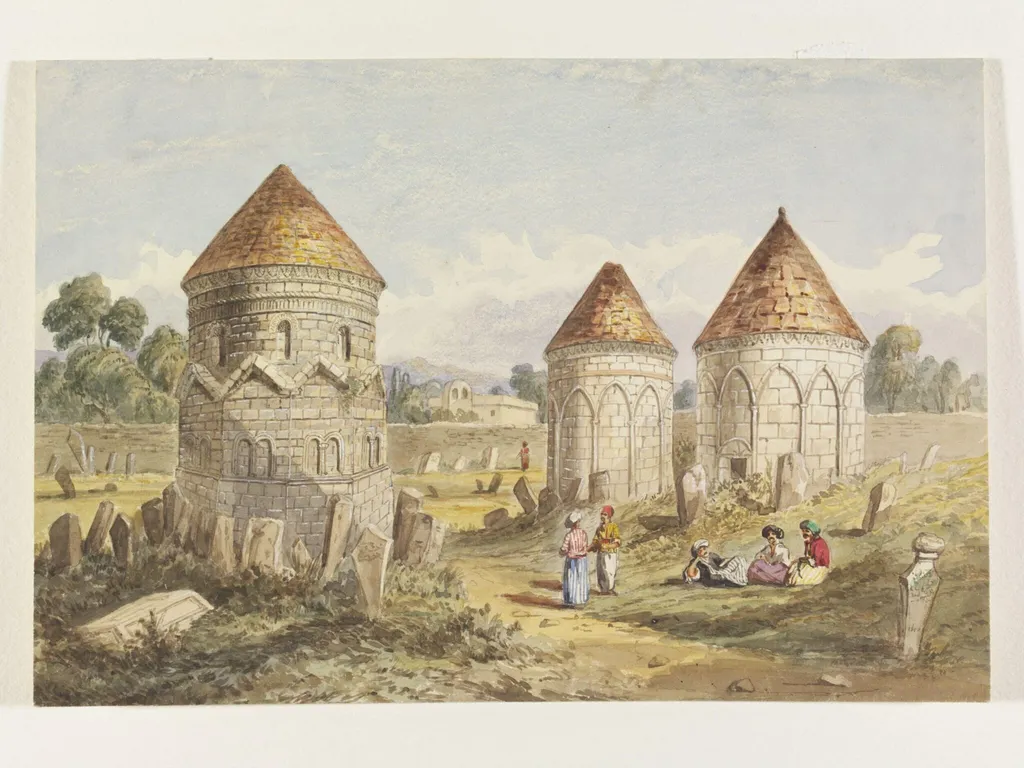
Tomb of Caliph, Erzerum is a watercolor work on paper by the Romanticist artist Frederick Charles Cooper. It dates from 1849 and is held in the collection of the Victoria and Albert Museum.
About this work
Overview
Frederick Charles Cooper created this watercolour in 1849 during his participation in Austen Henry Layard’s second expedition to Mesopotamia.
Frederick Charles Cooper created this watercolour in 1849 during his participation in Austen Henry Layard’s second expedition to Mesopotamia. The work captures a funerary structure near Erzerum, a region along the expedition’s route. Though not a primary excavation site, the tomb became a subject of documentary interest, reflecting the broader cultural and architectural observations made by the team. Cooper’s drawings served as visual records for scholarly and public audiences.
Subject & Meaning
The image depicts a cluster of weathered stone towers with conical roofs, surrounded by leaning gravestones in an overgrown landscape. Figures in traditional attire are present, suggesting local use or veneration of the site. The composition conveys a sense of quiet endurance—ancient monuments existing alongside contemporary life. The scene avoids idealization, instead emphasizing the passage of time and the persistence of memory in a remote region.
Technique & Style
Executed in watercolour, the work employs delicate washes to render the softness of the sky and the roughness of stone surfaces. Cooper’s attention to texture—cracked masonry, moss-covered gravestones, and the subtle gradations of light—reflects a topographical precision common in expeditionary art. The restrained palette and atmospheric perspective align with Romantic-era tendencies to evoke mood through natural elements rather than dramatic narrative.
History & Provenance
The drawing originated as part of Cooper’s fieldwork for Layard’s 1849–1851 campaign, later referenced in the 1853 publication. Some of his works entered the British Museum’s collection, though this piece remained in private hands. It was acquired by W. T. Spencer in November 1966 and has since remained in a private collection, its institutional history limited but its origin firmly tied to early archaeological documentation.
Context
Cooper’s watercolours emerged during a period when Western expeditions to the Near East sought to record antiquities before they disappeared or were altered. Erzerum, though outside Nineveh’s core, was a significant stop along travel routes. These images contributed to European understanding of regional architecture and burial customs, bridging ethnographic observation with emerging archaeological practice in the mid-nineteenth century.
Legacy
Though not widely exhibited, Cooper’s drawings from this expedition remain valuable as primary visual records of sites now altered or lost. His approach—detailed, unembellished, and attentive to environmental context—offers insight into how early archaeologists perceived and interpreted cultural remains. The work stands as a quiet testament to the role of artistic documentation in shaping historical knowledge.
Artist & collection
Artist
Frederick Charles Cooper painted watercolours of Ottoman-era landmarks he saw in 1849.

![Yediküle with a Muslim Cemetery, Constantinople, by Michel-François Préaulx [Préaux]](https://artifactworldgallery.com/img/michel-francois-preaulx-preaux--yedikule-with-a-muslim-cemetery-constantinople--c422bdec8e9c6ba8-w320.webp)