Artwork
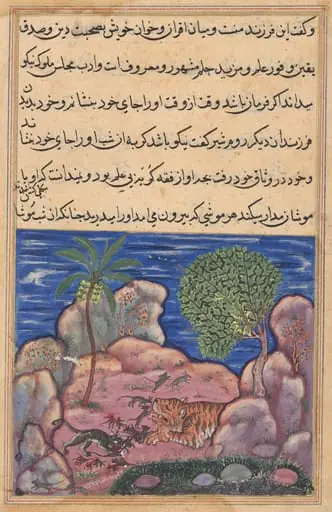
The parrot mother cautions her young on the danger of playing with foxes, from a Tuti-nama (Tales of a Parrot): Fifth Night
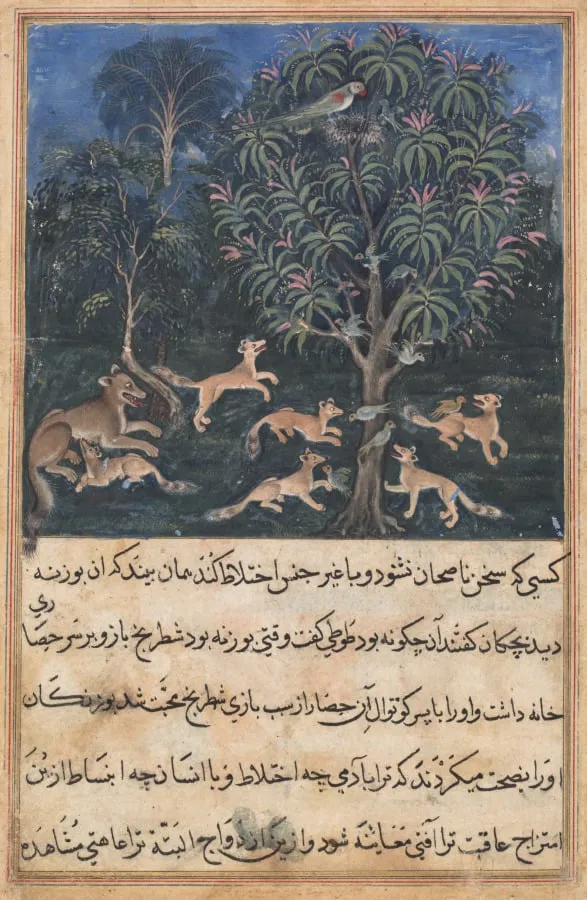
The parrot mother cautions her young on the danger of playing with foxes, from a Tuti-nama (Tales of a Parrot): Fifth Night is an unspecified painting by the Mughal Painting artist Daswanth. It dates from 1560 and is held in the collection of the Cleveland Museum of Art. The painting illustrates a vivid scene from a 16th‑century Indian manuscript of parrot tales.
About this work
If you like this, look up Mughal India, court of Akbar (reigned 1556–1605) to see more of these lively, storybook paintings.
You see a bright green parrot mom on a tree branch, scolding her chicks while fox cubs play below.
This painting comes from a book of parrot tales told to a queen in 1500s India. The artist, Dasavanta, worked for Emperor Akbar, who loved stories. The colors are flat and bold—no shadows—so every leaf and feather pops.
If you like this, look up Mughal India, court of Akbar (reigned 1556–1605) to see more of these lively, storybook paintings.
Overview
The painting illustrates a vivid scene from a 16th‑century Indian manuscript of parrot tales. A bright green mother parrot perches on a treetop branch, admonishing her fledglings while fox cubs frolic beneath. The composition is rendered in flat, saturated hues without modelling, giving each feather and leaf a striking presence.
Subject & Meaning
The narrative depicts a mother parrot warning her young about the hazards of playing with foxes, a moral lesson embedded in the larger story of Tuti‑nama. The dialogue frames the caution as part of a broader conversation about relationships, using animal characters to convey human concerns.
Technique & Style
Executed by the court artist Dasavanta, the work employs the Mughal miniature tradition of bold, unshaded colour fields. Linear outlines define forms, while the lack of chiaroscuro emphasizes decorative pattern over three‑dimensional illusion, characteristic of the Akbar‑era manuscript illustrations.
History & Provenance
Created for a royal manuscript presented to a queen in the 1500s, the painting originates from the Mughal court of Emperor Akbar (1556–1605). Dasavanta, a painter attached to Akbar’s atelier, contributed to the series of illustrated tales that circulated among the elite.
Context
The image belongs to a collection of parrot stories—Tuti‑nama—used as entertainment and moral instruction in Mughal India. Such manuscripts blended Persian literary forms with Indian artistic conventions, reflecting the syncretic culture fostered by Akbar’s patronage.
Artist & collection

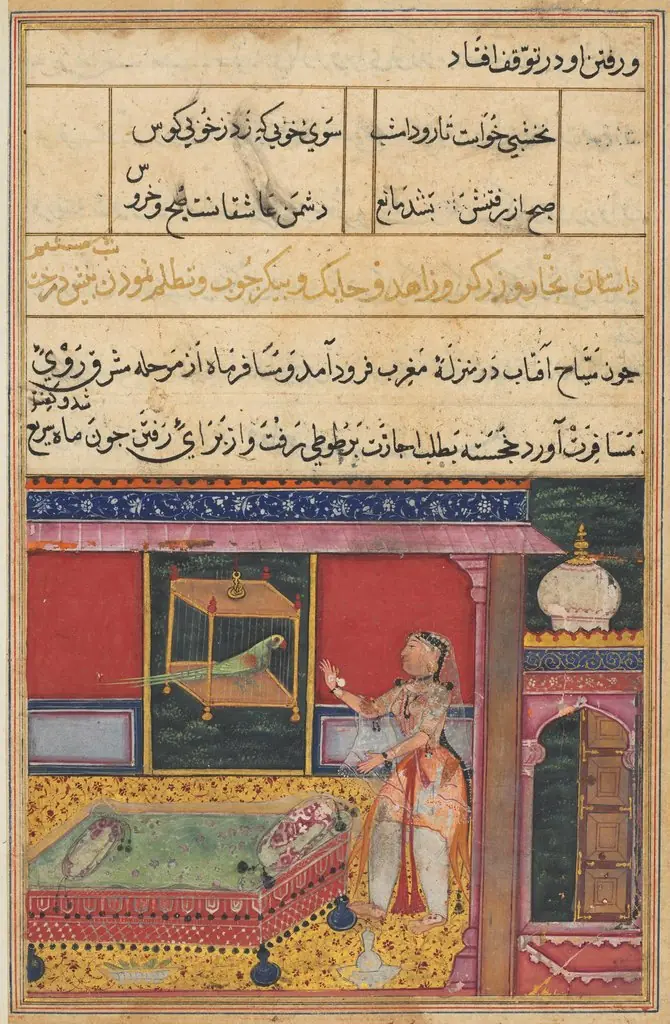 The Parrot Addresses Khujasta at the Beginning of the Sixth Night, from a Tuti-nama (Tales of a Parrot)
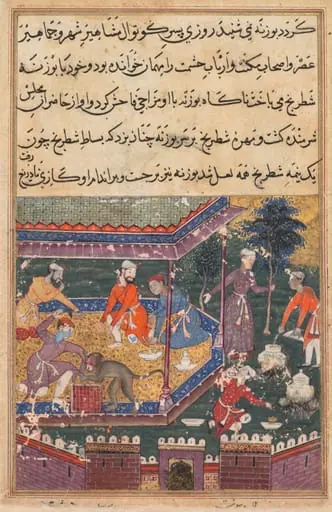 The wounded monkey bites the hand of the prince, his chessmate, in the presence of guests, from a Tuti-nama (Tales of a Parrot): Fifth Night
 The Parrot Addresses Khujasta at the Beginning of the Sixth Night, from a Tuti-nama (Tales of a Parrot)
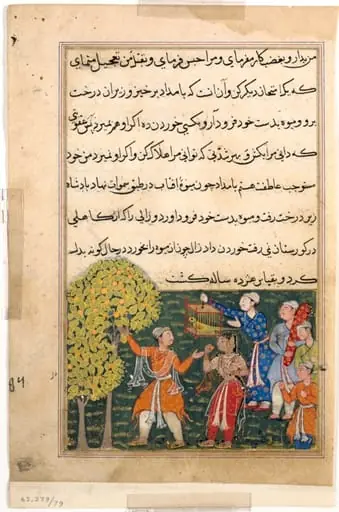 The king plucks fruit from the Tree of Life with his own hands and feeds it to a lady, from a Tuti-nama (Tales of a Parrot): Ninth Night
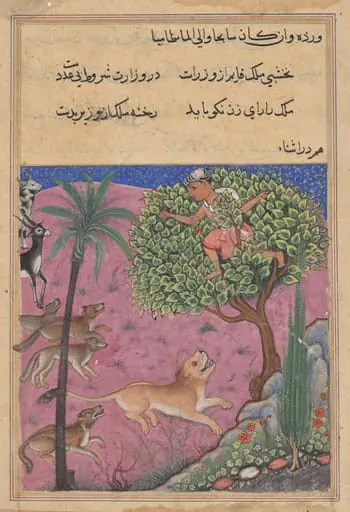 The wolf and the jackal, serving as viziers, instigate the lion who pursues the Brahman up a tree, from a Tuti-nama (Tales of a Parrot): Twenty-first Night
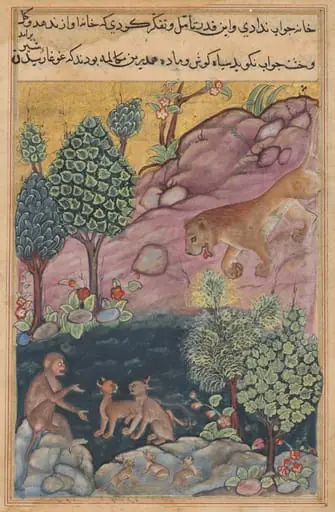 The lion returns to his territory and sees the monkey conversing with the lynx, from a Tuti-nama (Tales of a Parrot): Twenty-ninth Night
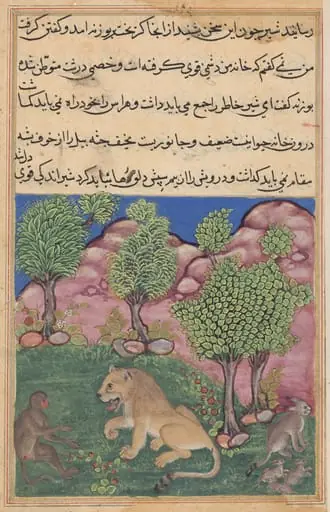 The monkey advises the suspicious lion to cast off fear and take possession of his territory, from a Tuti-nama (Tales of a Parrot): Twenty-ninth Night
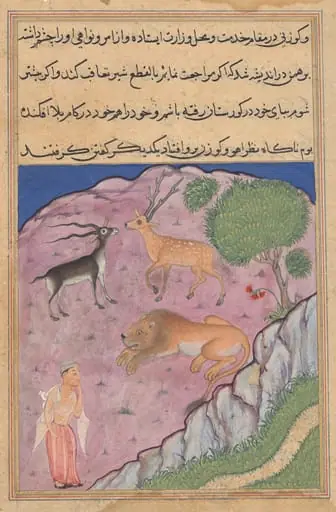 The Brahman comes upon a lion who has a deer and a gazelle as his viziers, from a Tuti-nama (Tales of a Parrot): Twenty-first Night
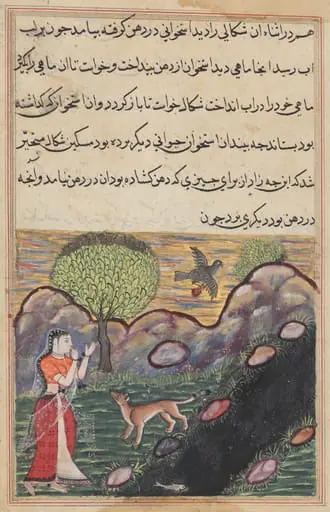 The daughter-in-law of the king of Banaras sees the jackal deprived of its food by a bird, as it unsuccessfully attempts to catch a fish, from a Tuti-nama (Tales of a Parrot): Sixteenth Night
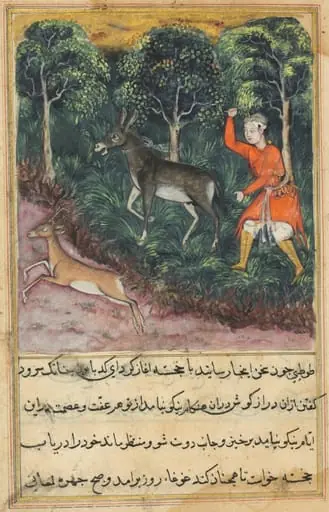 The gardener seizes and beats a donkey who insisted on braying, while the deer, its companion flees to safety, from a Tuti-nama (Tales of a Parrot): Forty-first Night
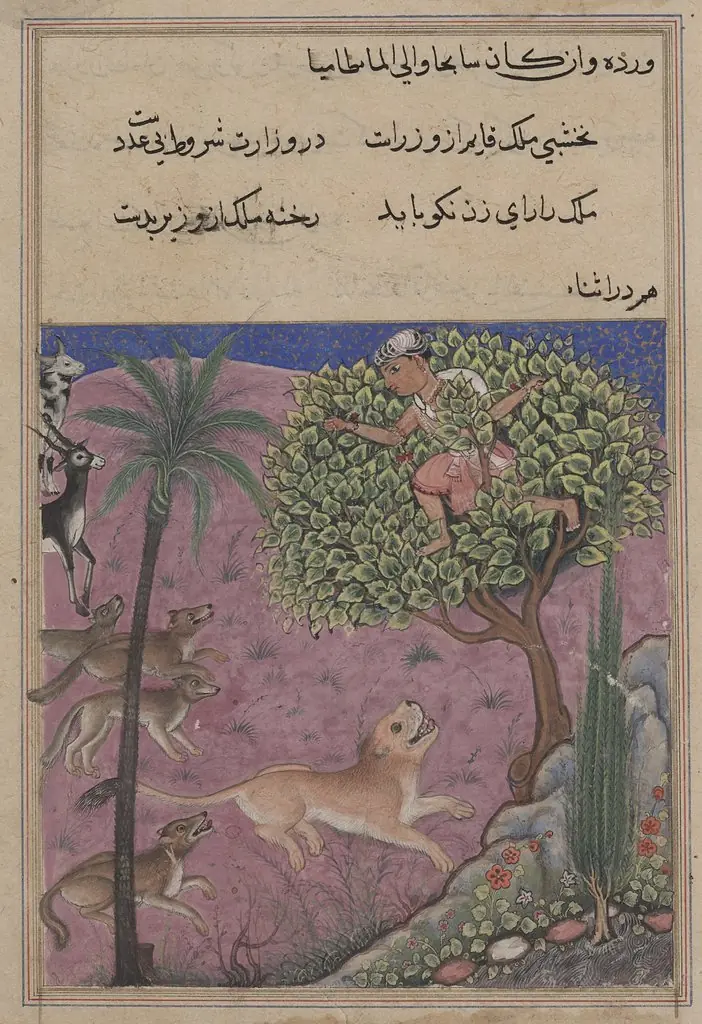 The wolf and the jackal, serving as viziers, instigate the lion who pursues the Brahman up a tree, from a Tuti-nama (Tales of a Parrot): Twenty-first Night
 The cat attacks the mice which disturb the lion, from a Tuti-nama (Tales of a Parrot): Fifteenth Night