Artwork
Long-legged Avocet
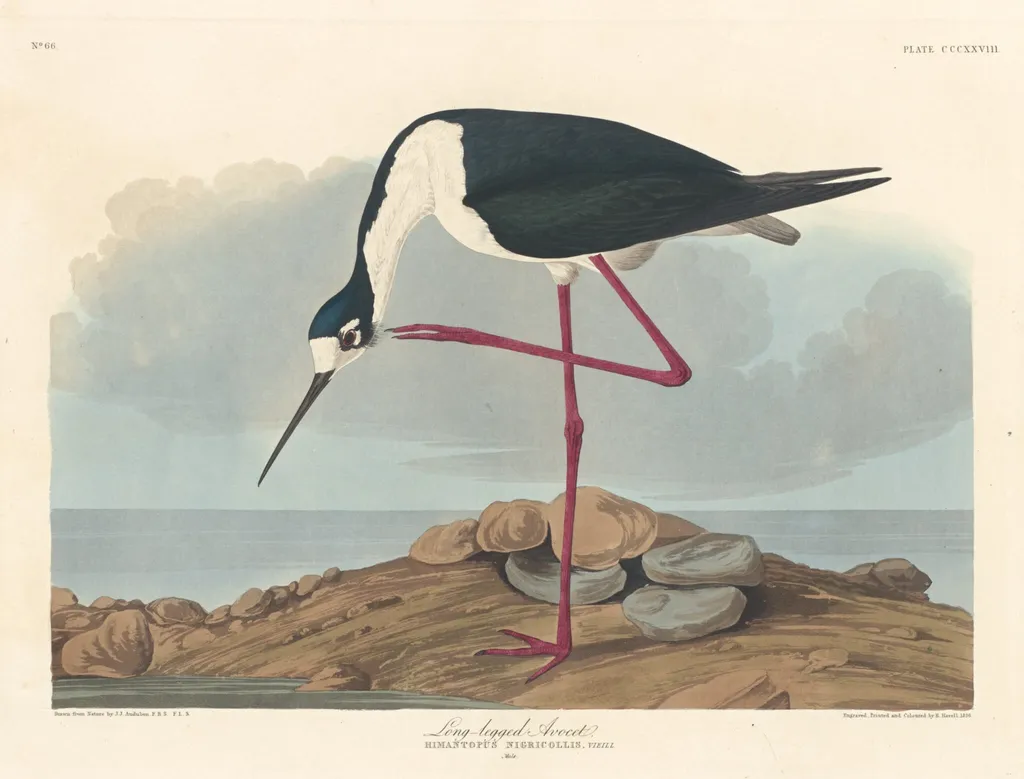
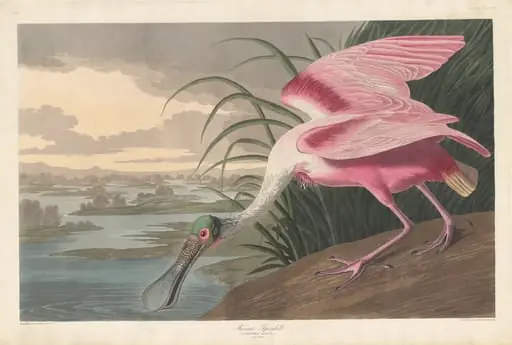
Long-legged Avocet is an ink print by the Romanticist artist Robert Havell Jr.. It dates from 1836 and is held in the collection of the National Gallery of Art. Created in 1836, this hand‑colored engraving and aquatint portrays a long‑legged avocet perched on a rocky shoreline.
About this work
Overview
Created in 1836, this hand‑colored engraving and aquatint portrays a long‑legged avocet perched on a rocky shoreline. Executed on Whatman wove paper, the image combines delicate line work with subtle tonal washes, allowing the bird’s pink leg and contrasting black‑white plumage to stand out against a muted, cloud‑dotted sky.
Subject & Meaning
The composition presents the avocet in a naturalistic pose, its long, pink leg supporting a body angled toward the ground, while a curved, scythe‑like beak suggests its feeding behavior. The bird’s placement on a shore strewn with rocks and shells emphasizes its wading habitat, offering a study of form and movement rather than allegorical content.
Technique & Style
Robert Havell Jr. employed aquatint to achieve soft, atmospheric tones, then added hand‑applied color to highlight key details such as the bird’s leg and plumage. The use of Whatman wove paper provides a smooth surface that enhances the fine engraving lines, while the combination of print and pigment reflects the early‑19th‑century British tradition of natural history illustration.
History & Provenance
Havell Jr., a member of a Reading‑based family of engravers and etchers, produced the print within a lineage noted for technical skill in aquatint and occasional links to Indian artistic circles. The work was likely issued as part of a series of ornithological studies circulated among collectors and scientific societies during the period.
Artist & collection

Artist
The Havell family of Reading, Berkshire, England, included a number of notable engravers, etchers and painters, as well as writers, publishers, educators, and musicians.