Artwork
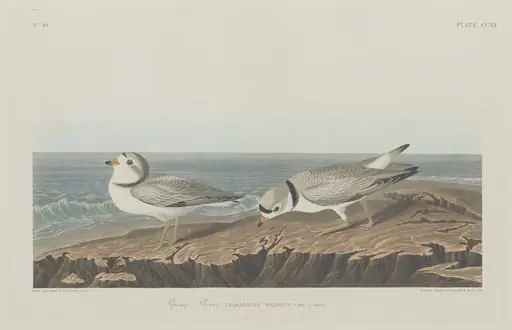
Ring Plover
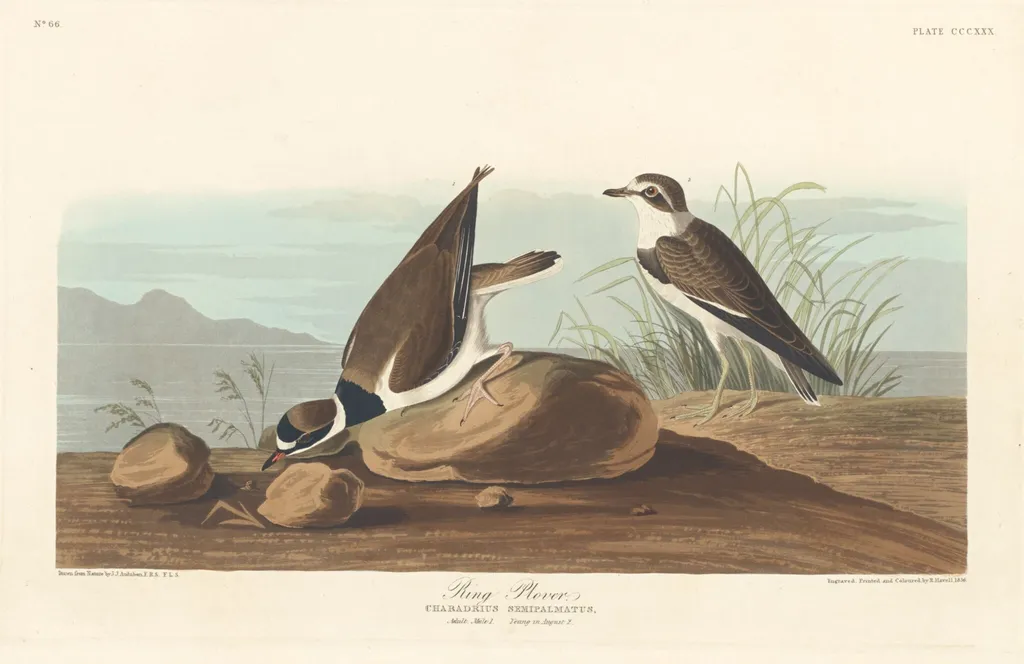
Ring Plover is an ink print by the Romanticist artist Robert Havell Jr.. It dates from 1836 and is held in the collection of the National Gallery of Art.
About this work
Overview
Ring Plover is a hand-colored engraving and aquatint print created by Robert Havell Jr. in 1836 on Whatman wove paper, characteristic of fine engravings from the period.
Subject & Meaning
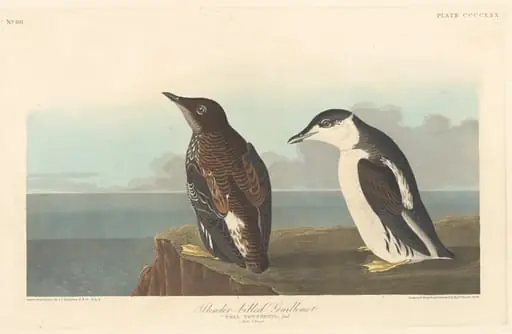
Contrary to the singular title, the print depicts two ring plovers in a coastal scene: one standing alert on a rock, the other recumbent with outstretched wings. The composition suggests a moment of vulnerability or unusual behavior, inviting interpretation.
Technique & Style
Executed with detailed precision, the print showcases Havell's mastery of engraving and aquatint. The color palette, featuring earthy tones for the birds and rocks, blue for water, and accents of green, reflects a realistic yet subtly Romantic approach.
History & Provenance
Robert Havell Jr., part of the renowned Havell family from Reading, Berkshire, created this work. Notably, the family was known for its connections to Indian art and culture, though this piece's subject matter aligns more closely with Western naturalist traditions.
Context
While labeled as an example of Romanticism due to its emotional and somewhat mysterious depiction of nature, the print's detailed rendering also grounds it in the naturalist tendencies of the early 19th century.
Legacy
The legacy of *Ring Plover* is intertwined with the broader appreciation of the Havell family's contributions to aquatint and engraving techniques, as well as the evolving interest in Romantic-era natural history illustrations.
Artist & collection

Artist
The Havell family of Reading, Berkshire, England, included a number of notable engravers, etchers and painters, as well as writers, publishers, educators, and musicians.