Artwork
Trumpeter Swan
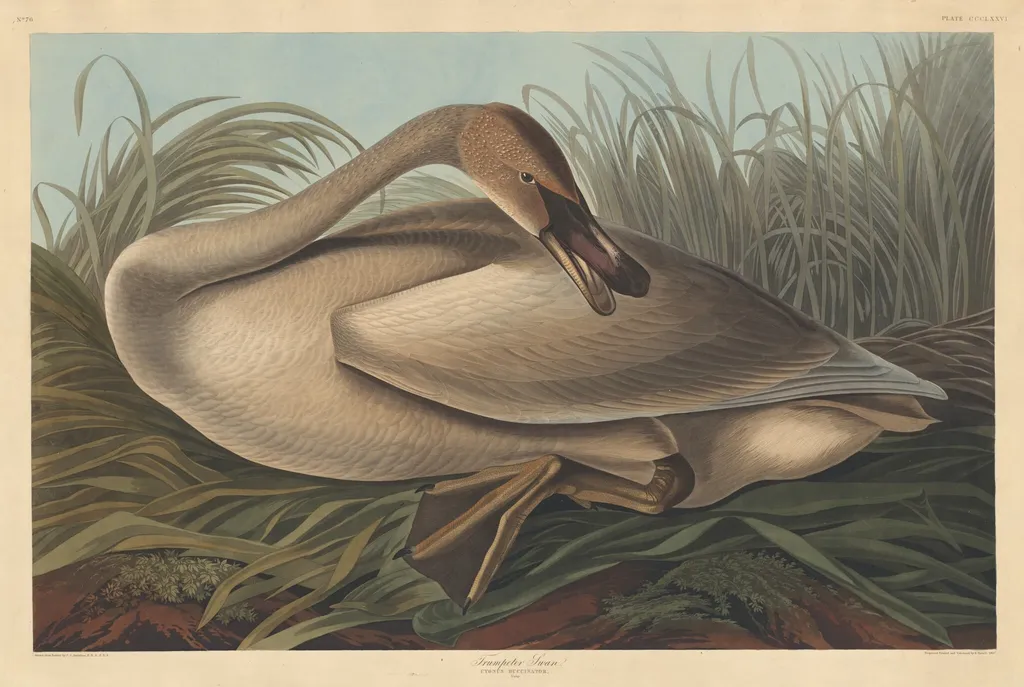
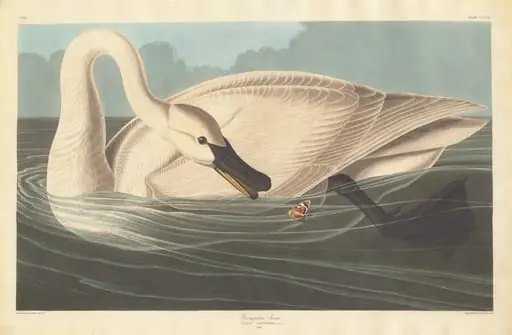
Trumpeter Swan is an ink print by the Romanticist artist Robert Havell Jr.. It dates from 1837 and is held in the collection of the National Gallery of Art.
About this work
Overview
As part of a family of engravers based in Reading, Berkshire, Havell applied technical precision to depict wildlife with scientific accuracy.
Robert Havell Jr.'s 1837 print of the trumpeter swan is a hand-colored engraving and aquatint on Whatman wove paper, produced during the height of British natural history illustration. As part of a family of engravers based in Reading, Berkshire, Havell applied technical precision to depict wildlife with scientific accuracy. The work belongs to a broader tradition of ornithological prints, where art and natural observation converged to document species for both scholarly and public audiences.
Subject & Meaning
The trumpeter swan is portrayed mid-preening, its neck curved in a calm, natural posture that suggests quiet solitude. The focus on individual behavior rather than habitat or movement reflects a desire to capture the bird’s form and demeanor with dignity. The absence of human presence or dramatic context emphasizes the animal’s autonomy, aligning with early 19th-century ideals of nature as an orderly, observable realm worthy of patient study.
Technique & Style
Havell employed aquatint to achieve soft gradations of tone across the swan’s plumage, mimicking the texture of feathers through controlled ink washes. Hand-coloring added subtle variations in white and gray, enhancing realism without artificial vibrancy. The background’s deep green grasses, rendered with fine line work, create spatial depth and contrast, grounding the bird in a believable environment while maintaining the print’s delicate, intimate scale.
History & Provenance
The print was made during a period when the Havell family was deeply involved in publishing natural history works, including collaborations on Audubon’s *Birds of America*. Robert Havell Jr. inherited his father’s workshop and continued its legacy of technical excellence. This particular print likely circulated among collectors and scientific institutions, valued for its fidelity to the subject and craftsmanship rather than commercial appeal.
Context
In the 1830s, European and American naturalists were systematically documenting North American wildlife, often relying on artists to translate specimens into enduring images. Havell’s swan reflects this trend, produced as part of a visual archive that sought to classify and preserve knowledge of species before widespread habitat loss. The choice of Whatman paper, prized for its durability and fine grain, underscores the print’s intended longevity and scholarly use.
Legacy
Havell’s work contributed to the standardization of ornithological illustration, influencing later naturalists and printmakers through its balance of accuracy and aesthetic restraint. While not widely exhibited today, such prints remain important references in the history of scientific imagery, valued for their methodical execution and quiet observation of the natural world, distinct from later romanticized depictions of wildlife.
Artist & collection

Artist
The Havell family of Reading, Berkshire, England, included a number of notable engravers, etchers and painters, as well as writers, publishers, educators, and musicians.