Artwork
Landscape with Sail Boats
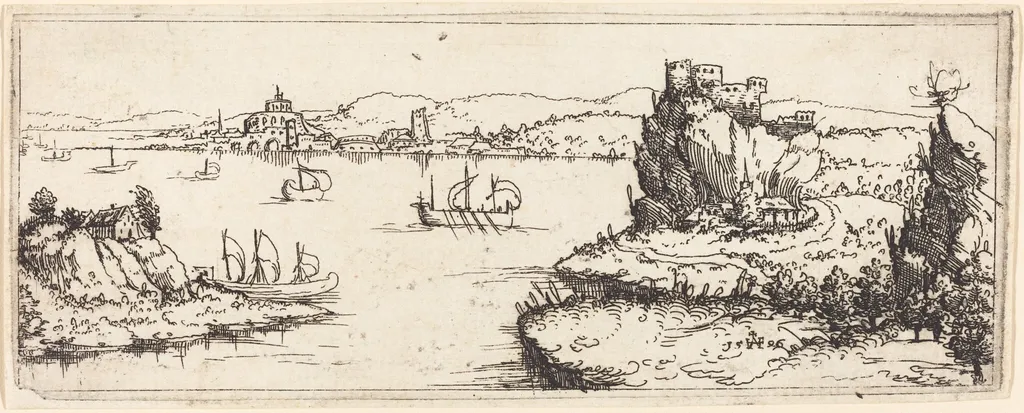
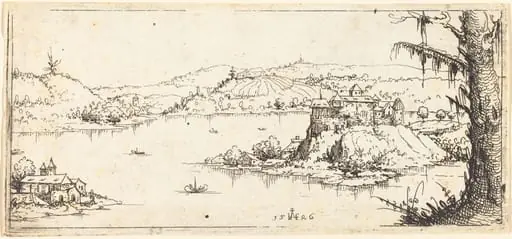
Landscape with Sail Boats is an ink print by the Renaissance artist Augustin Hirschvogel. It dates from 1546 and is held in the collection of the National Gallery of Art.
About this work
Overview
This print exemplifies his shift from technical illustration to lyrical landscape representation.
Created in 1546 by Augustin Hirschvogel, *Landscape with Sail Boats* is a black-and-white etching from a series of thirty-five small landscape prints made between 1545 and 1549. Hirschvogel, known for his work in mathematics and cartography, applied precise draftsmanship to natural scenes, helping define the aesthetic of the Danube School. This print exemplifies his shift from technical illustration to lyrical landscape representation.
Subject & Meaning
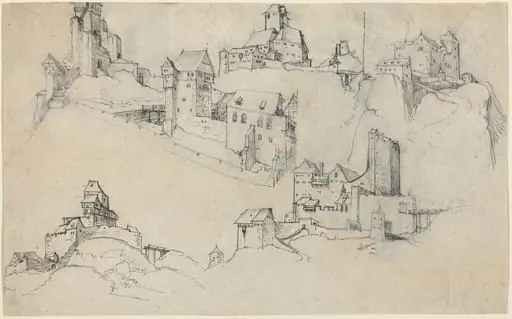
The scene portrays a winding river flanked by rugged cliffs and scattered vegetation, with sailboats gliding along its surface. A castle perches on a distant hill, suggesting human presence amid wild terrain. The composition balances natural forces—rock, water, wind—with quiet human activity. No narrative is overt; instead, the image evokes contemplation of place, scale, and the relationship between settlement and wilderness.
Technique & Style
Hirschvogel used etching, a method involving acid-bitten lines on a metal plate, to achieve fine, irregular strokes. The resulting texture mimics the spontaneity of sketching, with jagged contours and swirling water rendered through dense, hand-drawn marks. Unlike smooth engraving, this technique preserved a tactile, almost unfinished quality, aligning with the Danube School’s preference for expressive line over polished finish.
History & Provenance
The print emerged during Hirschvogel’s most productive period in Nuremberg, where he collaborated with publishers to distribute small-format landscapes to collectors. Though few original impressions survive, the series was widely circulated in southern Germany and Austria. Its popularity helped elevate etching from a reproductive tool to a medium for original artistic expression in the mid-16th century.
Context
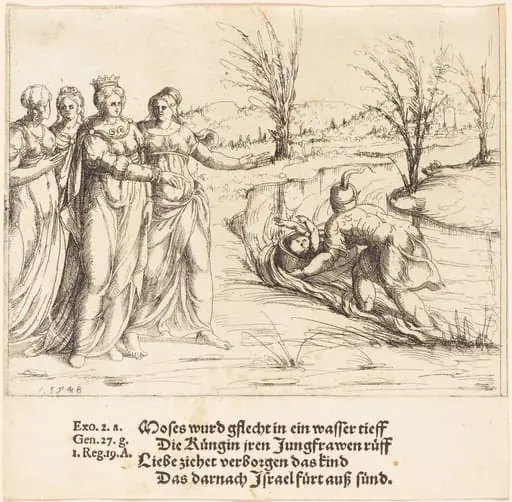
Hirschvogel’s landscapes responded to growing interest in natural scenery among educated patrons, separate from religious or mythological themes. His work coincided with the rise of topographical drawing and early cartographic surveys in the Holy Roman Empire. The Danube School’s focus on regional terrain reflected a broader cultural turn toward observing and documenting the physical world with renewed attention.
Legacy
Though Hirschvogel’s name faded after his death, his etchings influenced later generations of Northern European printmakers who valued intimate, atmospheric landscapes. His integration of technical precision with expressive line work bridged the gap between scientific illustration and artistic vision, contributing to the evolution of landscape as an independent genre in printmaking.
Artist & collection
Artist
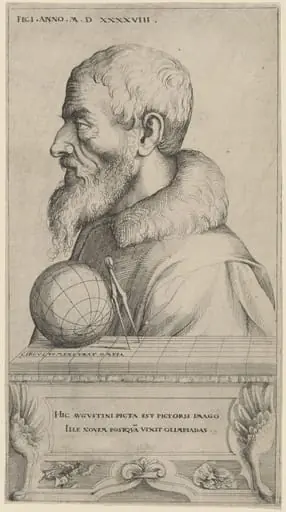
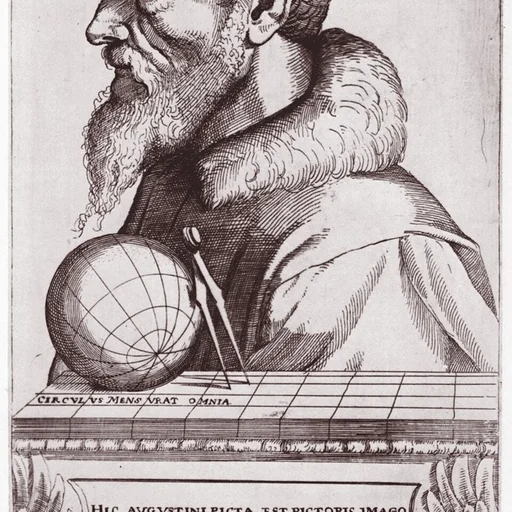
Augustin Hirschvogel (1503 – February 1553) was a German artist, mathematician, and cartographer known primarily for his etchings.