Artwork
Frieze of Ornament
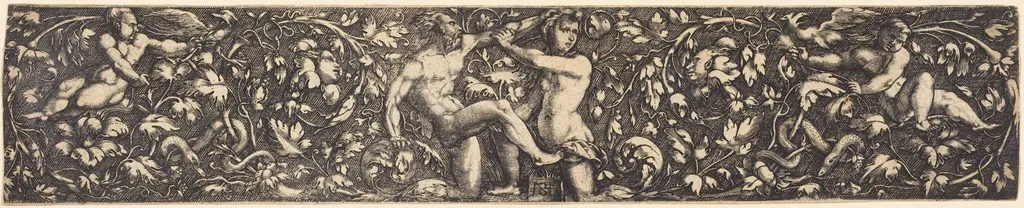
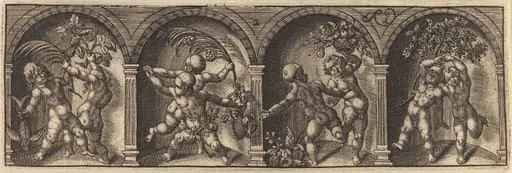
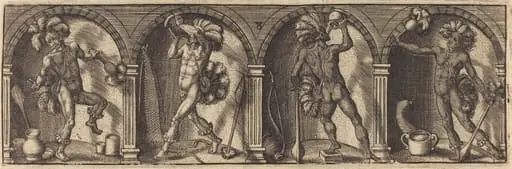
Frieze of Ornament is an ink print by the Renaissance artist Johann Ladenspelder. It dates from 1536 and is held in the collection of the National Gallery of Art.
About this work
Overview
Johann Ladenspelder’s Frieze of Ornament, executed as an engraving in 1536, presents a compact, horizontally‑stretched composition. The image is dominated by a central pair of figures—a standing individual clutching a bow and a kneeling companion—surrounded by a dense array of diminutive people, animals, and intertwining foliage rendered in fine incised lines against a dark ground.
Subject & Meaning
The central duo appears to be engaged in a narrative moment, though the exact story remains ambiguous. Encircling them, a bustling crowd of tiny figures and creatures, tangled in vines, suggests a festive or allegorical scene where human activity and nature intertwine, inviting viewers to infer a moral or mythological context.
Technique & Style
Ladenspelder employs the traditional engraving method, using a burin to incise precise, white‑colored lines that define forms and create tonal variation. The dense hatching and cross‑hatching generate depth and texture, while the meticulous detailing of foliage and miniature figures demonstrates the artist’s command of line to suggest movement within a confined space.
History & Provenance
Created in the mid‑sixteenth century, the print reflects the Northern Renaissance interest in ornamental design and narrative friezes. While specific ownership records are scarce, the work is known from early print collections and has been cited in catalogues of Ladenspelder’s oeuvre, confirming its attribution and dating to 1536.
Context
During the 1530s, engravers in Germany and the Low Countries frequently produced decorative bands for architectural and book‑illustration purposes. Ladenspelder’s frieze aligns with this tradition, combining ornamental motifs with a figurative scene, illustrating the period’s blend of decorative art and storytelling.
Legacy
The piece exemplifies the intricate line work that characterizes early modern engraving, influencing later printmakers who sought to integrate complex narrative content within ornamental frameworks. Its dense composition continues to be studied as a representative example of Renaissance print design.
Artist & collection