Artwork
Apollo on Parnassus
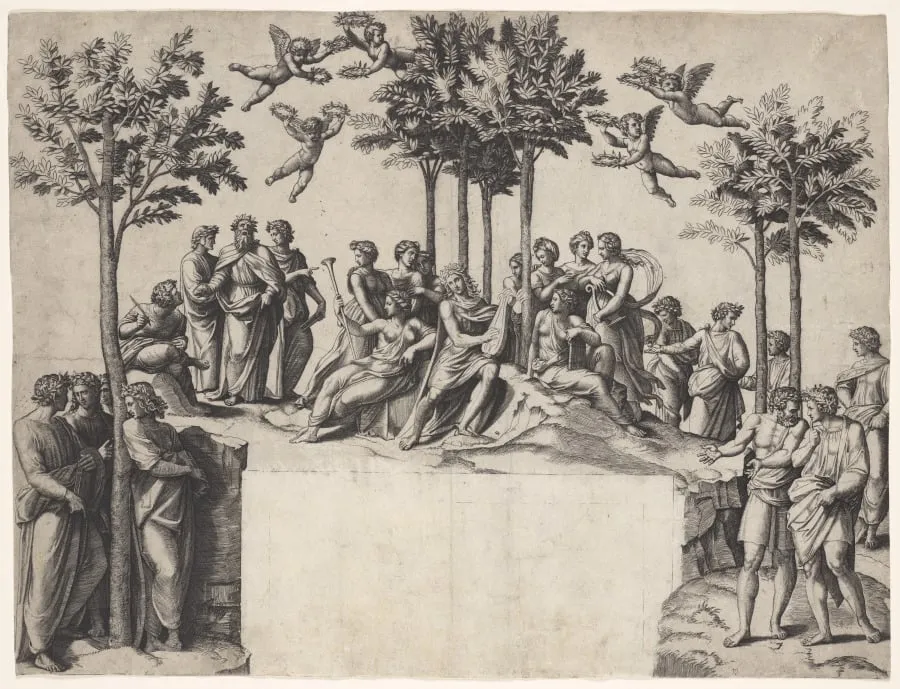
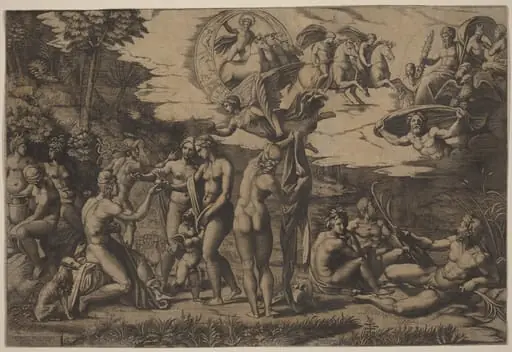
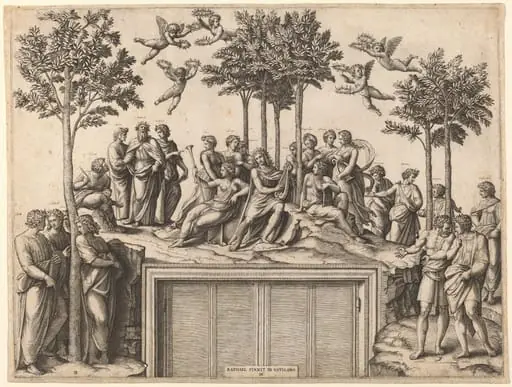
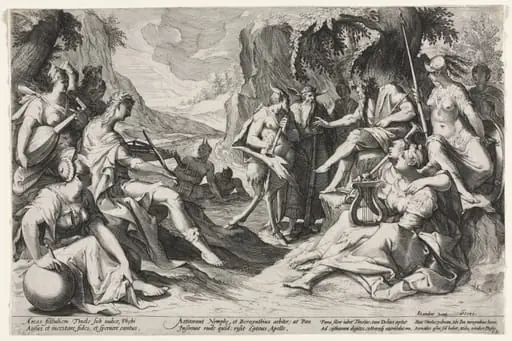
Apollo on Parnassus is a print by the Renaissance artist Marcantonio Raimondi. It dates from 1518 and is held in the collection of the Cleveland Museum of Art. Created around 1510, this engraving reproduces a fresco designed by Raphael for Pope Julius II’s private chambers.
About this work
Overview
The image captures a mythological gathering on Mount Parnassus, blending classical antiquity with contemporary intellectual reverence.
Created around 1510, this engraving reproduces a fresco designed by Raphael for Pope Julius II’s private chambers. Executed by Marcantonio Raimondi, it translated Raphael’s composition into a widely distributable print, enabling the dissemination of Renaissance humanist ideals across Europe. The image captures a mythological gathering on Mount Parnassus, blending classical antiquity with contemporary intellectual reverence.
Subject & Meaning
The scene centers on Apollo, god of poetry and music, playing the lyre amid the nine Muses. Surrounding them are revered literary figures: Homer, Virgil, and Dante, arranged to signify a lineage of poetic tradition from antiquity to the Renaissance. Their presence in the Vatican underscores the era’s fusion of classical learning with Christian authority, affirming poetry as a sacred pursuit.
Technique & Style
Raphael’s original fresco employed sfumato to soften contours and unify figures within a luminous atmosphere, a technique Raimondi adapted through delicate line work and tonal gradations in engraving. The composition is balanced and hierarchical, with Apollo elevated at the center, guiding the viewer’s eye across the assembled poets and muses in a harmonious, terraced arrangement.
History & Provenance
The fresco was painted between 1509 and 1511 in the Stanza della Segnatura, part of the Pope’s private apartments in the Vatican. Raimondi’s engraving followed soon after, becoming one of the earliest and most influential reproductive prints of High Renaissance art. Its circulation helped establish Raphael’s reputation beyond Italy and solidified the print’s role in transmitting artistic ideas.
Context
During the early 16th century, the Vatican actively embraced classical mythology as a vehicle for cultural prestige. The depiction of pagan deities and poets in a papal residence reflected humanist scholarship’s dominance among elite circles. This work exemplifies how ancient narratives were repurposed to celebrate intellectual achievement under the Church’s patronage.
Legacy
Raimondi’s engraving became a model for reproductive printmaking in Europe, influencing generations of artists and publishers. It contributed to the standardization of classical themes in visual culture and reinforced the idea that artistic excellence could bridge sacred and secular domains. The print’s longevity ensured Raphael’s vision endured far beyond the walls of the Vatican.
Artist & collection

Artist
Marcantonio Raimondi, often called simply Marcantonio (c. 1470/82 – c. 1534), was an Italian engraver, known for being the first important printmaker whose body of work consists largely of prints copying paintings. He…