Artwork
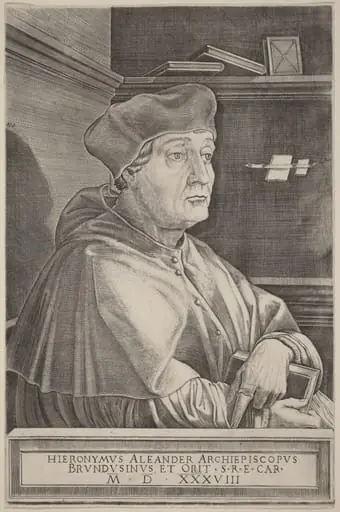
Hieronymus Alexander, Archbishop of Brindisi
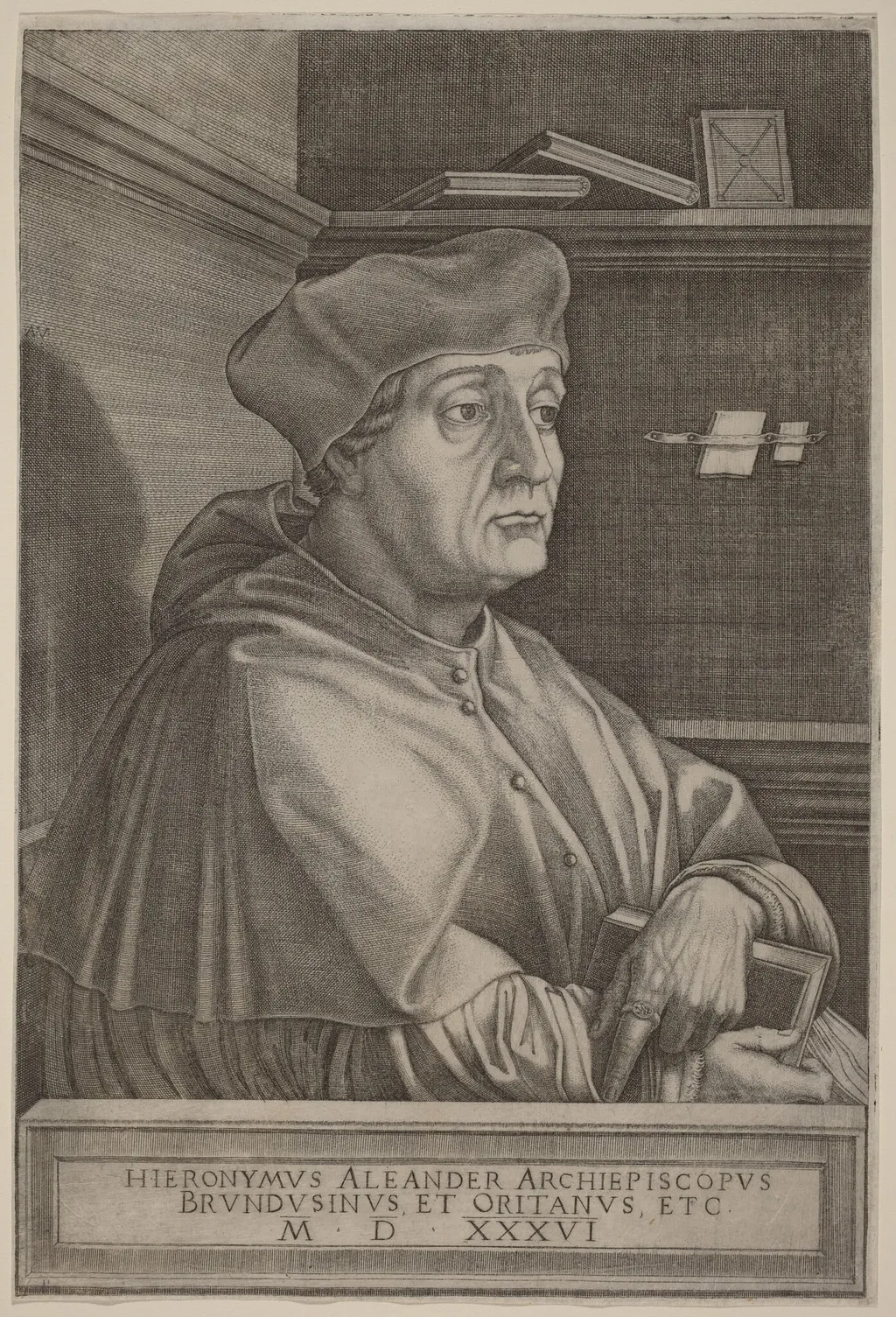
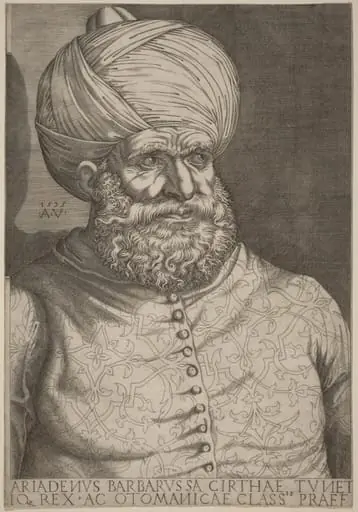
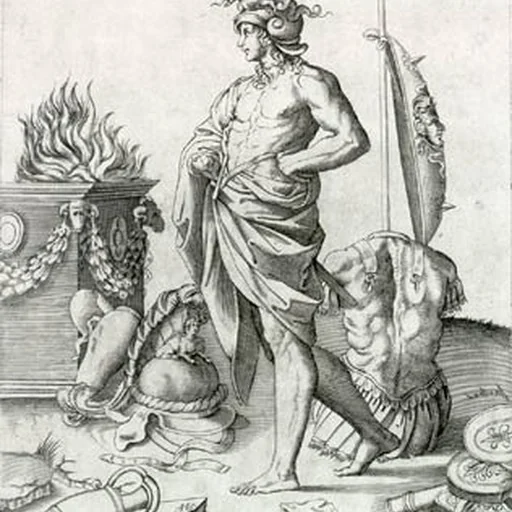
Hieronymus Alexander, Archbishop of Brindisi is an ink print by the Renaissance artist Agostino dei Musi. It dates from 1536 and is held in the collection of the National Gallery of Art.
About this work
Overview
Executed in ink on paper, the work reflects Veneziano’s mastery of line and detail, characteristic of his Roman workshop output during the mid-16th century.
This 1536 engraving by Agostino Veneziano depicts Girolamo Aleandro, Archbishop of Brindisi, as a formal portrait in the Renaissance tradition. Executed in ink on paper, the work reflects Veneziano’s mastery of line and detail, characteristic of his Roman workshop output during the mid-16th century. Though labeled as a painting in some sources, it is a printed impression made from a metal plate, typical of the period’s reproductive print culture.
Subject & Meaning
Girolamo Aleandro was a cardinal and humanist scholar deeply involved in Church politics and the early Reformation debates. The engraving presents him in ecclesiastical attire, emphasizing his authority and intellectual stature. His stern expression and formal pose convey gravitas, aligning with the era’s expectation that religious leaders be portrayed with dignity and moral seriousness, not personal charm.
Technique & Style
Veneziano employed fine, controlled lines to render the texture of fabric, lace, and the metallic sheen of ecclesiastical insignia. The background is minimal, focusing attention on the figure’s face and attire. His use of cross-hatching creates depth and volume, demonstrating the precision expected of professional engravers who reproduced portraits for wider dissemination among educated elites.
History & Provenance
The print was produced in Rome during a period when Venetian and Roman printmakers competed to circulate images of influential figures. Agostino Veneziano, trained in the workshop of Marcantonio Raimondi, was known for translating designs into engraved form. This portrait likely served as a diplomatic or commemorative object, possibly commissioned by Aleandro’s circle or distributed by publishers seeking to capitalize on his prominence.
Context
In the 1530s, the Catholic Church sought to reinforce its authority amid Protestant challenges. Portraits of high-ranking clergy like Aleandro, who had served as papal nuncio and debated Lutherans in Germany, functioned as visual propaganda. Engravings allowed such figures to be visually recognized across Europe, reinforcing institutional presence beyond the confines of Rome or the Vatican.
Legacy
Veneziano’s engraving contributed to the standardization of clerical portraiture in print. Though not widely reproduced today, it exemplifies how Renaissance engravers translated individual identity into enduring visual types. The work remains a reference for understanding how ecclesiastical power was visually constructed and circulated in early modern Europe.
Artist & collection
Artist
Agostino Veneziano ("Venetian Agostino"), whose real name was Agostino de' Musi (c. 1490 – c. 1540), was an important and prolific Italian engraver of the Renaissance.