Artwork
Dido
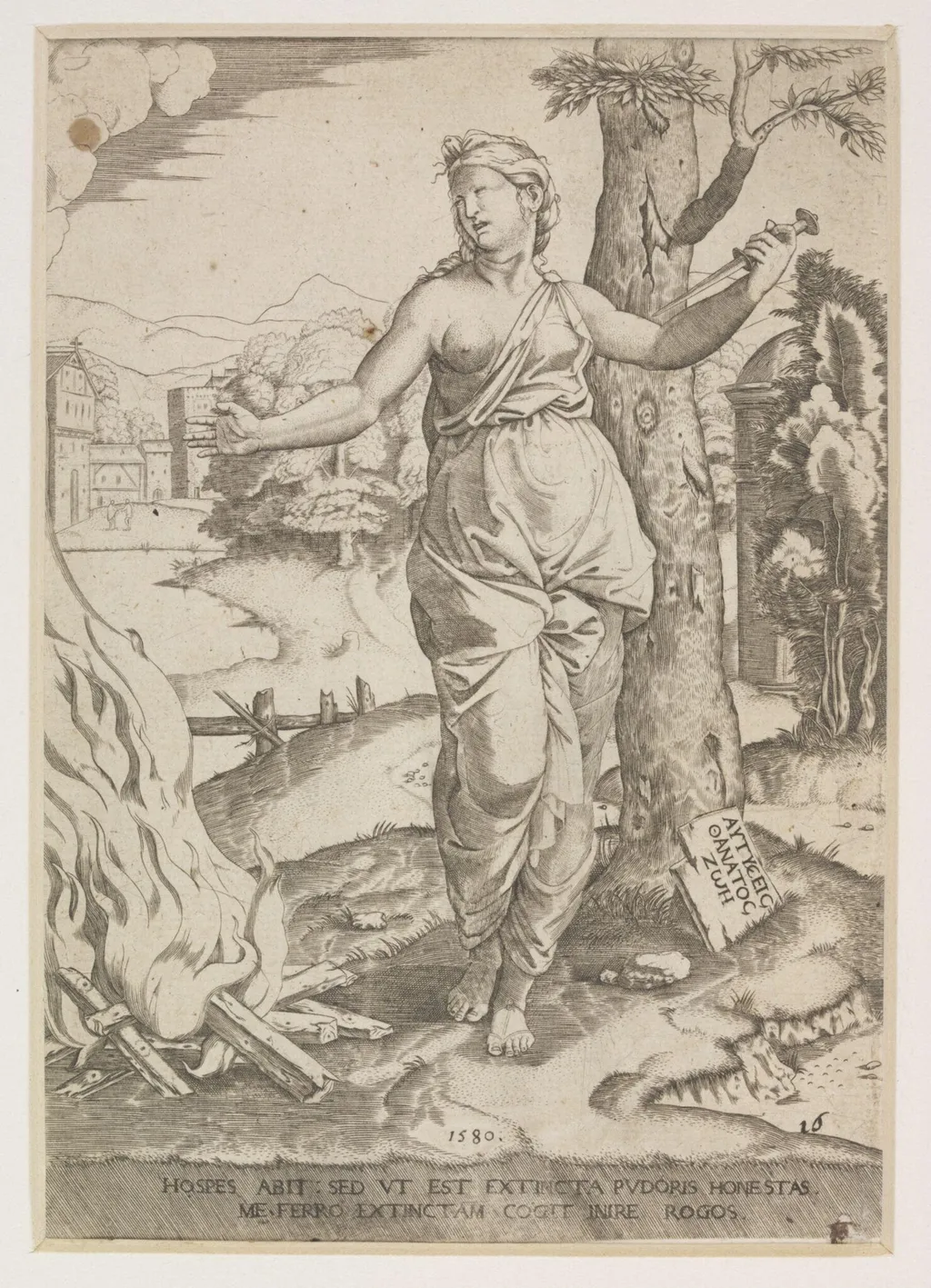
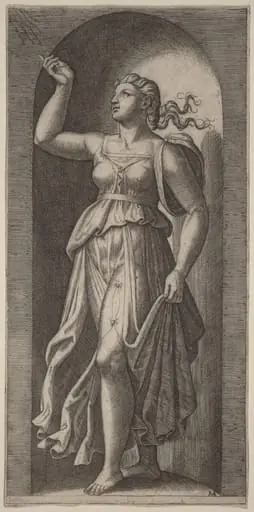
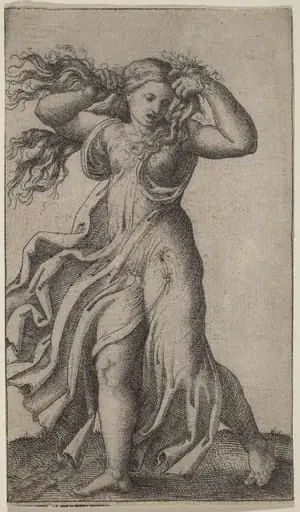
Dido is a print by the Renaissance artist Marcantonio Raimondi. It is held in the collection of the Victoria and Albert Museum.
About this work
The year "1580" is printed at the bottom, but the scene looks older, mixing real and symbolic elements.
This print shows a woman standing in a dramatic landscape. She holds a branch in one hand and a scroll in the other, dressed in flowing robes. Behind her, a city burns while a ship sails in the distance. The sky is dark with clouds, and the ground looks rocky and uneven.
The scroll she holds has Latin words on it, hinting this is a story with deeper meaning. The year "1580" is printed at the bottom, but the scene looks older, mixing real and symbolic elements.
Next, check out the Renaissance movement to see how artists used stories like this.
Overview
Dido is a 1580 engraving by Marcantonio Raimondi, depicting a dramatic scene in a landscape setting. The print features a woman, identified as Dido, in flowing robes, with a city burning and a ship sailing in the background.
Subject & Meaning
The scene is drawn from classical mythology, with Dido preparing to take her own life. The Latin inscription at the bottom of the print, 'HOSPES ABIT: SED VT EST EXTINCTA PVDORIS HONESTAS, &c.', provides context for the narrative, while the scroll held by Dido contains additional Latin text.
Technique & Style
The composition is based on a design by Raphael, but reversed, and incorporates a landscape adapted from a print by Lucas van Leyden. The engraving combines realistic and symbolic elements, with a dramatic landscape featuring a burning city and a sailing ship.
History & Provenance
The print is dated 1580 and is identified as Copy A, catalogued as Bartsch 187. It is an example of Renaissance printmaking, reflecting the artistic influences and techniques of the time.
Artist & collection

Artist
Marcantonio Raimondi, often called simply Marcantonio (c. 1470/82 – c. 1534), was an Italian engraver, known for being the first important printmaker whose body of work consists largely of prints copying paintings. He…