Artwork
The husband berates his wife for purchasing gravel instead of sugar, from a Tuti-nama (Tales of a Parrot): Eighth Night
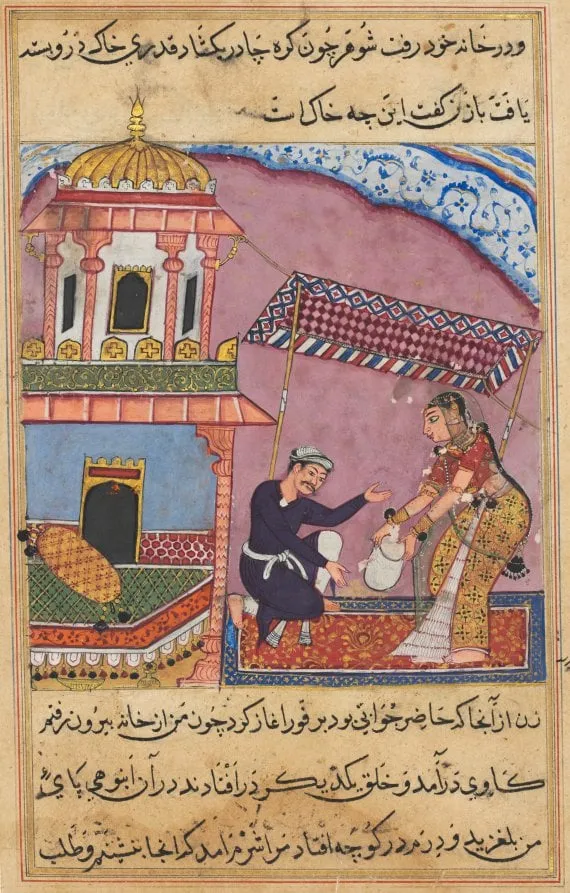
The husband berates his wife for purchasing gravel instead of sugar, from a Tuti-nama (Tales of a Parrot): Eighth Night is an unspecified painting by the Mughal Painting artist Unknown. It dates from 1560 and is held in the collection of the Cleveland Museum of Art.
About this work
This painting comes from a book of stories told by a parrot to keep its owner from sneaking out at night.
You see a man yelling at his wife while she holds a bag of gravel. A servant stands nearby, looking nervous. The room is small, with patterned walls and bright colors.
This painting comes from a book of stories told by a parrot to keep its owner from sneaking out at night. The wife in the story just got caught cheating—but she lies so well her husband believes her. The artist made the scene feel real, even though it’s fiction.
To see more art like this, look up Mughal India, court of Akbar (reigned 1556–1605).
Overview
The painting depicts a domestic dispute in a compact interior: a husband shouts at his wife, who clutches a sack of gravel, while a nervous servant watches. The walls are adorned with patterned designs and vivid hues, creating a lively backdrop that contrasts with the tension of the scene.
Subject & Meaning
The work illustrates a moment from the eighth night of a Tuti‑nama, a collection of moral tales narrated by a parrot. In the story, a wife who has been unfaithful returns home to find that a merchant’s clerk has swapped the sugar she intended to bring with gravel. Her husband confronts her, and she offers a swift, convincing falsehood that averts his anger, highlighting themes of deception and social propriety.
Technique & Style
Rendered in the Mughal court painting tradition of the late 16th century, the composition employs precise brushwork and a rich palette typical of Akbar’s atelier. Attention to detail appears in the patterned wall panels and the realistic rendering of the characters’ gestures, while the bright colors enhance the narrative’s immediacy.
Context
The scene belongs to a larger illustrated manuscript that uses parrot‑told anecdotes to discourage nocturnal escapades. Such visual storytelling was common in Mughal India, where courtly patronage encouraged the production of richly illustrated books that combined literary and artistic instruction.
History & Provenance
Created during the reign of Emperor Akbar (1556–1605), the painting was part of a manuscript commissioned for a royal or aristocratic patron. The work has remained within collections of Mughal art, serving as an example of the period’s narrative painting and its engagement with moral literature.
Artist & collection

 Domestic Scene
 Giacomo and Cardinal Marco, investing Andrea, Abbot of San Zeno, with his Benefice
 The Nymph of Fontainebleau
 Portrait of a Woman
 Madonna and Child with Saints in the Enclosed Garden
 Venus and Minerva
 Family Group of Four on Sofa
 Wall painting from Room H of the Villa of P. Fannius Synistor at Boscoreale
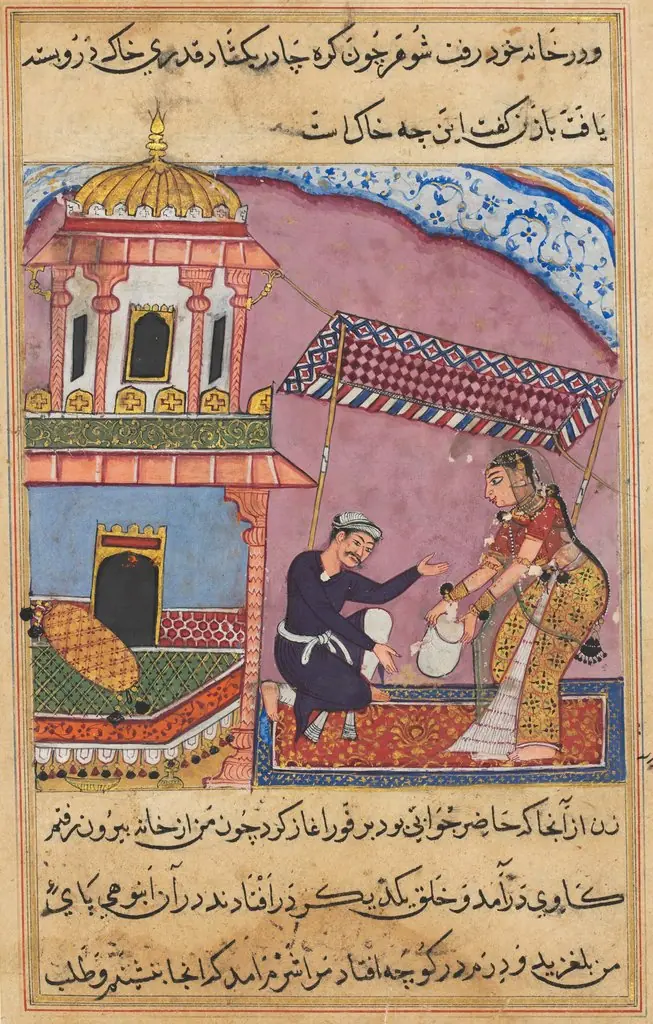 The husband berates his wife for purchasing gravel instead of sugar, from a Tuti-nama (Tales of a Parrot): Eighth Night
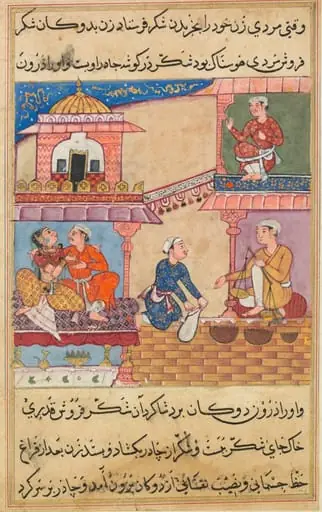 The merchant’s clerk replaces the sugar purchased by the philandering wife with gravel, from a Tuti-nama (Tales of a Parrot): Eighth Night
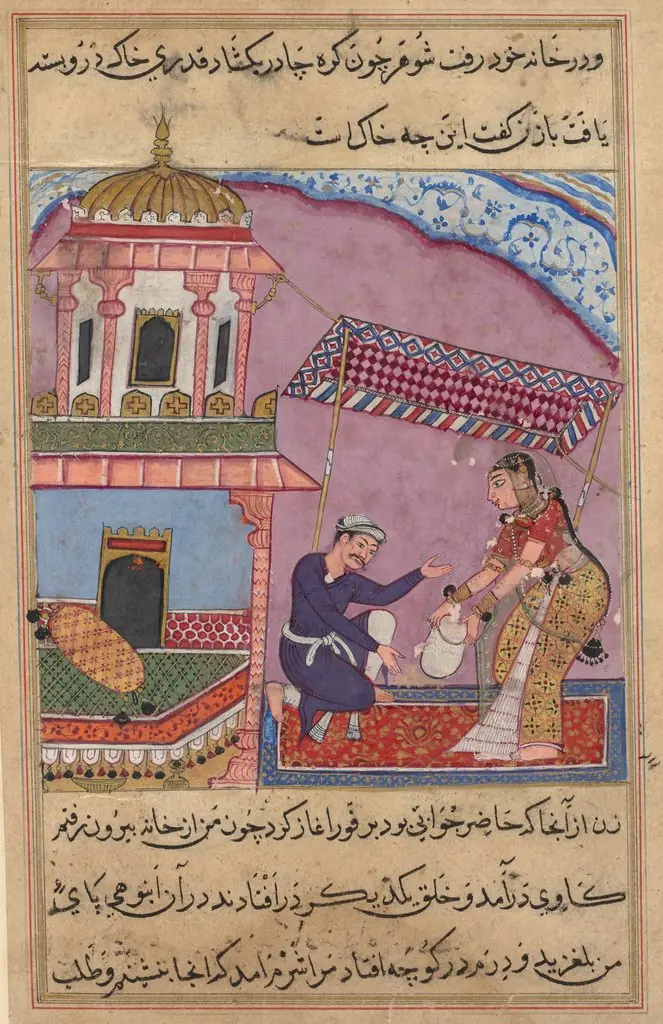 The merchant’s clerk replaces the sugar purchased by the philandering wife with gravel, from a Tuti-nama (Tales of a Parrot): Eighth Night
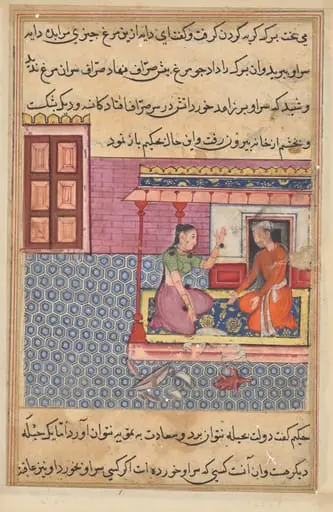 The pious man’s wife offers the seven-colored bird as food to her lover, but not finding its head, he breaks the pot and bowl in anger, from a Tuti-nama (Tales of a Parrot): Fifty-second Night
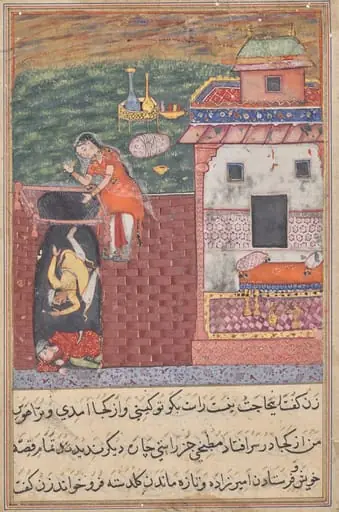 The two cooks, who attempt to seduce the warrior’s loyal wife, are trapped by her in a cellar, from a Tuti-nama (Tales of a Parrot): Fourth Night
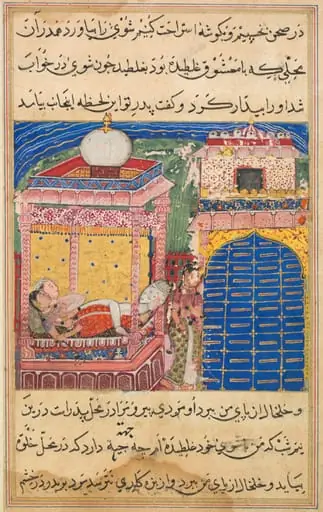 The deceitful wife persuades her husband to sleep in the same place where she had previously slept with her lover, from a Tuti-nama (Tales of a Parrot): Eighth Night
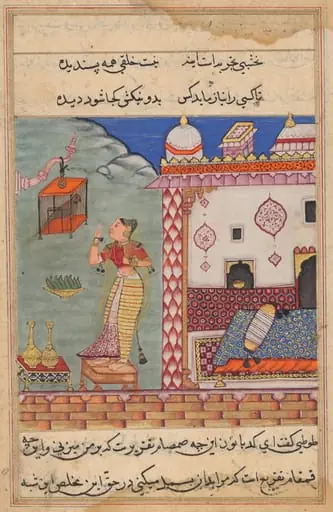 The Parrot Addresses Khujasta at the Beginning of the Twenty-seventh Night, form a Tuti-nama (Tales of a Parrot)
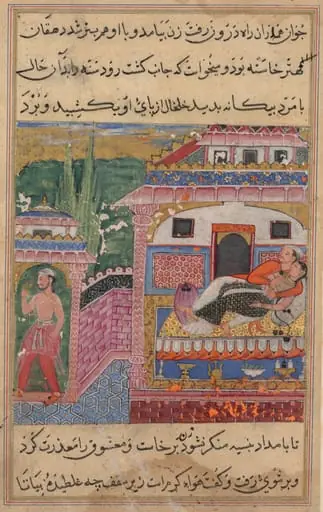 The farmer, father of the son with the deceitful wife, steals away with her anklet while she is in bed with her lover, from a Tuti-nama (Tales of a Parrot): Eighth Night
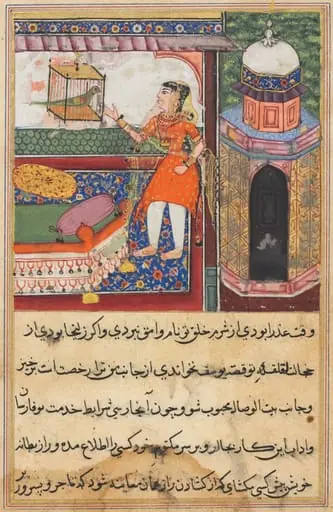 The Parrot Addresses Khujasta at the Beginning of the Tenth Night, from a Tuti-nama (Tales of a Parrot)
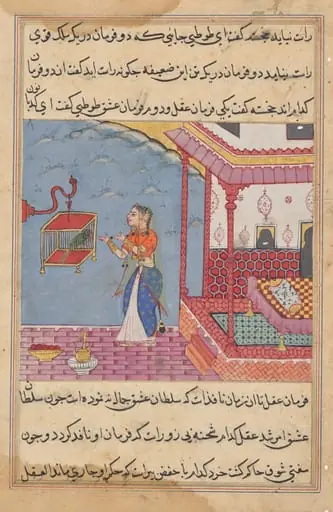 The Parrot Addresses Khujasta at the Beginning of the Twenty-Fourth Night, from a Tuti-nama (Tales of a Parrot)
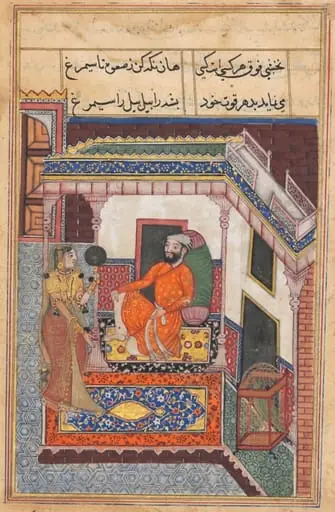 The parrot laughs on hearing the Raja of Ujjain’s wife admire her beauty in a mirror, from a Tuti-nama (Tales of a Parrot: Forty-sixth Night