Artwork
The parrot addresses Khujasta at the beginning of the forty-fourth night, from a Tuti-nama (Tales of a Parrot)
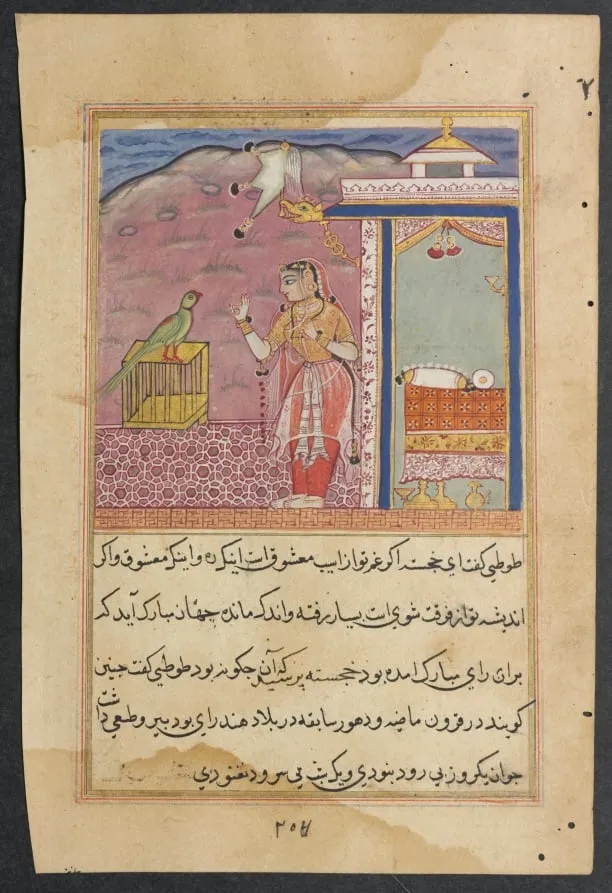
The parrot addresses Khujasta at the beginning of the forty-fourth night, from a Tuti-nama (Tales of a Parrot) is an unspecified painting by the Patna School of Painting artist Unknown. It dates from 1560 and is held in the collection of the Cleveland Museum of Art. The work depicts a seated woman, Khujasta, in a pink robe beneath a tree, attentively listening to a green parrot perched on a branch.
About this work
This scene is from a *Tuti-nama*, a book of stories told by a clever parrot to keep his owner from sneaking out at night.
A woman in a pink robe sits under a tree, listening to a green parrot perched on a branch. Bright flowers and rolling hills fill the background.
This scene is from a *Tuti-nama*, a book of stories told by a clever parrot to keep his owner from sneaking out at night. The soft colors and flat shapes come from an older Indo-Persian style, before Mughal artists added more depth.
To see more art like this, look up mughal india, court of akbar (reigned 1556–1605).
Overview
The work depicts a seated woman, Khujasta, in a pink robe beneath a tree, attentively listening to a green parrot perched on a branch. The background is filled with vivid flowers and gently undulating hills, rendered in a palette of soft, pale hues that characterize an early Indo‑Persian painting tradition.
Subject & Meaning
The scene illustrates a moment from the *Tuti‑nama*, a collection of tales narrated by the clever parrot Tuti to his mistress. In this episode, the bird recounts a story about a king whose offspring conspire against him and a musician whose verses restore their moral sense, emphasizing the power of storytelling.
Technique & Style
Executed in the pre‑Mughal Indo‑Persian aesthetic, the painting relies on flat planes of color and minimal shading. The composition favors delicate, pastel tones and stylized forms rather than realistic depth, reflecting an artistic convention that preceded the more three‑dimensional approach introduced by later Mughal painters.
Context
The image belongs to a manuscript tradition that predates the Mughal court of Akbar (1556–1605), when Persianate artistic influences dominated Indian visual culture. Its stylistic features illustrate the transitional phase before Mughal artists incorporated greater spatial illusion and naturalistic detail into Indian painting.
Artist & collection

 Domestic Scene
 Giacomo and Cardinal Marco, investing Andrea, Abbot of San Zeno, with his Benefice
 The Nymph of Fontainebleau
 Portrait of a Woman
 Madonna and Child with Saints in the Enclosed Garden
 Venus and Minerva
 Family Group of Four on Sofa
 Wall painting from Room H of the Villa of P. Fannius Synistor at Boscoreale
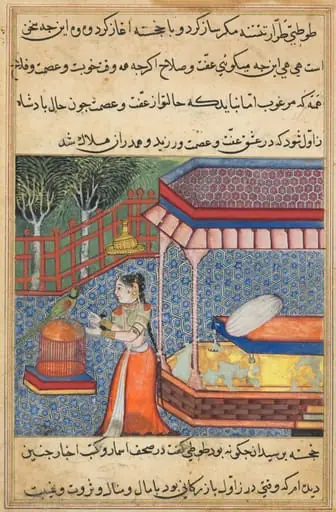 The parrot addresses Khujasta at the beginning of the thirty-sixth night, from a Tuti-nama (Tales of a Parrot)
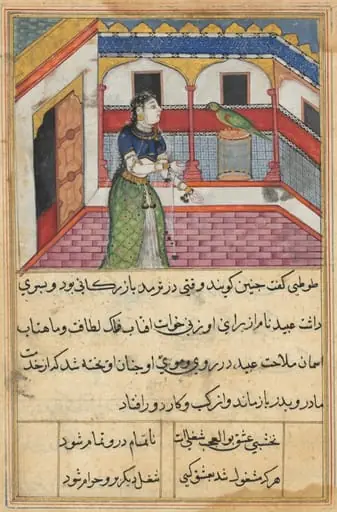 The parrot addresses Khujasta at the beginning of the forty-second night, from a Tuti-nama (Tales of a Parrot)
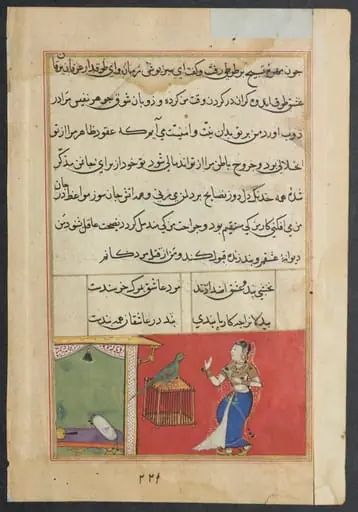 The parrot addresses Khujasta at the beginning of the forty-seventh night, from a Tuti-nama (Tales of a Parrot): Forty-seventh Night
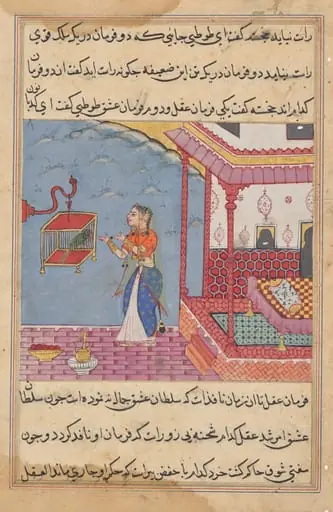 The Parrot Addresses Khujasta at the Beginning of the Twenty-Fourth Night, from a Tuti-nama (Tales of a Parrot)
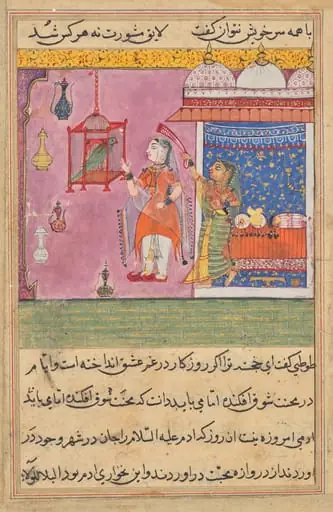 The Parrot Addresses Khujasta at the Beginning of the Nineteenth Night, from a Tuti-nama (Tales of a Parrot)
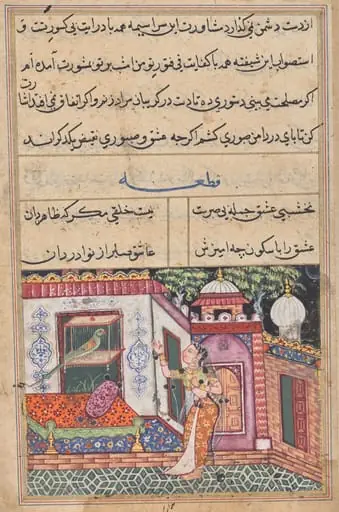 The Parrot Addresses Khujasta at the Beginning of the Eleventh Night, from a Tuti-nama (Tales of a Parrot)
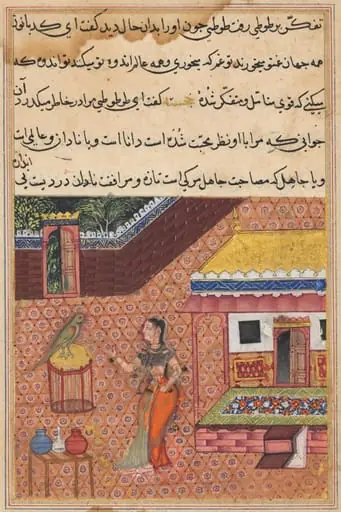 The parrot addresses Khujasta at the beginning of the thirty-fourth night, from a Tuti-nama (Tales of a Parrot)
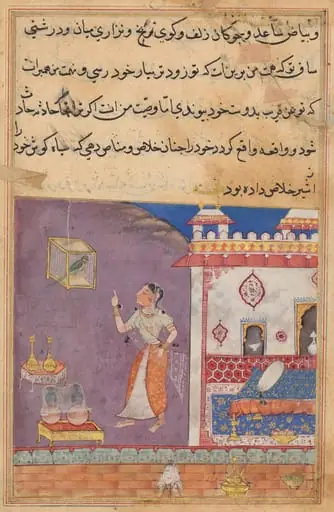 The Parrot Addresses Khujasta at the Beginning of the Twenty-ninth Night, from a Tuti-nama (Tales of a Parrot)
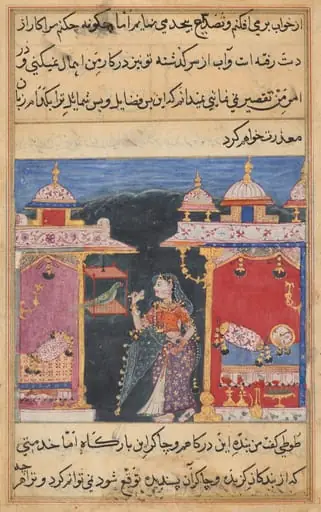 The Parrot Addresses Khujasta at the Beginning of the Seventh Night, from a Tuti-nama (Tales of a Parrot)
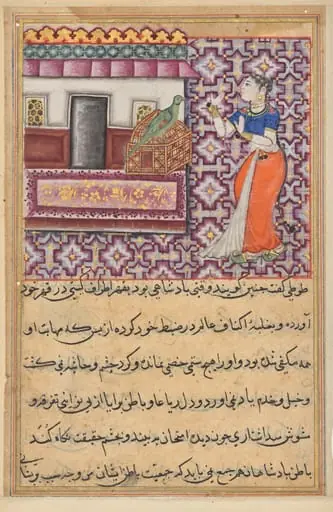 The parrot addresses Khujasta at the beginning of the fiftieth night, from a Tuti-nama (Tales of a Parrot): Fiftieth Night
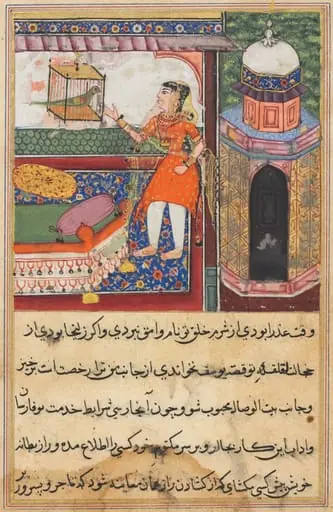 The Parrot Addresses Khujasta at the Beginning of the Tenth Night, from a Tuti-nama (Tales of a Parrot)