Artwork
Christ Appearing to Mary Magdalen
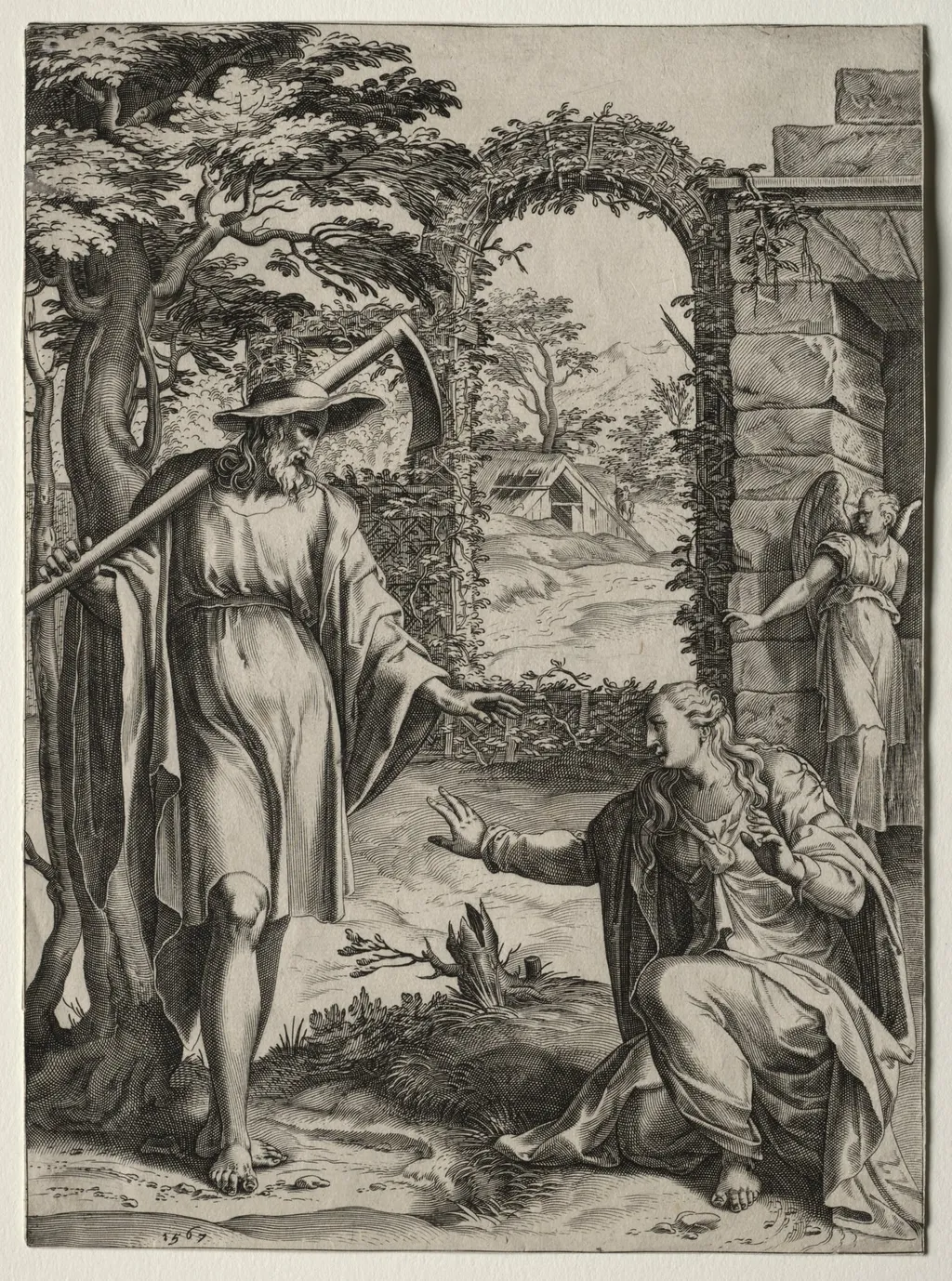
Christ Appearing to Mary Magdalen is a print by the Renaissance artist Cornelis Cort. It dates from 1567 and is held in the collection of the Cleveland Museum of Art.
About this work
Overview
Though attributed to Giulio Clovio’s original design, the print was executed by another hand and published in Antwerp around the mid-to-late 1500s.
This engraving depicts Christ appearing to Mary Magdalene after his resurrection, rendered in fine linear detail. Though attributed to Giulio Clovio’s original design, the print was executed by another hand and published in Antwerp around the mid-to-late 1500s. It exemplifies the trend of translating monumental Renaissance figures into intimate graphic formats, bridging the scale of manuscript illumination with the reach of printed imagery.
Subject & Meaning
The scene captures the moment of recognition between Christ and Mary Magdalene, as described in the Gospel of John. Christ stands upright, calm and resolute, while Mary kneels in reverence, her posture conveying both grief and awe. The garden setting alludes to the Garden of Eden and the tomb, reinforcing themes of renewal and divine revelation through a quiet, intimate encounter.
Technique & Style
The engraving employs sharp, controlled lines to model the figures with sculptural volume, echoing Michelangelo’s dynamic torsion and muscular tension. Dramatic chiaroscuro enhances the emotional gravity, with light carving through deep shadows to define form. The background, rendered with delicate foliage, contrasts the figures’ energy, recalling the ornamental traditions of illuminated manuscripts adapted for print.
History & Provenance
Produced in Antwerp, a leading hub for print production in the 16th century, the work was part of a broader circulation of reproductive engravings. Though based on Clovio’s drawing, the print likely emerged from a workshop familiar with his style. Its publication reflects the commercial demand for devotional imagery and the dissemination of Italian artistic ideals beyond the Alps.
Context
In the mid-1500s, Antwerp’s print culture thrived on reproducing Italian compositions for Northern European audiences. Clovio’s adaptation of Michelangelo’s figures into small-scale formats catered to collectors seeking portable, refined art. This print contributed to the cross-regional exchange of stylistic models, helping to anchor Mannerist forms in the visual language of Northern printmakers.
Legacy
The engraving served as a vehicle for transmitting Michelangelo’s figural language to artists unfamiliar with his original works. Its widespread distribution helped standardize certain compositional and anatomical conventions across Europe. Though modest in scale, it played a quiet but persistent role in shaping devotional imagery and the evolution of print as a medium for artistic influence.
Own this work as a print
Artist & collection

Artist
Cornelis Cort (c. 1533 – c. 17 March 1578) was a Dutch engraver and draughtsman. He spent the last 12 years of his life in Italy, where he was known as Cornelio Fiammingo.