Artwork
Bartram Sandpiper
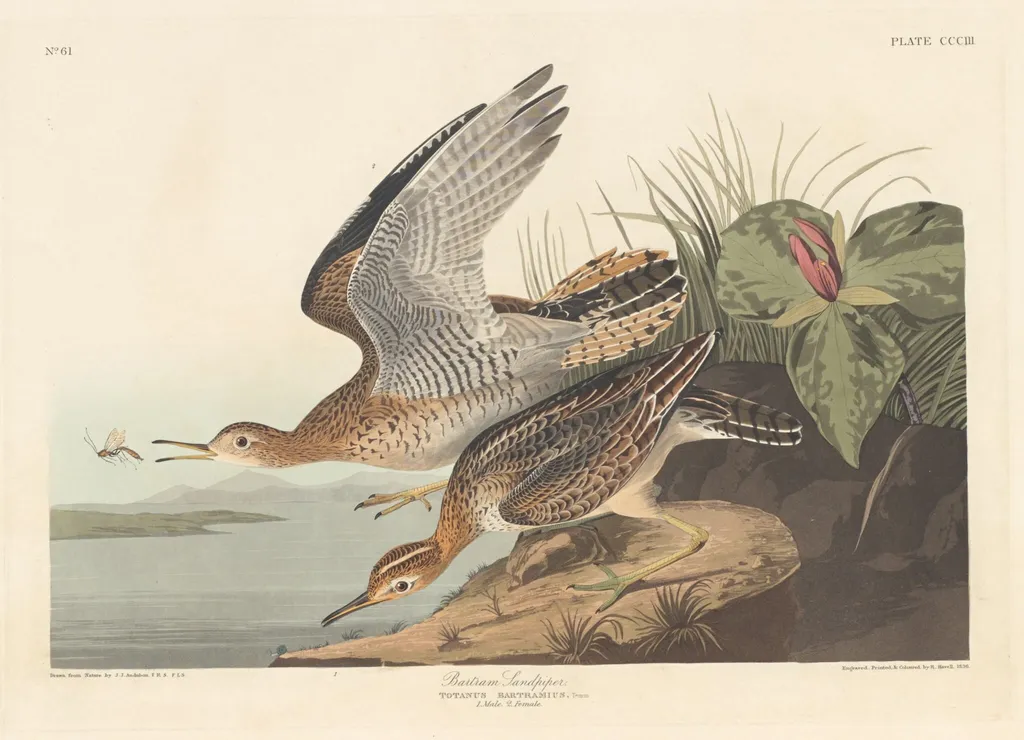
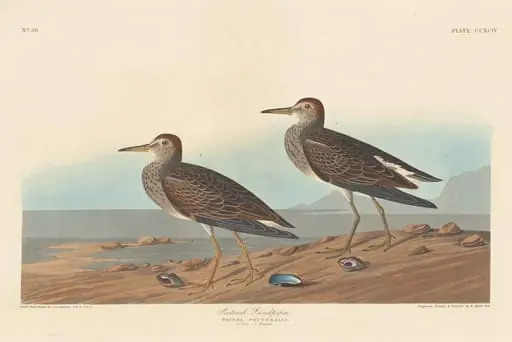
Bartram Sandpiper is an ink print by the Romanticist artist Robert Havell Jr.. It dates from 1836 and is held in the collection of the National Gallery of Art.
About this work
Overview
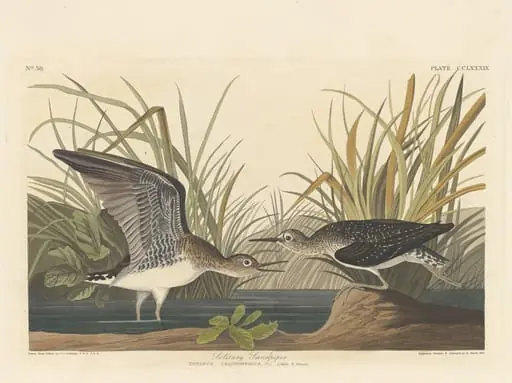
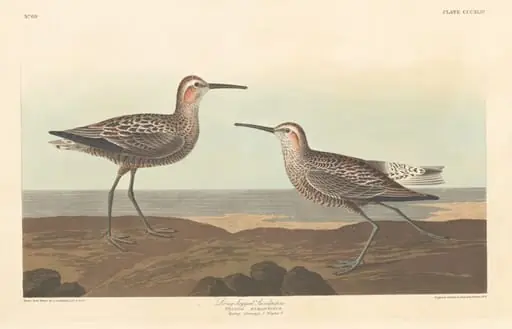
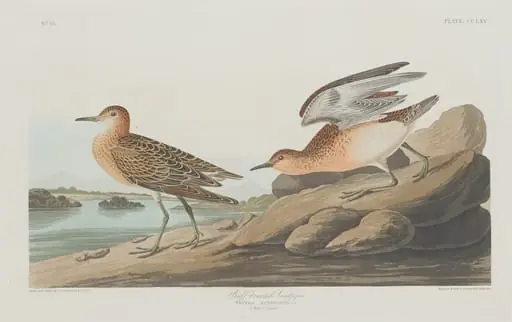
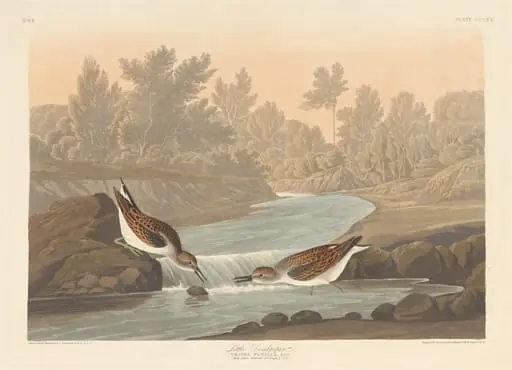
Created in 1836 by Robert Havell Jr., this hand-colored engraving and aquatint on Whatman wove paper depicts a sandpiper species native to North American shorelines. Part of a broader series documenting avian life, the work exemplifies the Havell family’s technical mastery in printmaking, particularly their refined use of aquatint to achieve subtle tonal gradations and delicate color layering.
Subject & Meaning
The inclusion of a vivid red flower and distant mountains grounds the scene in a specific ecological context, implying a quiet, undisturbed natural habitat.
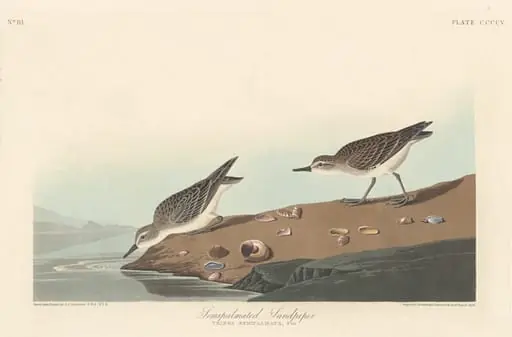
The composition features two sandpipers: one in mid-flight with wings fully extended, the other standing alert on a rocky outcrop near water. The birds are rendered with anatomical precision, suggesting scientific observation rather than mere ornamentation. The inclusion of a vivid red flower and distant mountains grounds the scene in a specific ecological context, implying a quiet, undisturbed natural habitat.
Technique & Style
Havell employed engraving for precise linework and aquatint for soft atmospheric tones, applying watercolor by hand to enhance feather textures and environmental details. The shading on the birds’ plumage reveals careful observation of light and form, while the background’s muted greens and blues create depth without overwhelming the central subjects. The use of Whatman paper ensured durability and a smooth surface for fine color application.
History & Provenance
The print was produced during Robert Havell Jr.’s collaboration on ornithological publications, continuing a family tradition of scientific illustration begun by his father. Though not part of Audubon’s Birds of America, it shares its commitment to accurate natural history depiction. The work likely circulated among naturalists and collectors, reflecting 19th-century interest in documenting North American wildlife.
Context
In the 1830s, American naturalists were systematically recording regional fauna, often with European printmaking techniques adapted for local subjects. Havell’s work emerged amid growing public fascination with natural history, supported by institutions and private patrons. The inclusion of native flora alongside the bird underscores an emerging ecological awareness, even as colonial expansion reshaped the landscapes being depicted.
Legacy
Havell’s prints contributed to the visual record of North American birds at a time when field observation was still developing. While less widely known than Audubon’s larger works, his precise, restrained style influenced later naturalist illustrators who prioritized accuracy over dramatic flair. The survival of such prints today offers insight into the intersection of science, art, and print culture in early 19th-century America.
Artist & collection

Artist
The Havell family of Reading, Berkshire, England, included a number of notable engravers, etchers and painters, as well as writers, publishers, educators, and musicians.