Artwork
Spotted Sandpiper
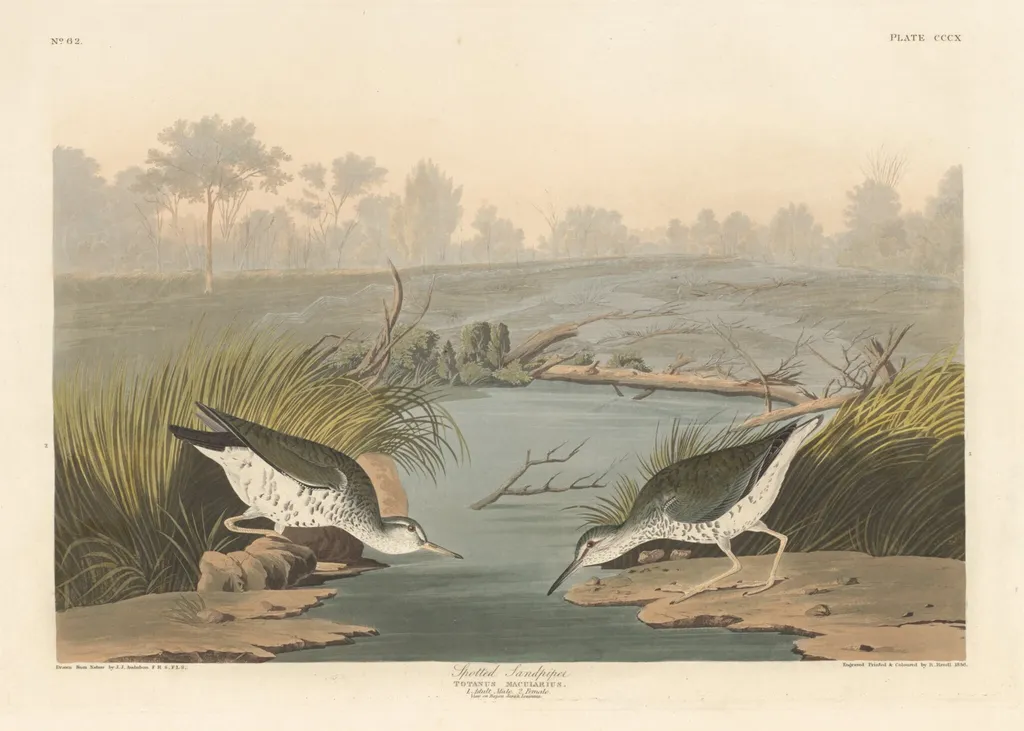
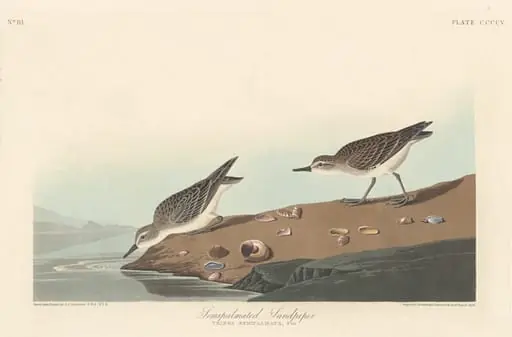
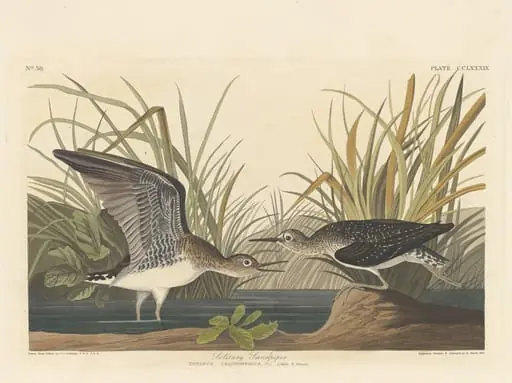
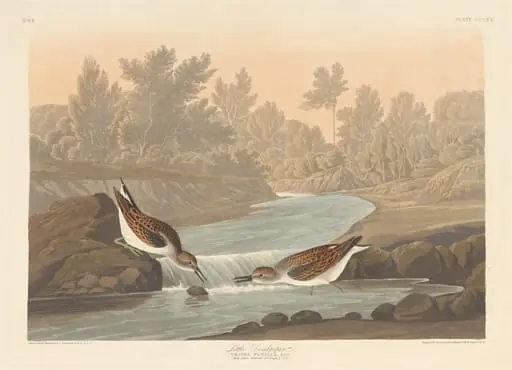
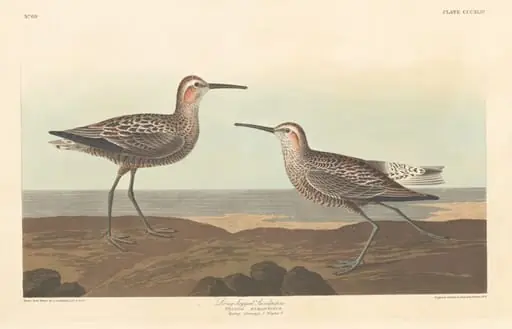
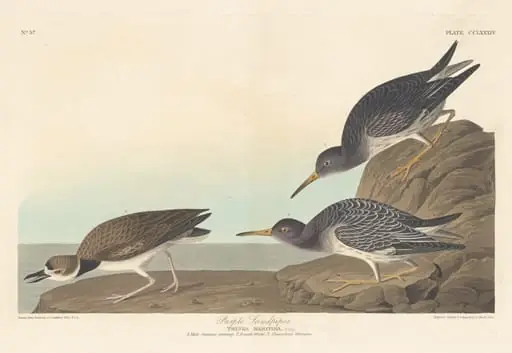
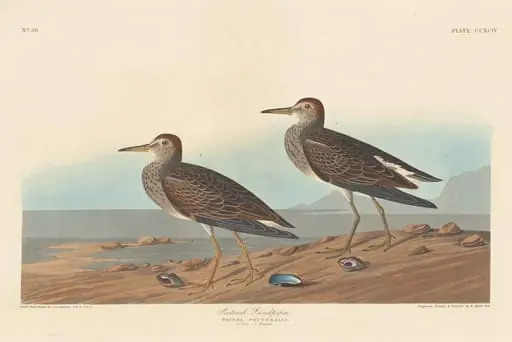
Spotted Sandpiper is an ink print by the Romanticist artist Robert Havell Jr.. It dates from 1836 and is held in the collection of the National Gallery of Art.
About this work
Overview
The work is part of a broader series of ornithological prints that emerged from the Havell family’s long-standing involvement in natural history illustration.
Robert Havell Jr. produced this hand-colored engraving and aquatint in 1836 on Whatman wove paper, a support favored for its durability and fine texture. The work is part of a broader series of ornithological prints that emerged from the Havell family’s long-standing involvement in natural history illustration. Their workshop, based in London, combined technical precision with artistic sensitivity, contributing significantly to 19th-century scientific publishing.
Subject & Meaning
The print portrays two spotted sandpipers poised along a freshwater edge, their spotted underparts and mottled backs rendered with careful attention to plumage detail. Their postures suggest foraging behavior, eyes fixed on the water’s surface. The composition avoids dramatic action, instead emphasizing quiet observation. This restrained focus reflects a scientific impulse to document species in their natural habitat, aligning with contemporary naturalist practices.
Technique & Style
Havell employed aquatint to achieve subtle tonal gradations in the landscape, while engraved lines defined the birds’ forms with clarity. Hand-coloring was applied with precision, layering delicate washes to mimic natural hues—soft greens and browns for vegetation, pale blue-greens for water. The use of Whatman paper enhanced the print’s texture, allowing for nuanced color absorption and preserving fine detail without bleeding or distortion.
History & Provenance
The Havell family operated a multi-generational printmaking studio in London, with Robert Havell Jr. continuing the work begun by his father and uncle. This print likely originated as part of a larger ornithological publication, possibly linked to American naturalist John James Audubon’s projects, with which Havell was professionally associated. Its survival in good condition reflects its value within private and institutional collections of natural history imagery.
Context
In the 1830s, European and American publishers increasingly sought accurate visual records of North American wildlife. Havell’s work emerged within this context, bridging scientific documentation and artistic representation. While his family had earlier engaged with Indian art, this print reflects a shift toward domestic fauna, aligning with growing public interest in native species and the expansion of natural history studies in the early United States.
Legacy
Havell’s prints, including this one, remain valued for their technical fidelity and restrained aesthetic. They represent a transitional moment in natural history illustration, where handcrafted methods preceded photographic reproduction. Though less celebrated than contemporaries like Audubon, Havell’s contributions sustained the credibility and visual quality of scientific publications during a period of rapid change in both art and biology.
Artist & collection

Artist
The Havell family of Reading, Berkshire, England, included a number of notable engravers, etchers and painters, as well as writers, publishers, educators, and musicians.