Artwork
Boat-tailed Grackle
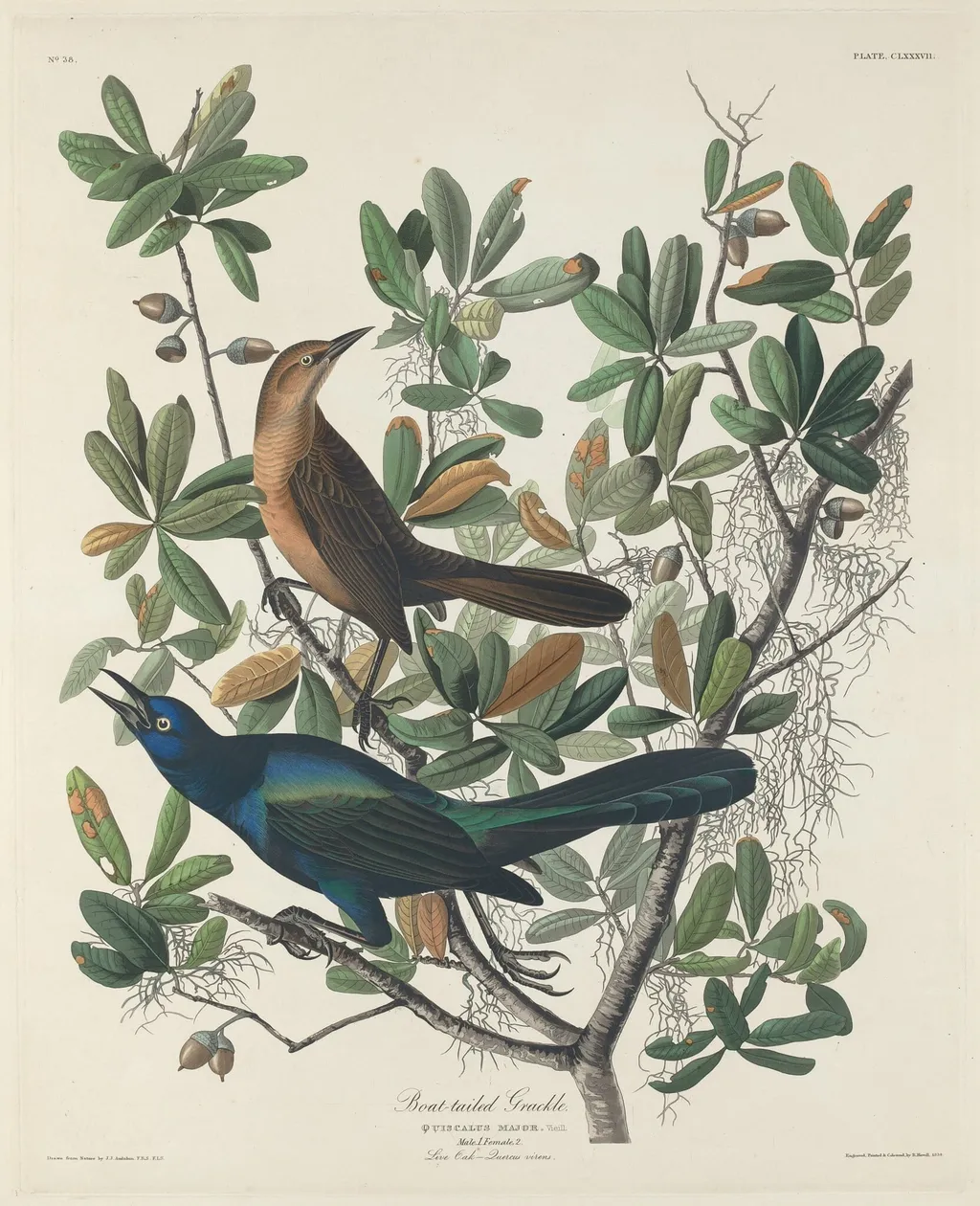
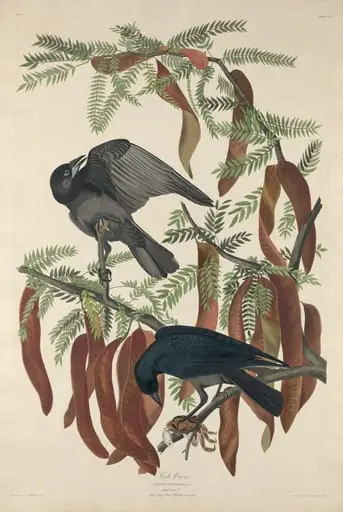
Boat-tailed Grackle is an ink print by the Romanticist artist Robert Havell Jr.. It dates from 1834 and is held in the collection of the National Gallery of Art.
About this work
Overview
Robert Havell Jr.’s *Boat‑tailed Grackle* is a hand‑colored engraving combined with aquatint, executed on Whatman wove paper in 1834. The print presents two birds perched on branches amid foliage and acorns, rendered with fine line work and subtle tonal shading that emphasize the texture of feathers and the birds’ distinctive coloration.
Subject & Meaning
The image portrays a boat‑tailed grackle, a North‑American blackbird, alongside a companion bird. The composition focuses on naturalistic detail, highlighting the birds’ plumage, beak, and long tail against a backdrop of leaves and tangled roots, reflecting an interest in accurate zoological observation.
Technique & Style
The work employs aquatint to achieve smooth gradations of tone, a method the Havell family mastered, while hand‑coloring adds precise hues to the feathers and surrounding foliage. Fine engraving lines define the birds’ forms, and the combination of line and wash creates a realistic, three‑dimensional effect.
History & Provenance
Robert Havell Jr. belonged to a lineage of English engravers based in Reading, Berkshire, continuing the practice established by his father, Robert Havell the Elder, and his uncle, Luke Havell. The family was noted for their contributions to natural history illustration and for disseminating Indian artistic influences through print.
Context
Produced during the early nineteenth‑century surge in scientific illustration, the print aligns with contemporary efforts to document wildlife for both scholarly and popular audiences. Its detailed rendering reflects the period’s emphasis on empirical observation and the growing market for colored prints of exotic fauna.
Artist & collection

Artist
The Havell family of Reading, Berkshire, England, included a number of notable engravers, etchers and painters, as well as writers, publishers, educators, and musicians.