Artwork
The Physician
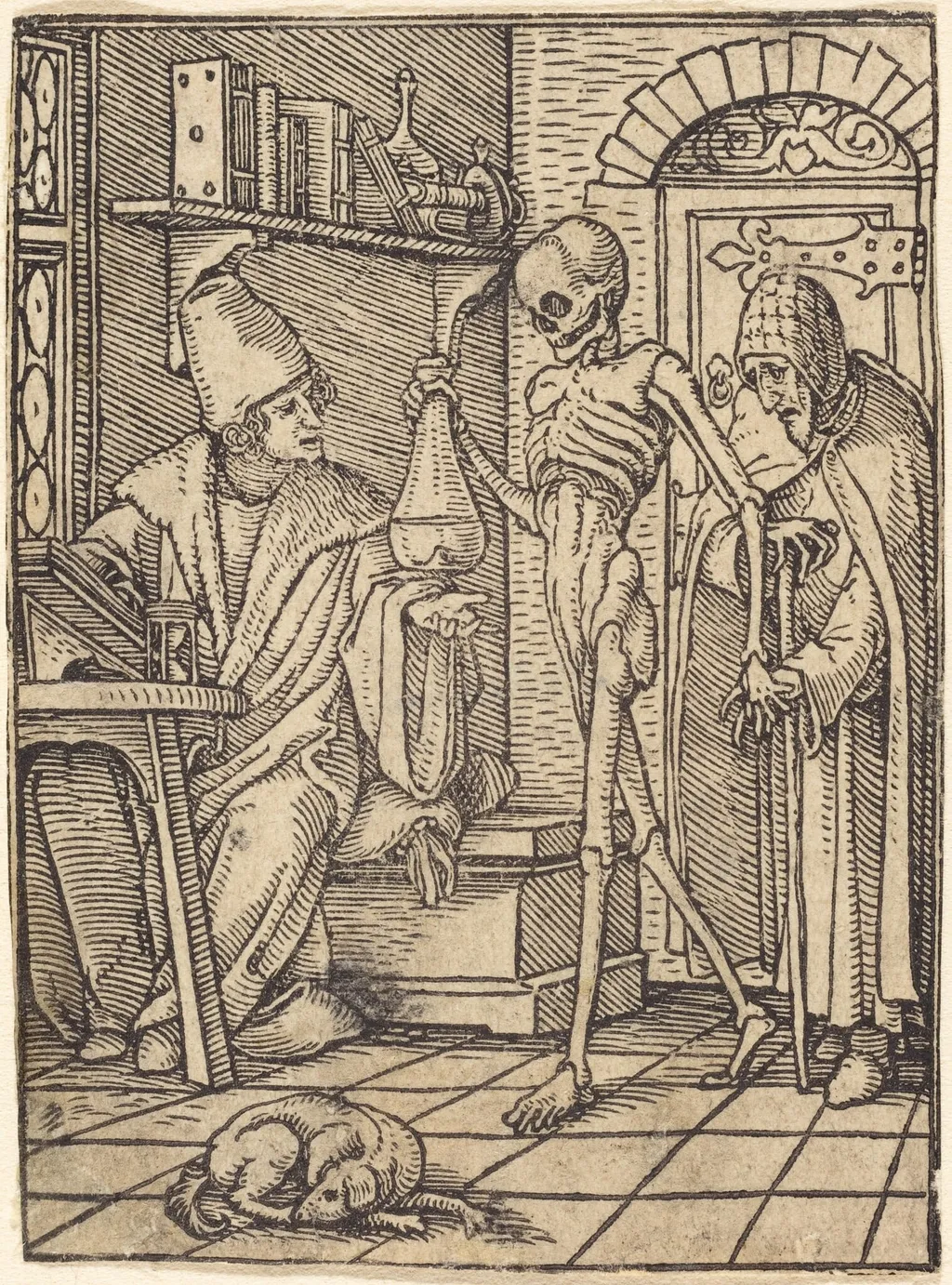
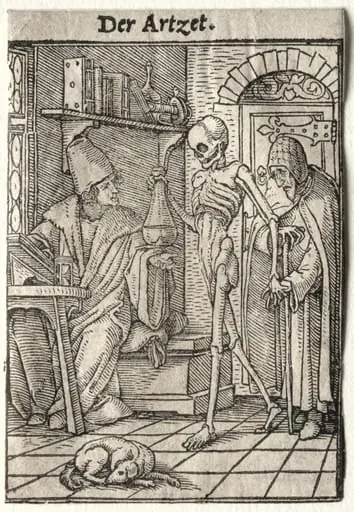
The Physician is an ink print by the Renaissance artist Hans Lützelburger. It dates from 1526 and is held in the collection of the National Gallery of Art.
About this work
Overview
The print reflects the technical refinement of German woodcut production in the early 16th century, combining detailed line work with compositional clarity.
Created around 1526, *The Physician* is a woodcut by Hans Lützelburger, a skilled blockcutter based in Augsburg. Known for his precision, Lützelburger contributed to major print projects of the era, including Holbein’s *Dance of Death*. He died in June 1526, leaving this work among his final outputs. The print reflects the technical refinement of German woodcut production in the early 16th century, combining detailed line work with compositional clarity.
Subject & Meaning
The scene portrays a medical consultation centered on urine analysis, a standard diagnostic method of the time. Four figures occupy a dim interior: a physician inspects a flask, a kneeling figure holds a motionless body, another gestures toward a crib with a newborn, and a fourth observes with a staff. The presence of the infant introduces ambiguity—possibly symbolizing life’s fragility, the physician’s role in birth, or a moral contrast between health and decay.
Technique & Style
Lützelburger employed fine, controlled lines to model form and shadow, enhancing the three-dimensionality typical of advanced woodcuts. The composition uses strong contrasts between light and dark areas, achieved through careful carving of the woodblock. Heavy drapery and tight spatial arrangement focus attention on the figures’ interactions. His signature, often placed on the reverse of blocks, confirms his direct involvement in the carving process.
History & Provenance
Lützelburger was active in Augsburg from approximately 1516 until his death in 1526. He was commissioned to cut 41 blocks for Holbein’s *Dance of Death*, a project he did not finish. *The Physician* likely originated as an independent print or part of a medical-themed series. Its survival suggests it circulated among educated audiences interested in medical practice, though its exact early ownership remains undocumented.
Context
In early 16th-century Europe, medical practice blended empirical observation with longstanding traditions. Urine analysis was widely accepted, and physicians often appeared in prints as figures of authority. The inclusion of a newborn may reflect contemporary anxieties about mortality and the limits of healing. Woodcuts like this served both educational and moral purposes, disseminating medical knowledge through accessible imagery.
Legacy
Lützelburger’s technical mastery influenced the standard for fine woodcut production in Germany. Though his career was brief, his work helped elevate the woodcut from a reproductive medium to one capable of nuanced expression. *The Physician* remains a testament to the collaboration between artists and craftsmen in the printmaking trade, preserving a snapshot of Renaissance medical culture through precise, deliberate carving.
Artist & collection

Artist
Hans Lützelburger (died June 1526), also known as Hans Franck, was a German blockcutter ("formschneider") for woodcuts, regarded as one of the finest of his day.