Artwork
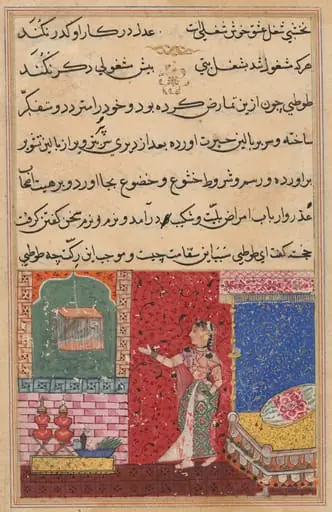
The Parrot Addresses Khujasta at the Beginning of the Twenty-second Night, from a Tuti-nama (Tales of a Parrot)
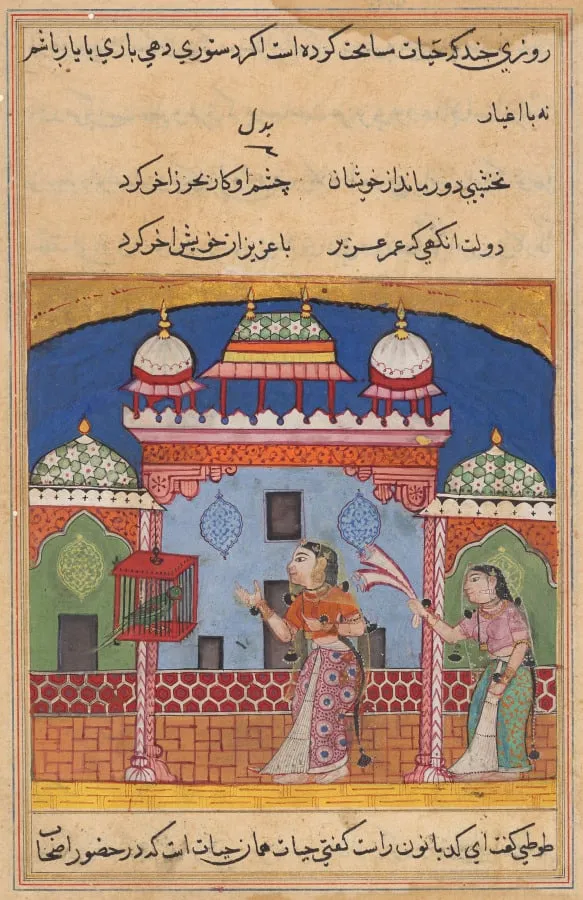
The Parrot Addresses Khujasta at the Beginning of the Twenty-second Night, from a Tuti-nama (Tales of a Parrot) is an unspecified painting by the Mughal Painting artist Unknown. It dates from 1560 and is held in the collection of the Cleveland Museum of Art.
About this work
A bright green parrot perches on a stand, talking to a woman in a red dress under a starry sky.
A bright green parrot perches on a stand, talking to a woman in a red dress under a starry sky. Around them, servants and animals fill a courtyard with patterned tiles and flowering trees.
This painting comes from a book of parrot tales told to delay a wife’s secret meeting. The flat colors and busy details are typical of Indian art before European styles arrived. The parrot isn’t just a bird—it’s the storyteller.
To see more work like this, look up Mughal India, court of Akbar (reigned 1556–1605).
Overview
This painting depicts a scene from the Tuti-nama (Tales of a Parrot), where a parrot advises Khujasta on her impending meeting with her lover, warning her against the folly of reckless behavior through a cautionary tale.
Subject & Meaning
The parrot serves as a wise narrator, cautioning Khujasta against unguarded behavior by recounting the misadventures of the amir's wife. The scene conveys the importance of discretion and prudent conduct in personal affairs.
Technique & Style
The work retains the traditional Indian painting characteristics of flat color planes and intricate patterns. Early experiments with depth and spatial recession under Akbar's reign are evident in the tilted birdcage and shaded doorways.
History & Provenance
Created during the early reign of Mughal Emperor Akbar (1556–1605), this painting is part of a Tuti-nama manuscript, illustrating stories meant to delay a wife's clandestine meeting.
Context
Pre-dating significant European stylistic influences on Indian art, the piece reflects the transitional period in Mughal art under Akbar, balancing traditional techniques with emerging innovations in perspective.
Legacy
This work represents an early example of Mughal period artistic evolution, influencing subsequent illustrations in Indian manuscripts. It is characteristic of the court art of Akbar's time, reflecting the blend of traditional and newly adopted artistic practices.
Artist & collection

 Domestic Scene
 Giacomo and Cardinal Marco, investing Andrea, Abbot of San Zeno, with his Benefice
 The Nymph of Fontainebleau
 Portrait of a Woman
 Madonna and Child with Saints in the Enclosed Garden
 Venus and Minerva
 Family Group of Four on Sofa
 Wall painting from Room H of the Villa of P. Fannius Synistor at Boscoreale
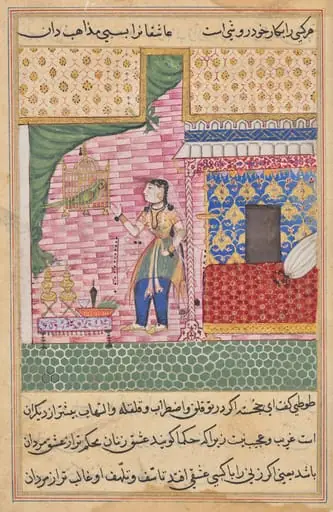 The Parrot Addresses Khujasta at the Beginning of the Seventeenth Night, from a Tuti-nama (Tales of a Parrot)
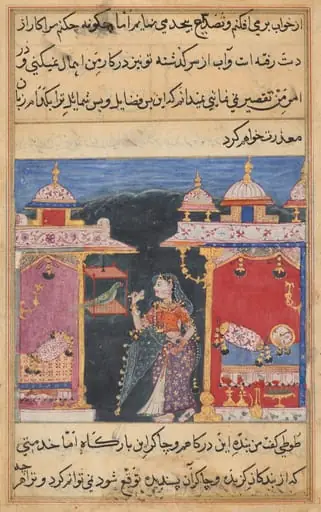 The Parrot Addresses Khujasta at the Beginning of the Seventh Night, from a Tuti-nama (Tales of a Parrot)
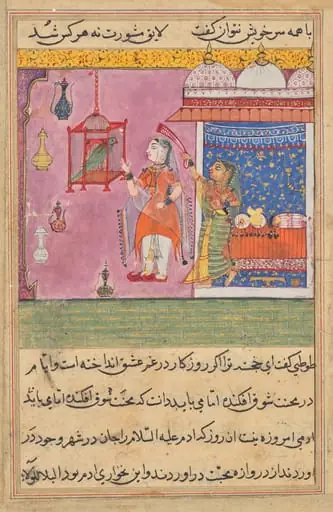 The Parrot Addresses Khujasta at the Beginning of the Nineteenth Night, from a Tuti-nama (Tales of a Parrot)
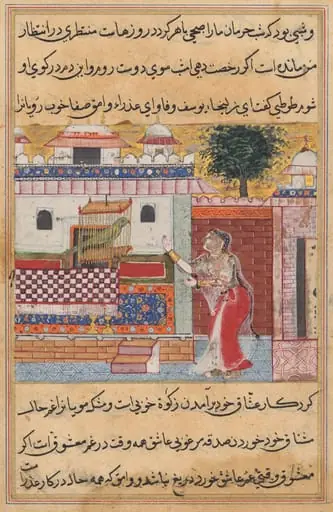 The Parrot Addresses Khujasta at the Beginning of the Twelfth Night, from a Tuti-nama (Tales of a Parrot)
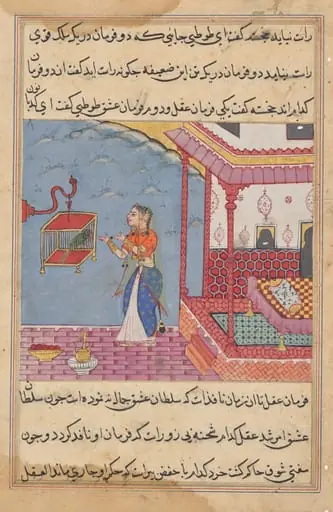 The Parrot Addresses Khujasta at the Beginning of the Twenty-Fourth Night, from a Tuti-nama (Tales of a Parrot)
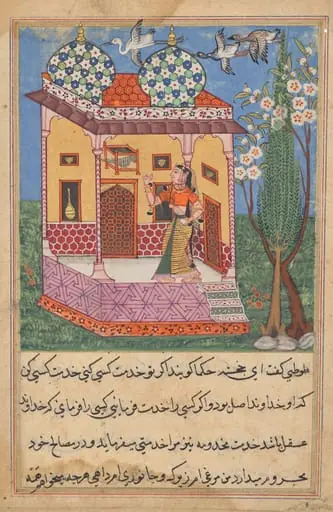 The Parrot Addresses Khujasta at the Beginning of the Twenty-sixth Night, from a Tuti-nama (Tales of a Parrot)
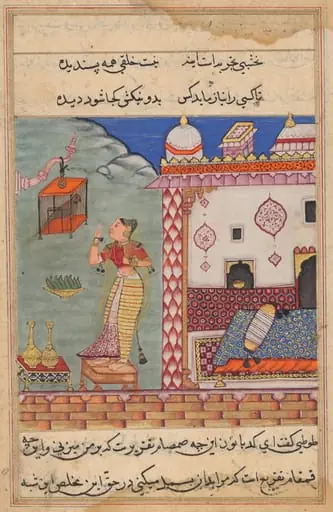 The Parrot Addresses Khujasta at the Beginning of the Twenty-seventh Night, form a Tuti-nama (Tales of a Parrot)
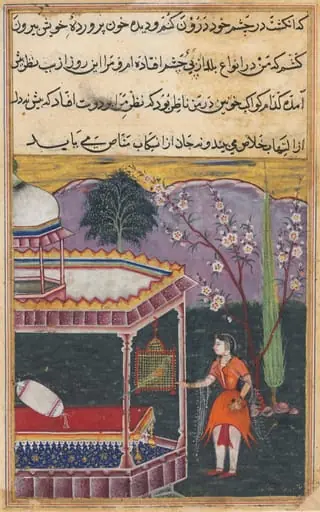 The Parrot Addresses Khujasta at the Beginning of the Eighth Night, from a Tuti-nama (Tales of a Parrot)
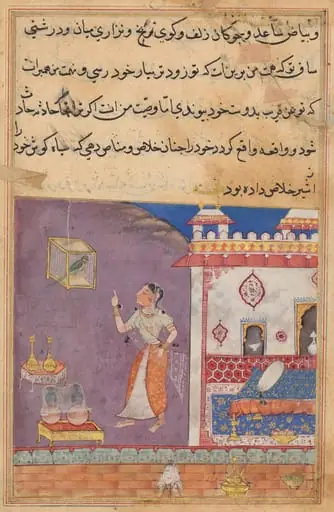 The Parrot Addresses Khujasta at the Beginning of the Twenty-ninth Night, from a Tuti-nama (Tales of a Parrot)
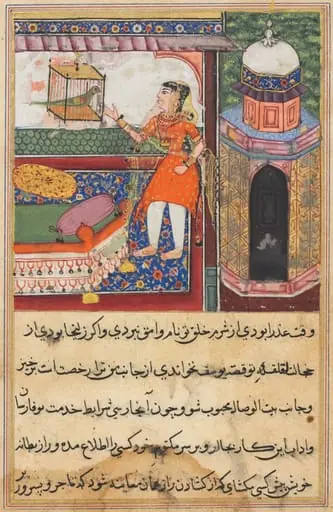 The Parrot Addresses Khujasta at the Beginning of the Tenth Night, from a Tuti-nama (Tales of a Parrot)
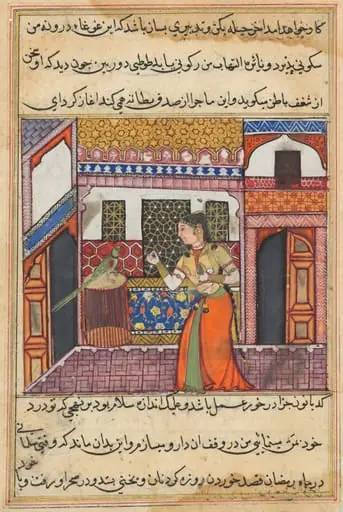 The parrot addresses Khujasta at the beginning of the forty-third night, from a Tuti-nama (Tales of a Parrot)
 The Parrot Addresses Khujasta at the Beginning of the Fifteenth Night, from a Tuti-nama (Tales of a Parrot)