Artwork
American Coot
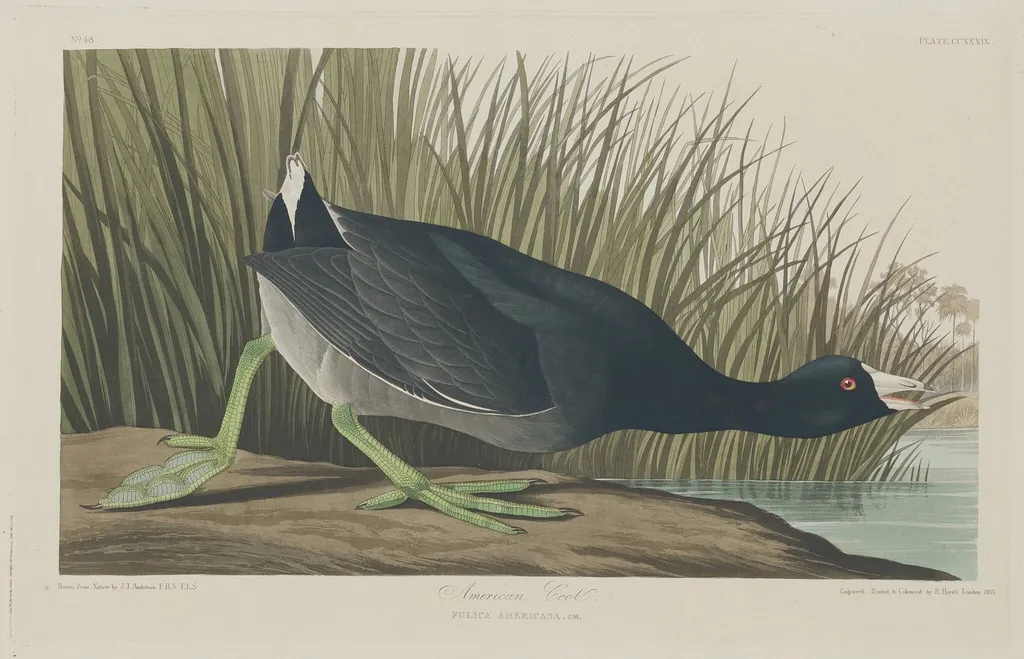
American Coot is an ink print by the Romanticist artist Robert Havell Jr.. It dates from 1835 and is held in the collection of the National Gallery of Art.
About this work
Overview
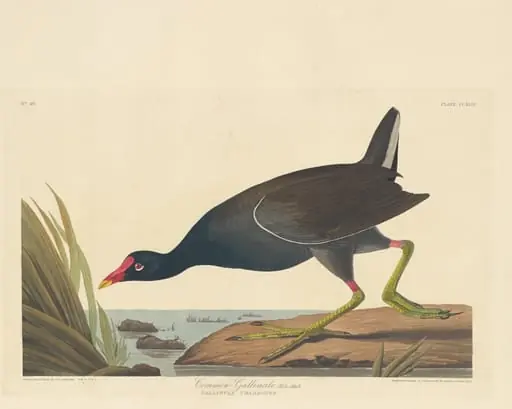
Created in 1835, *American Coot* is a hand‑colored print that combines engraving with aquatint on a sheet of Whatman wove paper. The image presents a solitary waterbird perched at the water’s edge, its dark plumage contrasted with a white head, long green legs, and a vivid red eye, set against reeds and a faint sky.
Subject & Meaning
The work portrays an American coot, a common marsh bird, captured in a moment of apparent call as its beak is open. By isolating the bird on a tranquil pond, the image emphasizes the species’ distinctive coloration and posture, serving both as a naturalistic study and a visual record of North American wildlife.
Technique & Style
Robert Havell Jr. employed fine line engraving to delineate feather texture, while the aquatint process provided tonal washes that model the bird’s form and the surrounding water. Hand‑applied watercolor adds selective color—green legs, red eye, and subtle hues to the background—reflecting the meticulous, scientific illustration style popular among early‑19th‑century naturalists.
History & Provenance
The print belongs to the Havell family’s extensive output in aquatint engraving; the lineage includes Robert Havell the Elder and his brothers, who were active in both British and Indian artistic circles. *American Coot* exemplifies the younger Havell’s continuation of the family’s reputation for precise, decorative natural history prints.
Context
Produced during a period when European audiences were eager for visual information about exotic and New World species, the print aligns with the surge of ornithological publications of the 1830s. Its detailed representation would have complemented contemporary scientific texts and appealed to collectors interested in both art and natural history.
Artist & collection

Artist
The Havell family of Reading, Berkshire, England, included a number of notable engravers, etchers and painters, as well as writers, publishers, educators, and musicians.