Artwork
Snow Goose
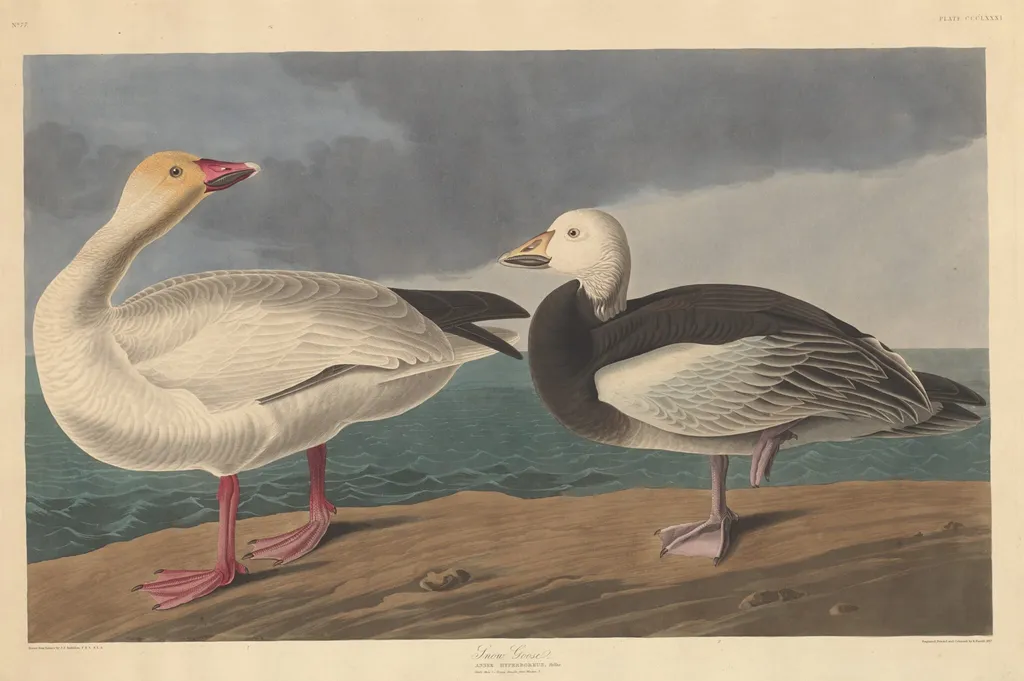
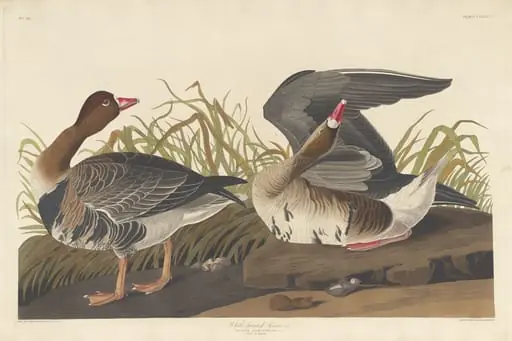
Snow Goose is an ink print by the Romanticist artist Robert Havell Jr.. It dates from 1837 and is held in the collection of the National Gallery of Art.
About this work
Overview
The work exemplifies the Havell family’s technical mastery in printmaking, particularly their refined use of aquatint to achieve subtle tonal gradations.
Created in 1837 by Robert Havell Jr., this hand-colored engraving and aquatint on Whatman wove paper is part of a series documenting North American birds. The work exemplifies the Havell family’s technical mastery in printmaking, particularly their refined use of aquatint to achieve subtle tonal gradations. It was produced during a period when scientific illustration and natural history were closely intertwined in artistic practice.
Subject & Meaning
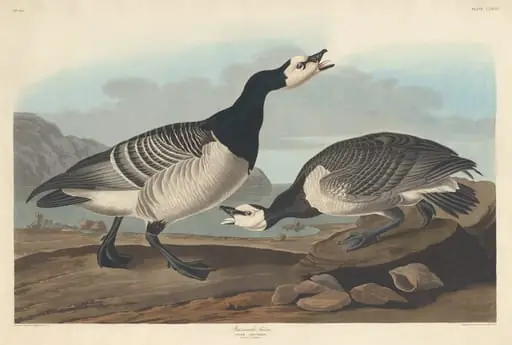
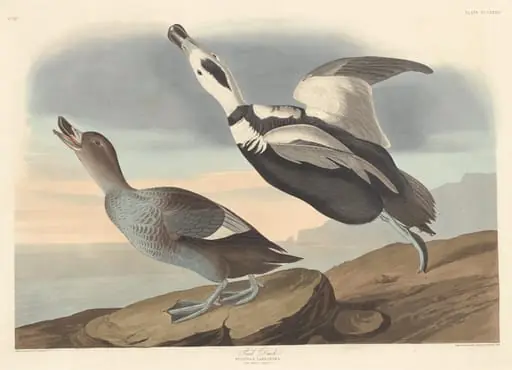
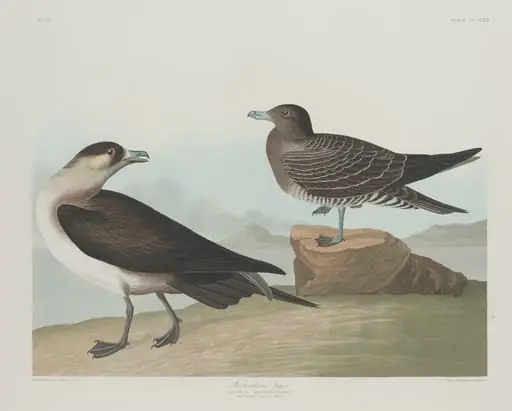
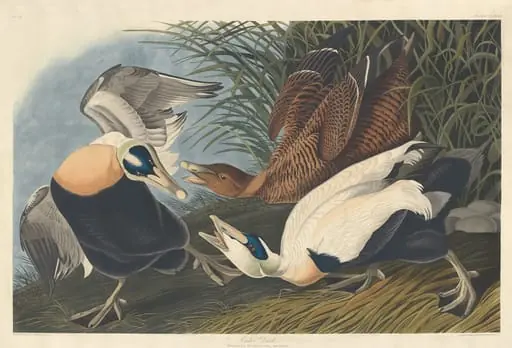
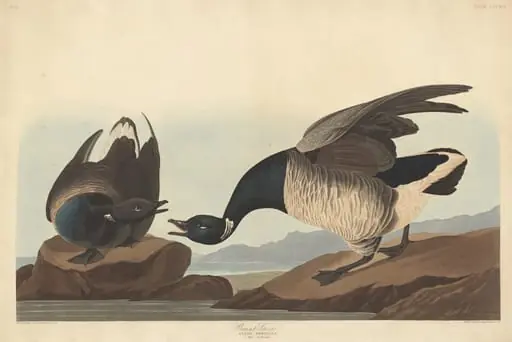
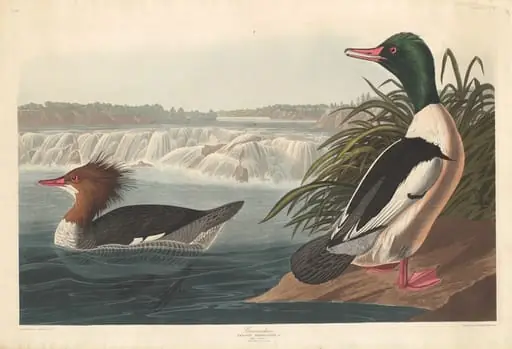
The print portrays two snow geese on a rocky shoreline, rendered with close attention to anatomical accuracy. One bird is predominantly white with pinkish bill and legs; the other displays dark brown wings and a pale head. Their placement suggests quiet observation rather than movement, aligning with the era’s emphasis on documenting species in their natural state. The scene conveys neither drama nor symbolism, but a deliberate record of avian form and habitat.
Technique & Style
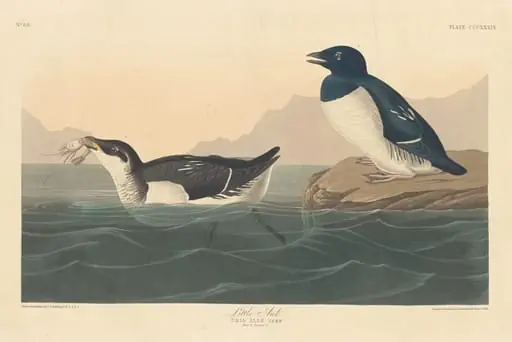
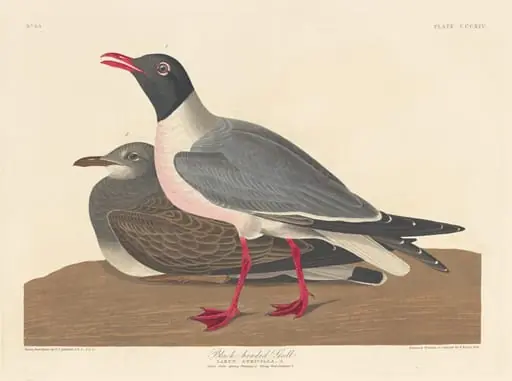
Havell employed engraving for fine linear detail and aquatint for soft atmospheric effects, particularly in the sky and water. The hand-coloring was applied with precision to match the birds’ natural plumage, enhancing realism without overt embellishment. The textured rocks and rippling water were achieved through controlled etching and ink density, reflecting the Havell family’s long-standing commitment to technical excellence in ornithological prints.
History & Provenance
Robert Havell Jr. worked within a multi-generational family workshop based in London, where his father and uncle had established a reputation for high-quality natural history prints. This piece likely originated as part of a larger publication project, possibly linked to John James Audubon’s ornithological surveys. The use of Whatman paper, prized for its durability and absorbency, underscores the print’s intended longevity and scholarly purpose.
Context
In the 1830s, European and American audiences showed growing interest in natural history, driven by colonial exploration and scientific classification. Artists like Havell operated at the intersection of art and science, producing images used by museums, universities, and private collectors. While the Havells were known for their work on American birds, their techniques were influenced by broader European print traditions, not Indian art as sometimes misattributed.
Legacy
Havell’s prints remain valued for their fidelity to natural forms and technical refinement. Though overshadowed in popular memory by Audubon’s larger-scale works, Havell’s contributions helped standardize the visual language of ornithological illustration. His prints are preserved in institutional collections as benchmarks of 19th-century printmaking, admired for their quiet precision rather than spectacle.
Artist & collection

Artist
The Havell family of Reading, Berkshire, England, included a number of notable engravers, etchers and painters, as well as writers, publishers, educators, and musicians.