Artwork
The Men of Ephraim Care for their Captives and Return Them to Jerico
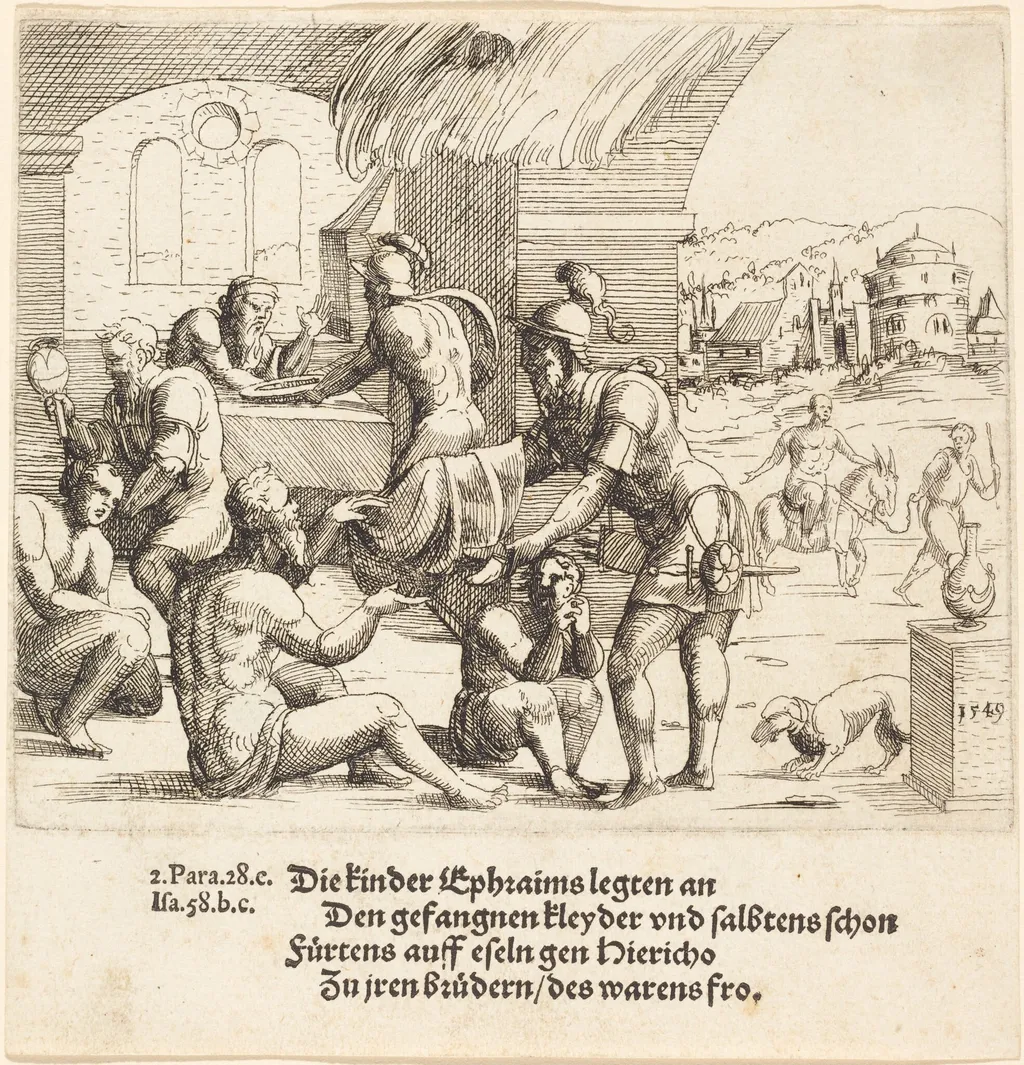
The Men of Ephraim Care for their Captives and Return Them to Jerico is an ink print by the Renaissance artist Augustin Hirschvogel. It dates from 1549 and is held in the collection of the National Gallery of Art.
About this work
Overview
The work exemplifies his shift from mathematical illustration to narrative printmaking.
Created in 1549 by the German artist Augustin Hirschvogel, this etching illustrates a biblical episode from the Book of Judges, in which the tribe of Ephraim rescues captives and returns them to Jericho. Hirschvogel, known for his precise linear style and topographical sensitivity, produced this as part of a small series of landscape-focused prints made during the latter half of the 1540s. The work exemplifies his shift from mathematical illustration to narrative printmaking.
Subject & Meaning
The scene portrays a moment of humanitarian action: men from Ephraim tend to released captives, guiding them toward Jericho. One figure holds a sword, suggesting protection rather than aggression, while another supports a weakened individual. The narrative emphasizes communal duty and mercy, aligning with biblical themes of restitution and moral responsibility. The setting is rendered with enough specificity to anchor the story in a recognizable ancient Near Eastern context.
Technique & Style
Hirschvogel employed fine-line etching to build texture and spatial depth, using delicate cross-hatching to define figures and terrain. The composition directs attention to the central group through controlled contrasts of light and shadow, while the background landscape—distant hills and a single structure—is rendered with cartographic clarity. His technique reflects both his training in geometry and his engagement with contemporary Northern European printmaking traditions.
History & Provenance
The print was made during Hirschvogel’s most productive period in Nuremberg, where he worked between artistic and scientific pursuits. Though few records of early ownership survive, the work was likely circulated among humanist collectors interested in biblical subjects and technical printmaking. It appears in later 16th-century catalogues of German prints, affirming its recognition within artistic circles of the time.
Context
Hirschvogel’s etching emerged alongside a broader interest in biblical narratives among Northern European artists, who increasingly turned to Old Testament stories for moral and civic themes. His work shares affinities with the Danube School’s interest in naturalistic landscape, though his style remains more linear and less atmospheric than his Bavarian contemporaries. The print reflects the intellectual climate of Reformation-era Germany, where scripture informed both religious and civic identity.
Legacy
Though Hirschvogel is less widely known today than some of his peers, his etchings contributed to the development of narrative printmaking in Central Europe. His fusion of cartographic precision with human drama influenced later generations of German draftsmen. This particular print remains a rare example of his engagement with biblical storytelling, preserving a moment of quiet compassion within a period often dominated by religious conflict.
Artist & collection
Artist
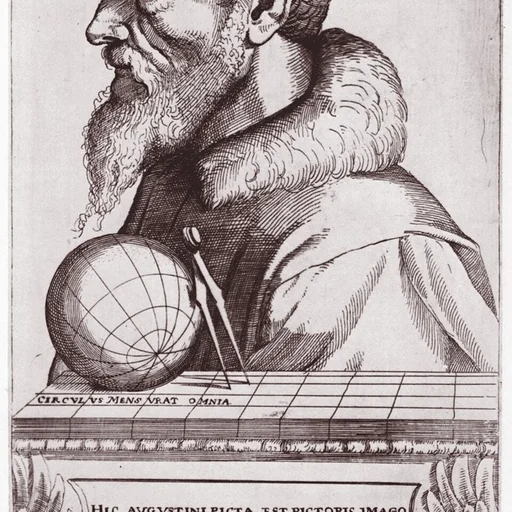
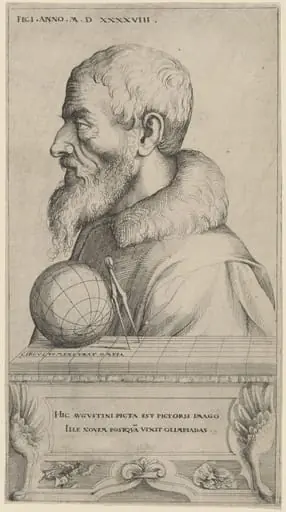
Augustin Hirschvogel (1503 – February 1553) was a German artist, mathematician, and cartographer known primarily for his etchings.

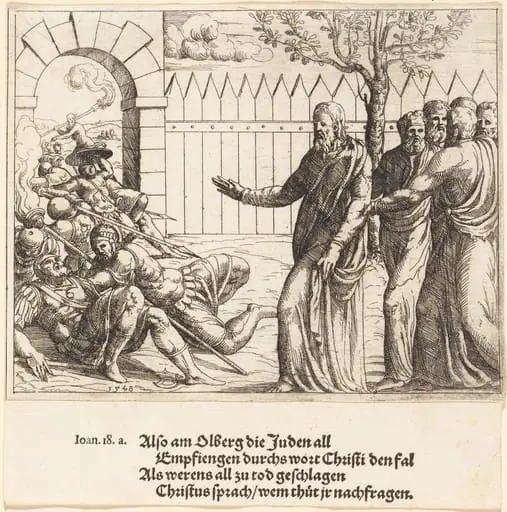 Jesus Identifies Himself before the Arrest
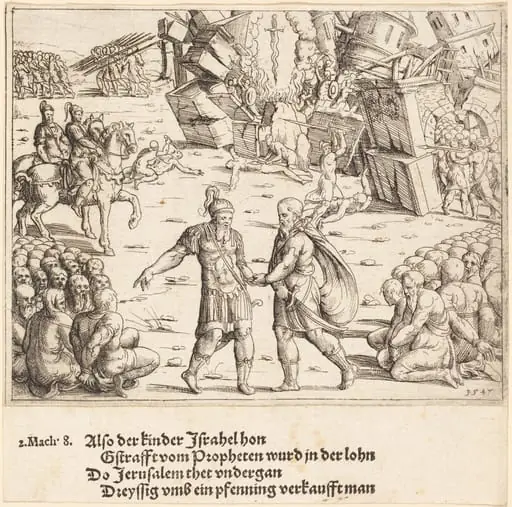 The Victory of Judas Maccabeus Over Niccanor
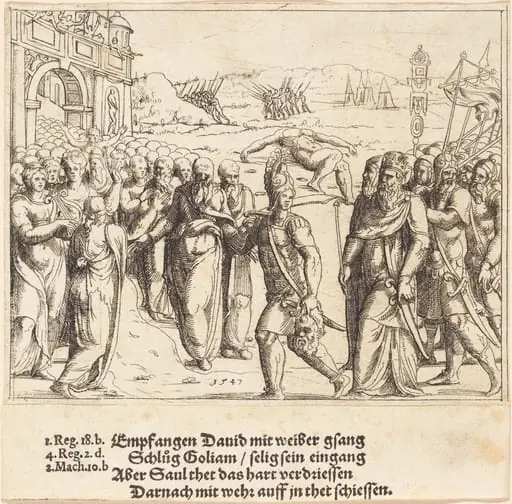 David is Welcomed after Killing Goliath, and Saul's Jealousy
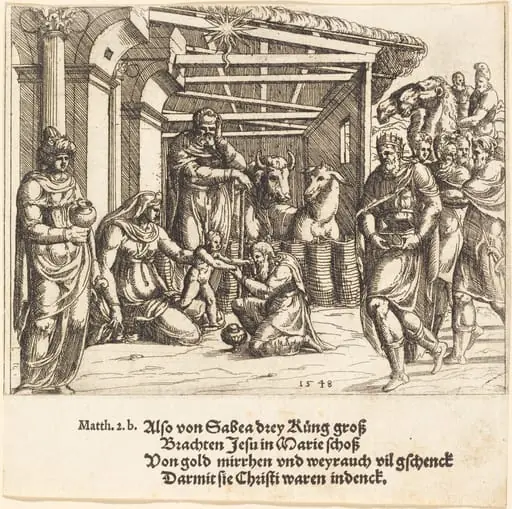 The Adoration of the Magi
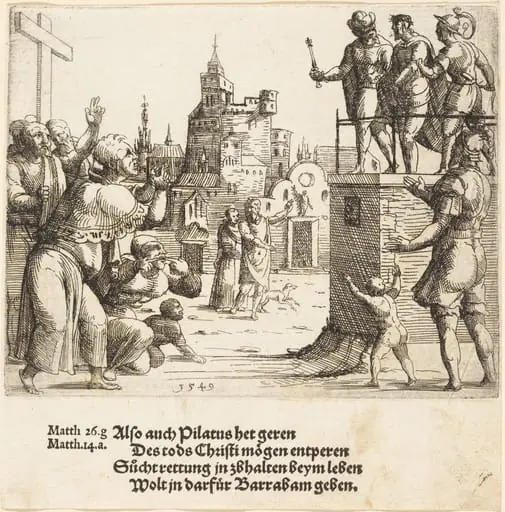 Ecce Homo
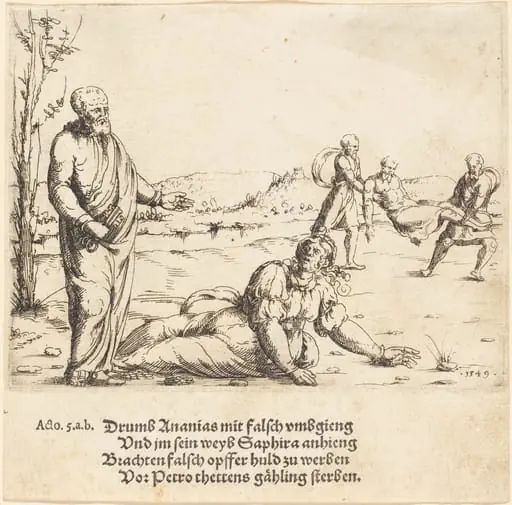 The Punishment of Ananias and Sapphira
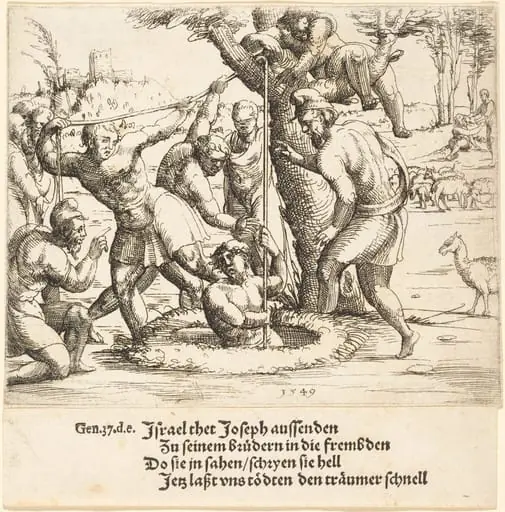 Joseph Thrown into the Well
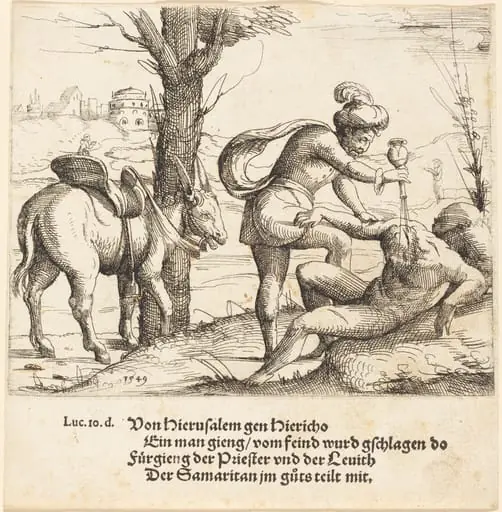 The Parable of the Good Samaritan
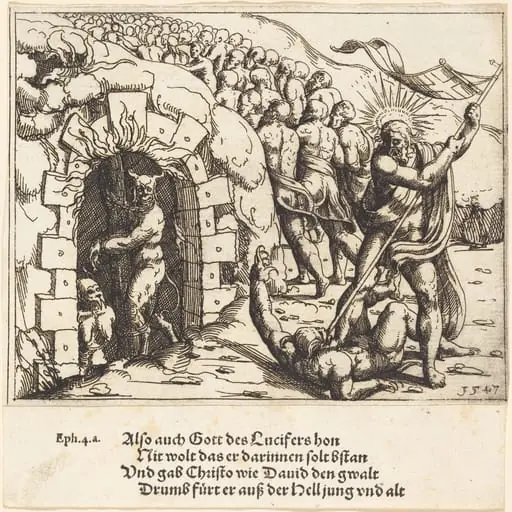 The Harrowing of Hell
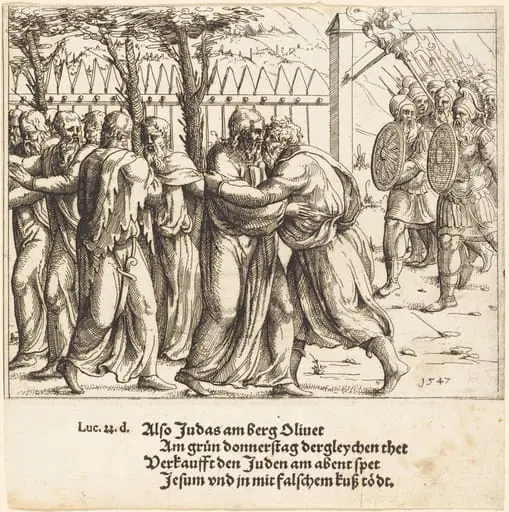 The Kiss of Judas