Artwork
Paris with the Apple
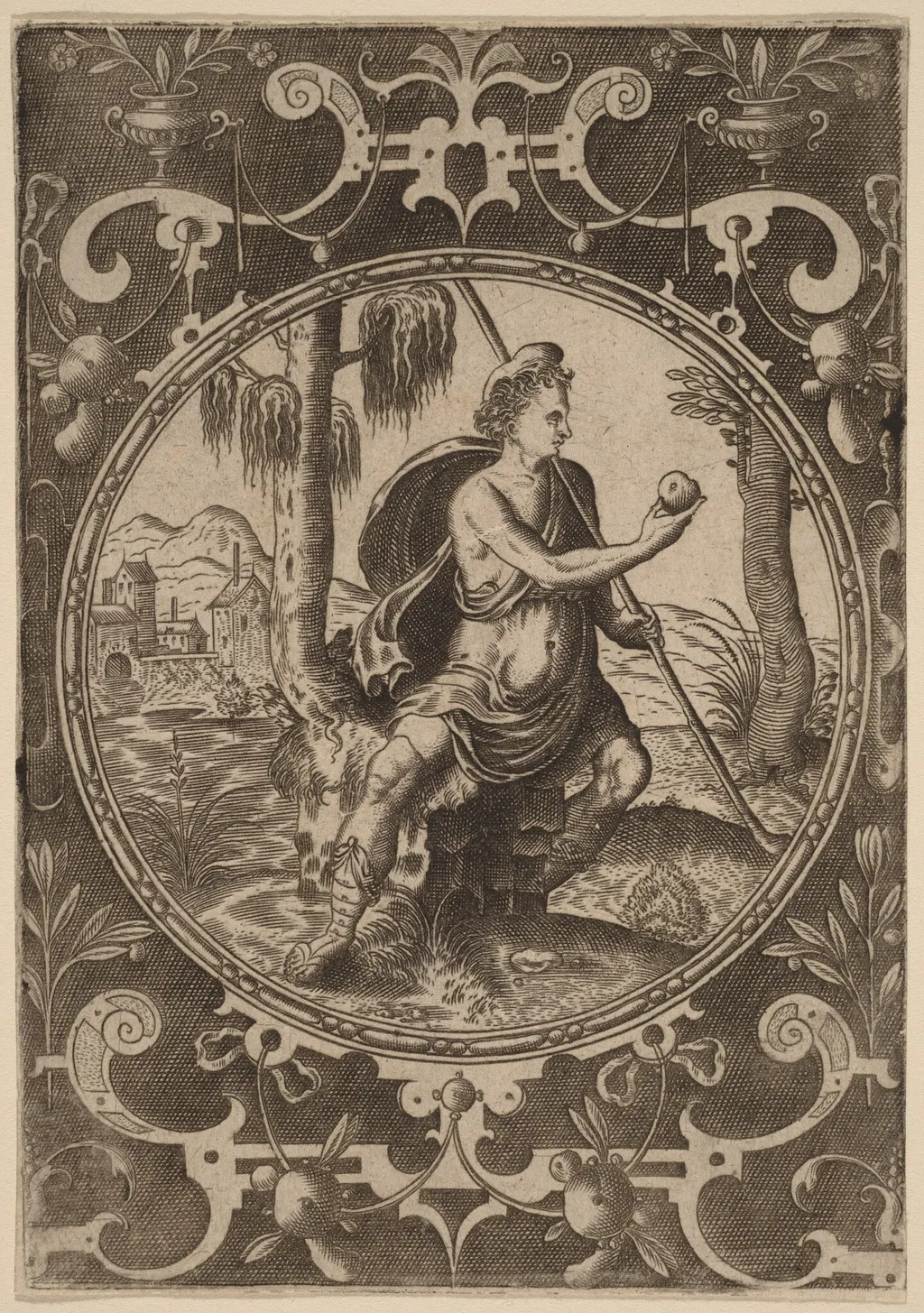
Paris with the Apple is an ink print by the Renaissance artist Netherlandish 16th Century. It dates from 1564 and is held in the collection of the National Gallery of Art. The work is an engraving executed on laid paper, presenting a solitary, bare‑chested male figure seated on a rock.
About this work
Overview
The work is an engraving executed on laid paper, presenting a solitary, bare‑chested male figure seated on a rock. He holds an apple in one hand and a scroll in the other, while a modest town rises on a hill behind him. Above the scene, two winged beings hover, and the composition is bounded by intricate swirling motifs and foliage that form a decorative frame.
Subject & Meaning
The central figure’s calm demeanor, the presence of an apple and a scroll, and the accompanying winged entities suggest allegorical intent rather than a literal portrait. The apple often signifies knowledge or temptation, while the scroll may denote learning or authority, indicating the figure could represent a personification of wisdom or a classical hero within a symbolic narrative.
Technique & Style
The image is rendered with fine, closely spaced lines and subtle cross‑hatching, creating tonal variation and a sense of three‑dimensionality on the flat paper surface. The engraving technique involves incising a metal plate with a burin, allowing for precise detail in the decorative border and the delicate rendering of the figures, characteristic of early modern printmaking.
Context
Engravings of this type were commonly used to disseminate allegorical and moral subjects to a broad audience in the pre‑photographic era. The inclusion of ornamental borders and mythic elements aligns the work with the decorative print traditions that flourished in Europe during the 16th and 17th centuries, where such images often served both educational and aesthetic purposes.
Artist & collection

Artist
This artist carved scenes with fine lines, mostly religious and mythological ones.