Artwork
Scaup Duck
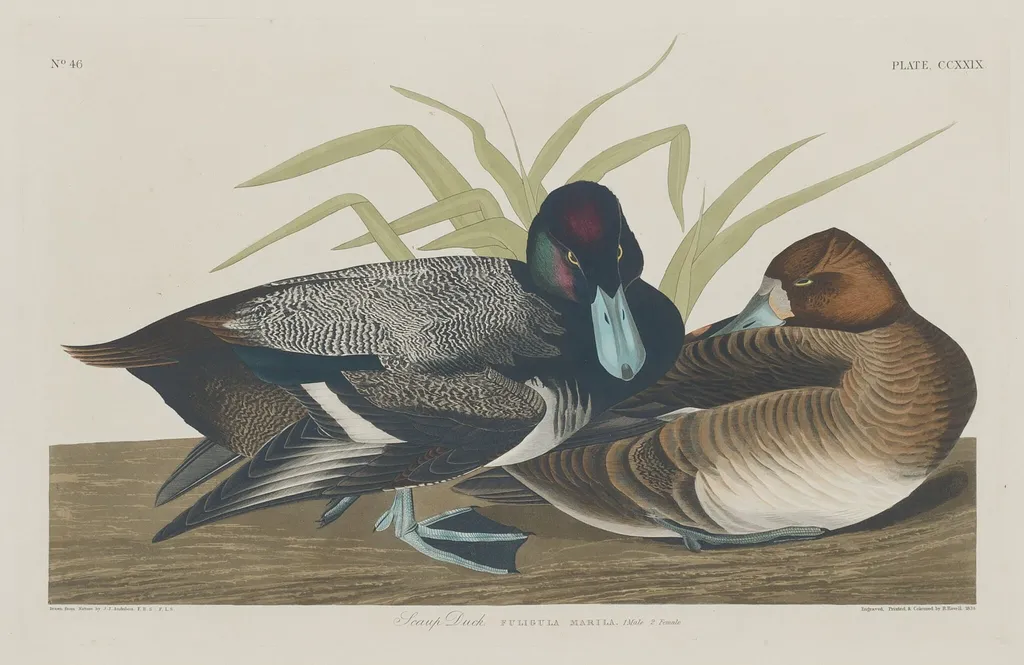
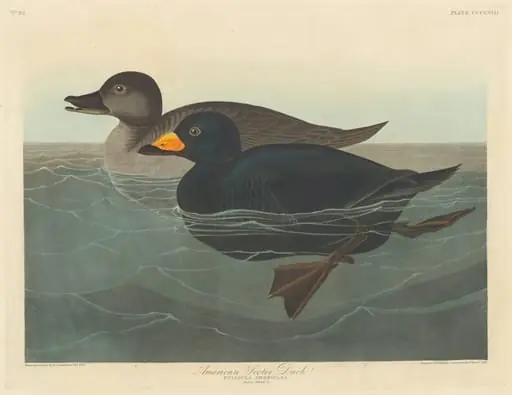
Scaup Duck is an ink print by the Romanticist artist Robert Havell Jr.. It dates from 1834 and is held in the collection of the National Gallery of Art. Created in 1834, this hand‑colored print combines engraving and aquatint on a sheet of Whatman wove paper.
About this work
He used a mix of engraving and aquatint, a way to print tones like ink wash.
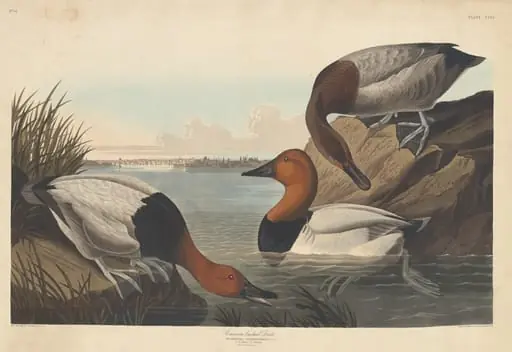
This print shows a male and female scaup duck floating on calm water. Their dark heads and bright blue beaks stand out against soft green reeds. The female’s brown feathers blend into the shadowed foreground.
Robert Havell Jr. made this in 1834 for a book about American birds. He used a mix of engraving and aquatint, a way to print tones like ink wash. The cross-hatching adds texture to every feather.
Look for Havell, Jr., Robert next to spot more of his bird prints.
Overview
Created in 1834, this hand‑colored print combines engraving and aquatint on a sheet of Whatman wove paper. It portrays a male and female scaup duck gliding on tranquil water, their dark heads and vivid blue bills contrasting with the surrounding green reeds and the muted tones of the background.
Subject & Meaning
The image captures two scaup ducks—one male, one female—in a natural pose, emphasizing the subtle differences in plumage: the female’s brown feathers merge with the shadowed foreground, while the male’s darker head and brighter beak draw the eye. The composition highlights the quiet intimacy of the birds’ environment.
Technique & Style
Havell employed a mixed process of line engraving for fine detail and aquatint to achieve tonal washes reminiscent of ink drawings. The aquatint areas provide soft gradations of colour, while cross‑hatching in the engraving adds texture to the feathers and reeds, allowing a nuanced representation of light and shadow.
History & Provenance
The print was produced by Robert Havell Jr. for an early 19th‑century publication on American birds. Havell came from a lineage of engravers; his father, Robert Havell the Elder, and uncle, Luke Havell, were established practitioners, and the family was noted for their work in aquatint, especially in relation to Indian art.
Context
During the 1830s, British natural‑history publishing relied on detailed prints to illustrate scientific texts. Havell’s contribution reflects the period’s demand for accurate, aesthetically refined depictions of wildlife, and his use of hand‑coloring aligns with contemporary practices for enhancing the visual appeal of such volumes.
Artist & collection

Artist
The Havell family of Reading, Berkshire, England, included a number of notable engravers, etchers and painters, as well as writers, publishers, educators, and musicians.