Artwork
The Somnath gates, Fort Agra
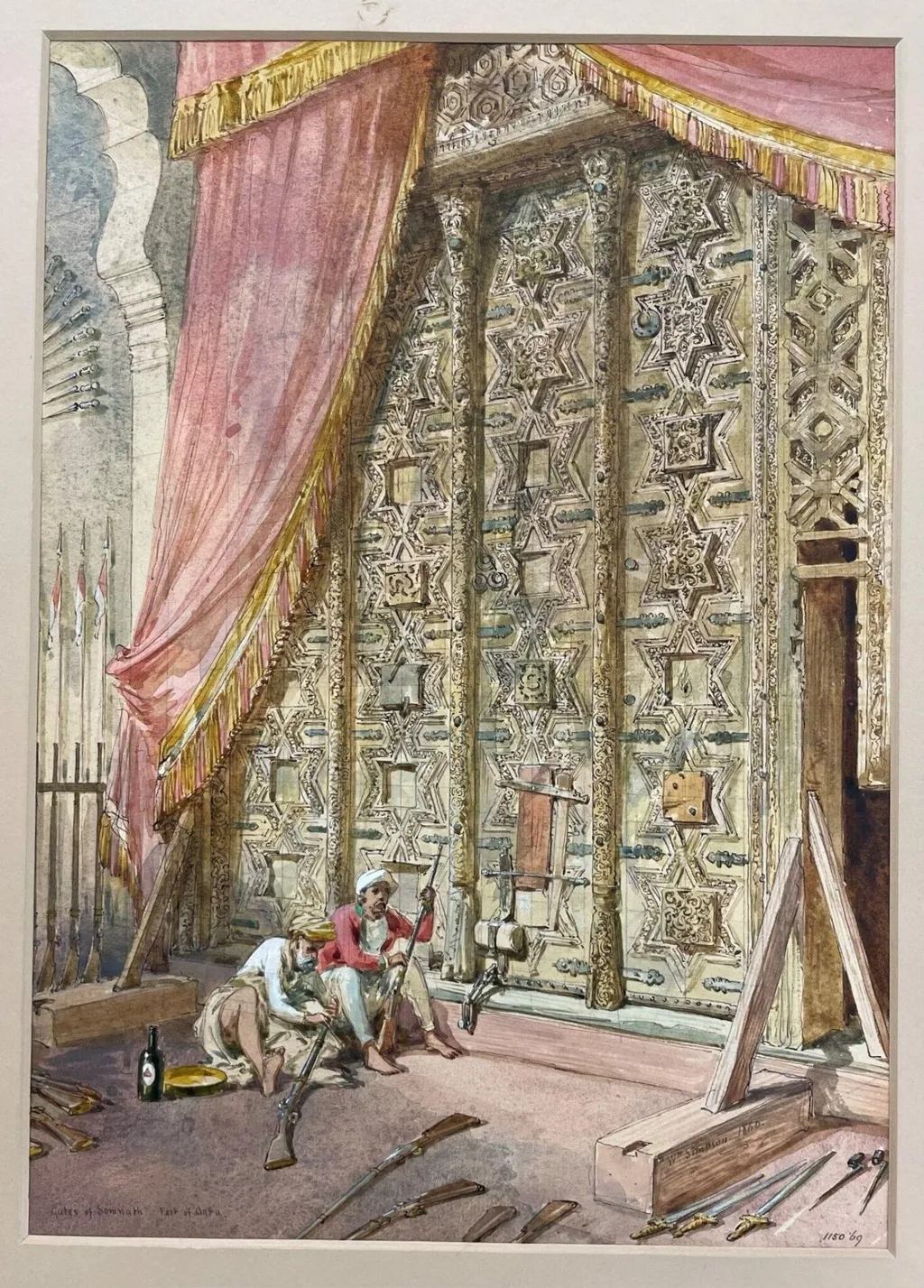
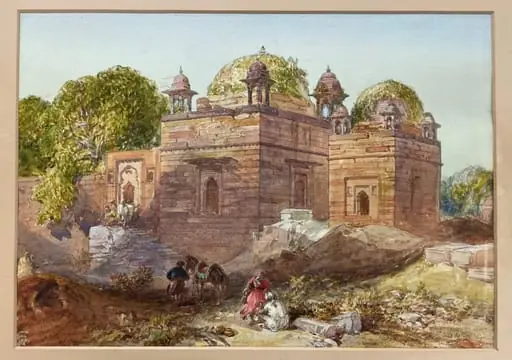
The Somnath gates, Fort Agra is a paint painting by the Impressionist artist William Simpson. It dates from 1866 and is held in the collection of the Victoria and Albert Museum.
About this work
The painting is titled The Somnath gates, Fort Agra.
It was created by William Simpson in 1866.
The painting is held at the Victoria and Albert Museum, which provides context to its creation and significance, as Simpson was commissioned to sketch sites in India after the Revolt of 1857.
You can learn more about this style by looking at Impressionism.
Overview
Though titled as a gate from Somnath, the painting depicts a structure actually sourced from Ghazni, reflecting contemporary misunderstandings about its origin.
William Simpson, a British artist known for his wartime documentation, painted The Somnath Gates, Fort Agra in 1866 after returning from India. Commissioned by the London firm Day and Sons, the work was part of a series capturing sites linked to the 1857 Revolt. Though titled as a gate from Somnath, the painting depicts a structure actually sourced from Ghazni, reflecting contemporary misunderstandings about its origin. The piece was completed in London using sketches made during Simpson’s 1859–1862 travels across India.
Subject & Meaning
The painting portrays a monumental wooden gate, mistakenly believed to have been looted from the Somnath Temple in Gujarat by Mahmud of Ghazni in 1025 and later recovered by the British in 1842. Its inclusion in the artwork served a symbolic purpose: to reinforce the narrative of British restoration of Indian heritage. The gate’s actual origin—Ghazni’s tomb of Mahmud Ghaznavi—was obscured by colonial rhetoric, turning it into a prop for imperial legitimacy rather than a historically accurate artifact.
Technique & Style
Simpson rendered the gate in watercolor with meticulous attention to architectural detail and atmospheric lighting. His preparatory pencil sketches, made on-site in India, informed the final composition, which balances topographical accuracy with romanticized tone. The palette is rich but restrained, emphasizing texture in the carved deodar wood and the play of shadow across the gate’s surface. The style reflects 19th-century British topographical traditions, not Impressionism, prioritizing clarity and documentary precision over brushwork spontaneity.
History & Provenance
The gate depicted was removed from the tomb of Mahmud Ghaznavi in Ghazni in 1842 under the orders of Lord Ellenborough, Governor-General of India. It was transported to Agra and displayed as the legendary Somnath gates, despite inscriptions identifying its true origin and material differences from Gujarati woodwork. Simpson’s 1866 painting perpetuated this misattribution. The artwork entered the Victoria and Albert Museum’s collection, where it now serves as evidence of colonial reinterpretation of cultural artifacts.
Context
Simpson’s work emerged in the aftermath of the 1857 Revolt, a period when British authorities sought to reassert control through cultural narratives. Commissioned to document sites tied to the uprising, his images helped construct a visual history that framed British presence as restorative. The Somnath gate, though misidentified, became emblematic of this effort—transforming a political gesture into a myth of redemption, aligning imperial action with the recovery of sacred Indian heritage.
Legacy
The painting endures as a document of colonial perception rather than historical fact. While technically accomplished, its significance lies in how it reveals the era’s conflation of archaeology and propaganda. Today, it is studied not for its artistic innovation but for the ways it reflects British attempts to rewrite South Asian history through visual culture. The V&A’s preservation of the work ensures its role as a critical artifact of imperial memory.
Artist & collection