Artwork
Buddhist vihara cave, Ajanta
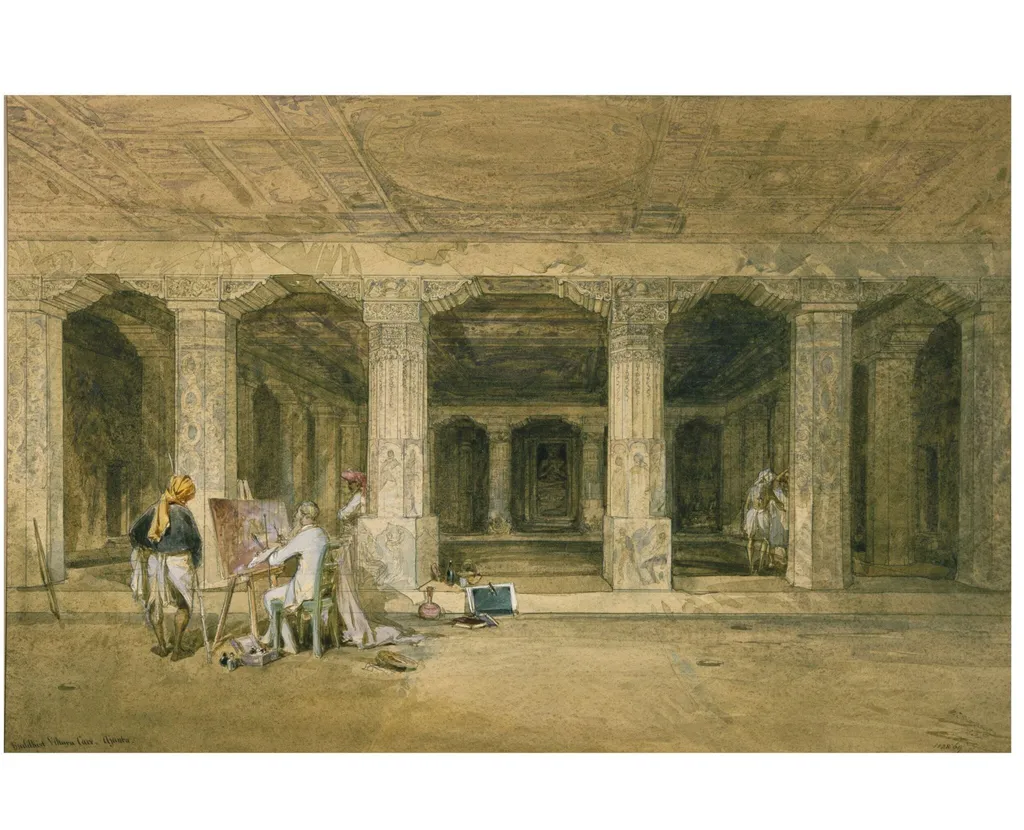
Buddhist vihara cave, Ajanta is a paint painting by the Impressionist artist William Simpson. It dates from 1862 and is held in the collection of the Victoria and Albert Museum.
About this work
This watercolor shows the inside of a Buddhist cave at Ajanta. It’s a quiet scene with pillars and shadowed walls.
Simpson went to India in 1859 to draw places tied to the 1857–58 uprising. He later turned these sketches into finished works back in London.
He used pencil first, then added color washes to finish the paintings.
Check out the Victoria and Albert Museum.
Overview
This watercolor, created after his return to London, captures a moment of artistic documentation within Cave 1, depicting fellow artist Robert Gill at work.
William Simpson, a Scottish artist and illustrator, traveled to India in 1859 under commission from the London publishing firm Day and Sons. His task was to document sites linked to the 1857–58 uprising, but he also recorded ancient monuments, including the Buddhist caves at Ajanta. This watercolor, created after his return to London, captures a moment of artistic documentation within Cave 1, depicting fellow artist Robert Gill at work. Simpson’s method involved rapid pencil sketches in the field, later refined with delicate color washes in his studio.
Subject & Meaning
The scene portrays Major Robert Gill, an artist and archaeologist, meticulously copying ancient Buddhist murals inside Cave 1 at Ajanta. His presence underscores the 19th-century effort to preserve and study India’s pre-Islamic artistic heritage. Simpson’s composition is quiet and contemplative, emphasizing the solitude of the act of recording. The cave’s dim interior, with its carved pillars and faded frescoes, frames Gill as both observer and custodian of a fading cultural legacy.
Technique & Style
Simpson rendered the scene using pencil underdrawing, enhanced with translucent watercolor washes to suggest shadow and texture. The muted palette reflects the cave’s natural dimness, while careful tonal gradations define the stone pillars and eroded murals. His technique balances topographical accuracy with atmospheric mood, avoiding dramatic flourish in favor of quiet observation. The work exemplifies 19th-century British topographical watercolor, where documentation and aesthetic restraint coexist.
History & Provenance
Simpson’s collection of 250 watercolors, including this piece, was intended for a grand illustrated volume on India, commissioned by Day and Sons. Financial collapse of the firm in 1867 halted publication, and the entire set was sold as bankrupt assets. Simpson later described this loss as the greatest disappointment of his career. The painting eventually entered the Victoria and Albert Museum’s collection, where it now serves as a record of both artistic endeavor and institutional failure.
Context
In the mid-19th century, British officials and artists increasingly turned to India’s ancient sites as subjects of scholarly interest, especially after the 1857 rebellion heightened cultural introspection. Robert Gill had been commissioned by the Archaeological Survey of India to copy Ajanta’s murals, a project that preceded formal preservation efforts. Simpson’s depiction of Gill at work reflects a broader imperial impulse: to visually archive what was perceived as a vanishing past, even as colonial structures reshaped the subcontinent.
Legacy
Though Simpson’s intended publication never materialized, his watercolors remain vital historical documents. This painting preserves not only the appearance of Ajanta’s interiors in the 1860s but also the human dimension of early archaeological work. Today, it stands as a testament to the quiet, often overlooked labor of artistic documentation — a bridge between colonial enterprise and the modern study of South Asian heritage.
Own this work as a print
Artist & collection

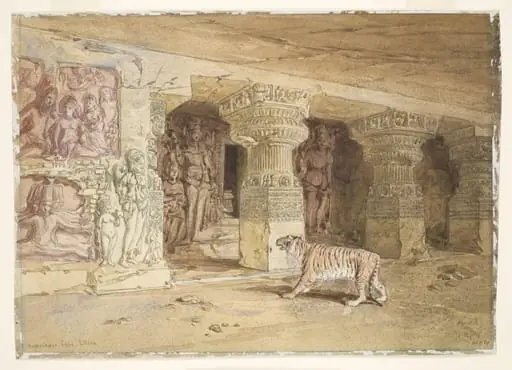 Rameshwar cave, Ellora
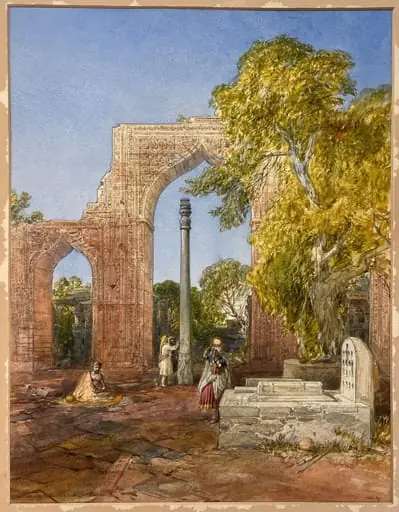 Iron Laht at the Kootub, Old Delhi
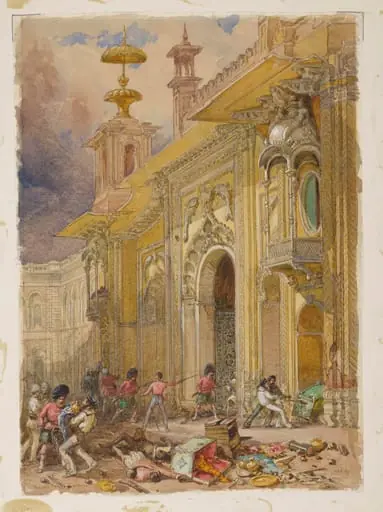 View of the Kaiser Bagh in Lucknow
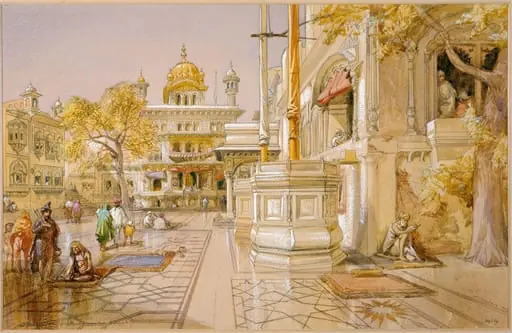 Akal Boonga at the Golden temple. Umritsar. Punjaub
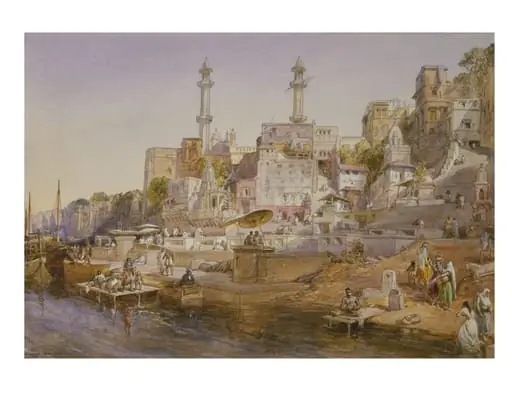 The Mosque of Aurangzeb and Panchganga Ghat from the Ganges, Benares.
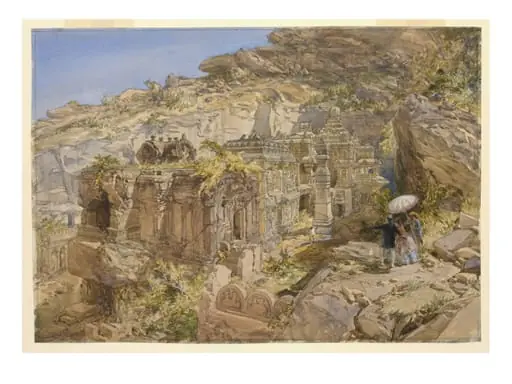 Kailasanatha temple, Ellora
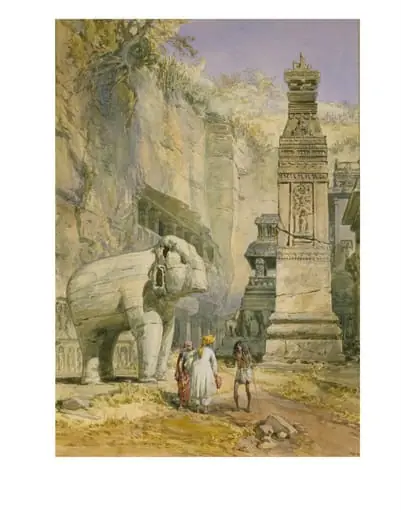 Untitled
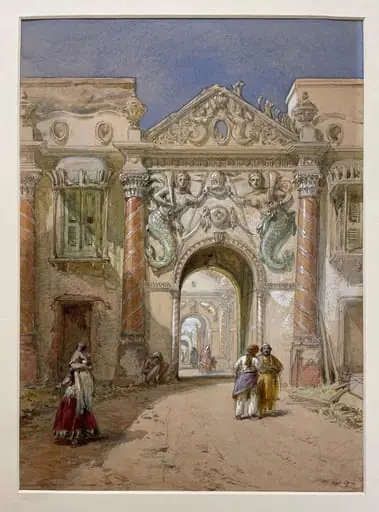 Mermaid gate, Kaiserbagh, Lucknow
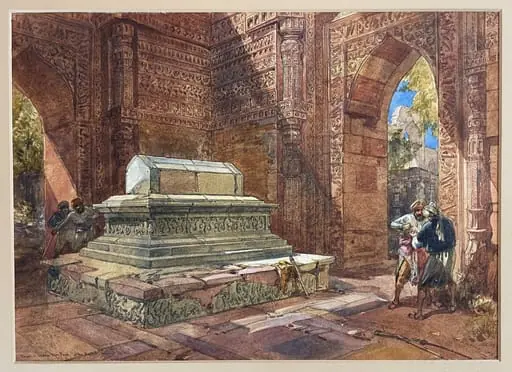 Tomb of Shams ud-Din Iltutmish at the Qutub Minar, Delhi
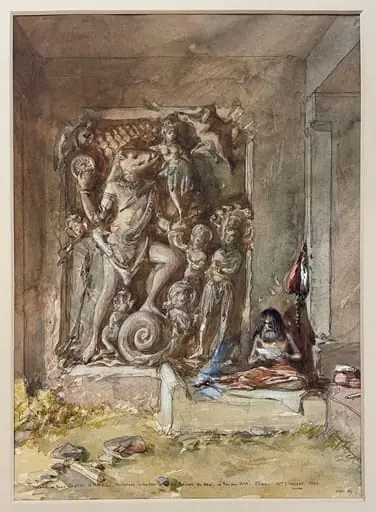 Varaha or Boar avatar of Vishnu